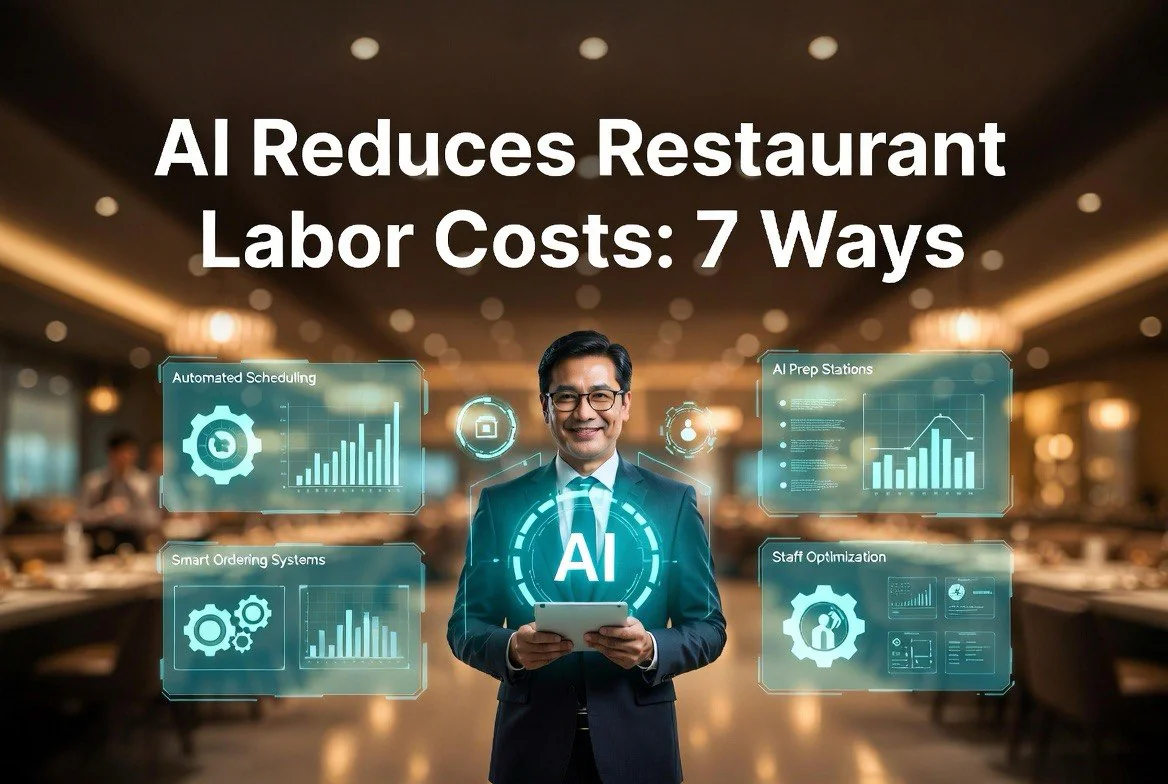
AI Reduces Restaurant Labor Costs: 7 Ways to Cut 20% Without Cutting Staff
⚡ Expert Summary: Key Takeaways
- AI-powered scheduling tools reduce labour costs by 10-15% in the first 90 days by matching staffing to actual demand rather than manager intuition.
- Voice AI and chatbots handle 40-60% of guest inquiries — reservations, menu questions, waitlist updates — without needing front-of-house staff to stop what they’re doing.
- AI inventory systems cut food waste by 12-18% and reduce the labour hours spent on manual counts and ordering by up to 80%.
- Kitchen display systems with AI prediction improve line cook efficiency by 10-15% by delivering real-time order sequencing and prep timing adjustments.
- Combined, seven AI tools can reduce total restaurant labour costs by 15-20% without cutting a single position — through efficiency, automation, and smarter scheduling.
Labour is your biggest expense. It accounts for 30-35% of revenue in most independent restaurants, and it’s getting more expensive every year as minimum wages rise and the talent pool tightens. For independent restaurant owners in the United States, labor cost remains the single largest operational expense, and AI tools are finally making a dent in that line item.
But here’s what most restaurant owners get wrong: cutting labour doesn’t mean cutting people. It means cutting the wasted hours — the admin work, the busywork, the inefficient processes that eat up your team’s time without adding value to the guest experience or your bottom line.
AI tools are changing that. They don’t replace your staff — they make them more productive by automating the repetitive, time-consuming tasks that pull your team away from the work that actually matters: serving guests and running a great restaurant.
With US restaurant labor costs rising 8.4% year-over-year according to Bureau of Labor Statistics data, independent operators need every efficiency tool available.
Here are the seven ways AI reduces restaurant labour costs, with real numbers and real tools you can deploy this month.
1. AI-Powered Scheduling
Manual scheduling is the single biggest time sink in restaurant management. A general manager spends 4-6 hours per week building schedules, making shift trades, and adjusting for call-offs. For a GM earning $55,000-70,000 per year, that’s $5,500-8,500 annually in labour cost just for the act of scheduling itself.
AI scheduling tools like 7shifts, HotSchedules, and Schedulefly use historical sales data, weather patterns, event calendars, and staff availability to generate optimized schedules automatically. They predict exactly how many staff you need for each shift based on real data, not gut feeling.
Independent restaurants using AI scheduling report 10-15% reduction in total labour costs within 90 days — not because they cut staff, but because they stopped overstaffing slow shifts and understaffing busy ones. The system knows that Tuesday at 2 PM needs two servers, not three, and that Friday at 8 PM needs six, not four.
Labour productivity increases because the right number of people are on the floor at the right times. No more paying staff to stand around during a slow lunch shift while scrambling for coverage on a Friday night.
Cost: $50-150 per month per location. ROI: $500-1,500 per month in reclaimed labour cost. Setup: 2-4 hours of configuration, then fully automated.
2. AI Reservations and Voice Ordering
Phone calls are the hidden labour drain in every restaurant. A busy restaurant receives 40-80 phone calls per day — reservations, takeout orders, menu questions, hours inquiries, special requests. Each call takes 2-5 minutes of staff time. That’s 2-7 hours per day of front-of-house labour spent on the phone rather than serving guests in the dining room.
AI voice agents handle these calls 24/7. They answer naturally, take reservations, process takeout orders, answer menu questions, and update the waitlist — all without a human picking up. Restivo and Slang.ai offer restaurant-specific voice AI that integrates with your existing phone system and reservation platform.
The impact on labour is immediate. Restaurants report a 40-60% reduction in phone-related staff interruptions after deploying voice AI. Your hosts and servers stay focused on the floor. The phone gets answered at 100% of the volume, 100% of the time, without adding a single staff hour.
The guest experience actually improves — wait times on hold drop to zero, and callers get accurate answers from a system that knows your menu and hours better than any new hire.
Cost: $150-400 per month. ROI: Eliminates 2-3 hours of phone time per day, freeing staff for floor service. Plus captures late-night bookings that were previously missed.
3. AI Chatbots for Website and Social Inquiries
Every restaurant gets questions through their website and social media channels. What are your hours? Do you take reservations? Can you accommodate gluten-free? Is there parking nearby? These questions eat up front-of-house time throughout the day — especially during the pre-service lull when managers are trying to prep for the shift.
An AI chatbot handles these inquiries instantly and autonomously. Placed on your website and connected to your Google Business Profile, it answers the 85% of common questions without needing a human response. For the 15% that require escalation, it routes to the right person via text or email — but even then, it provides the context so the staff member doesn’t have to ask “what’s this about?”
Square and OpenTable both include AI chatbot functionality in their standard restaurant packages. The chatbot learns your common questions over time — when a new menu item gets asked about frequently, it adds that to its knowledge base automatically.
Labour impact: 30-45 minutes per day recovered for front-of-house staff. That’s 15-22 hours per month across a moderately busy restaurant — the equivalent of bringing back half a shift position at no cost.
Cost: $50-200 per month (often included in existing POS or reservation subscriptions). ROI: Recovers 15-22 hours of staff time per month. Pays for itself inside the first week.
4. AI Inventory and Ordering Automation
Manual inventory management is one of the most labour-intensive processes in any restaurant. A typical independent restaurant spends 6-10 hours per week on physical inventory counts, manual ordering, and invoice reconciliation. For a kitchen manager earning $45,000-55,000 per year, that’s $6,500-10,000 annually in labour cost dedicated to counting things.
AI inventory platforms like MarketMan, BlueCart, and CrunchTime automate the entire process. They connect to your POS, track usage in real time, predict when you’ll run out of each ingredient, and generate purchase orders automatically. Some integrate with AI cameras that scan your walk-in and count inventory without any human touch.
The labour savings are dramatic. Restaurants report a 70-80% reduction in time spent on inventory management — from 6-10 hours per week down to 1-2 hours. Food waste drops by 12-18% because you’re ordering based on actual usage data, not best-guess par levels.
Your kitchen manager goes from being a counter and a spreadsheet wrangler back to being a kitchen manager — training staff, improving recipes, and overseeing food quality.
Cost: $100-300 per month. ROI: Recovers 4-8 hours of kitchen manager time per week. Food waste savings alone can exceed the monthly cost in the first 30 days.
5. AI-Driven Kitchen Display and Order Routing
Your kitchen display system (KDS) is probably the most underutilized labour-saving tool you already own. Most restaurants use it as a simple ticket printer replacement — orders appear on screen, cooks work through them in sequence. That’s missing the real value.
AI-enhanced KDS platforms like KitchenCut, Toaster, and advanced configurations of Toast’s KDS route orders intelligently based on station capacity, cook speed, and ticket complexity. A 12-top with four steaks, six chicken dishes, and two pastas gets split across the grill, sauté, and pasta stations simultaneously instead of hitting one station and causing a bottleneck.
Line cook efficiency improves by 10-15% with AI routing because no station gets overwhelmed while another sits idle. Ticket times drop by an average of 3-5 minutes during peak periods. Your line cooks produce more covers per hour without running faster — just running smarter.
Labour cost per cover drops proportionally. If your line produces 15% more covers in the same shift, your labour cost per dish drops by roughly the same percentage. The system costs nothing extra if you already have a modern KDS — it’s usually a configuration change or software update away.
Cost: $0-100 per month (mostly configuration of existing hardware). ROI: 10-15% efficiency gain on the hot line — typically translates to $500-1,500 per month in effective labour savings.
6. AI Training and Onboarding Automation
High turnover in restaurants means constant onboarding. The average independent restaurant hires 12-18 new front-of-house staff and 8-12 new back-of-house staff per year. Each onboarding cycle requires 15-30 hours of manager and trainer time — shadowing, menu quizzes, POS training, sidework training, and policy review.
AI training platforms like Bbot and advanced LMS integrations within Toast automate the knowledge transfer portion of onboarding. New hires access an AI tutor that answers questions about the menu, the POS system, sidework procedures, and house policies. The system quizzes them, tracks their progress, and flags gaps for manager follow-up.
Restaurants using AI onboarding report a 40-60% reduction in manager-led training time per new hire. A process that used to require 20 hours of trainer time now needs 8-10. Over the course of a year, that recovers 400-600 hours of manager labour — enough to eliminate the need for an assistant manager position or free up that role for actual floor leadership.
The quality of training also improves because the AI delivers consistent information every time. Every new hire gets the same menu training, the same policy overview, the same service standards — regardless of which manager is doing the onboarding that week.
Cost: $50-200 per month. ROI: Recovers 30-50 hours of manager time per month during peak hiring seasons. Reduces first-30-day turnover by 15-25% because new hires feel more supported.
7. AI Predictive Maintenance and Equipment Monitoring
Equipment breakdowns cause two kinds of labour waste. First, the emergency fix — you’re paying premium rates for a weekend repair call to fix a walk-in cooler that failed on a Friday afternoon. Second, the operational chaos — kitchen staff lose productivity when they have to work around broken equipment, use backup stations, or change prep workflows mid-shift.
AI predictive maintenance platforms monitor your kitchen equipment — walk-in coolers, freezers, ovens, fryers, dishwashers — through IoT sensors connected to the cloud. They learn normal operating patterns and alert you when something deviates. A compressor that’s running 15% harder than usual gets flagged three weeks before it fails. You schedule the repair during a slow Tuesday morning instead of losing a Friday night service.
The labour impact is twofold. You eliminate the chaos overhead — the 15-30 minutes of lost productivity per staff member when equipment goes down mid-service. And you eliminate the premium labour cost of emergency repairs and weekend call-out fees.
Restaurants using predictive maintenance report 30-50% fewer emergency service calls and 20-30% lower total equipment maintenance spend. On the labour side, kitchen staff productivity stays consistent because they’re never suddenly working around a broken oven or a downed prep station mid-shift.
Cost: $50-100 per month for basic sensor packages. ROI: Eliminates $2,000-5,000 per year in emergency repair premiums and recovers an estimated 40-80 hours of lost kitchen productivity.
The Combined Impact: 20% Labour Cost Reduction
Each of these seven tools delivers measurable labour savings on its own. But the real power comes from deploying them together as an integrated system that touches every labour-intensive point in your operation.
Here’s what the combined picture looks like for a typical independent restaurant doing $800,000 in annual revenue with 35% labour costs ($280,000):
- AI scheduling saves $28,000-42,000 (10-15%)
- Voice AI recovers 2-3 hours/day = $8,000-15,000
- Chatbot handles 85% of inquiries = $3,000-6,000
- Inventory automation saves 4-8 hrs/week manager time = $5,000-10,000
- KDS routing improves line efficiency 10-15% = $10,000-20,000
- AI onboarding reduces training labour 40-60% = $6,000-12,000
- Predictive maintenance eliminates emergency overhead = $3,000-8,000
Total combined savings: $63,000-113,000 per year — a 15-20% reduction in total labour cost.
None of these savings come from cutting staff. They come from making your existing team more productive — automating the busywork so your best people can focus on guests, food quality, and the work that actually drives revenue.
Your labour costs won’t fix themselves. But with the right AI tools deployed in the right order, you can hit 20% without adding a single new position or cutting a single existing one.
Implementation Timeline
Deploying all seven tools at once would be overwhelming — and unnecessary. Here’s a phased approach that maximizes ROI while minimizing disruption:
Month 1-2: Start with AI scheduling and inventory automation. These deliver the fastest, most measurable ROI and require the least staff training. Scheduling is mostly automated within two weeks. Inventory takes a month to gather baseline data, then saves 6-8 hours of manager time every week thereafter.
Month 2-3: Add voice AI or chatbot — pick whichever channel drives more volume for your restaurant. If you’re heavy on takeout and reservations, start with voice AI. If you get more web and social inquiries, start with the chatbot. Either one takes one afternoon to set up and starts saving labour immediately.
Month 3-4: Configure your KDS for AI routing and install predictive maintenance sensors on your critical equipment. These require minimal staff training — your cooks barely notice the change, and your equipment starts self-monitoring immediately.
Month 4-6: Deploy AI onboarding to capture the labour savings from your next wave of hires. Integration takes a few hours, and the training materials build themselves over time as the AI learns your common questions.
Total deployment cost: $500-1,500 per month for all seven tools. Total labour savings: $5,000-9,000 per month. Payback period: Less than one week from the moment the scheduling system goes live.
The restaurants that are pulling ahead right now aren’t doing anything your restaurant can’t also do. They’re just taking action while others are still reading about it.
Bottom Line
Labour costs aren’t going down. Minimum wages are rising in every state. The talent pool for kitchen and front-of-house roles is tighter than it’s been in 20 years. The old approach — cutting staff and hoping the remaining team can absorb the work — is failing. It burns out your best people and drives up turnover, which makes the labour problem worse.
AI offers a different path. Instead of cutting people, you cut the tasks that don’t need a person doing them. The phone calls. The scheduling spreadsheets. The inventory counts. The training repetition. The equipment panic.
Seven tools. Fifteen to twenty percent labour reduction. Zero positions cut.
The math is straightforward. The technology is proven. The question is whether you’re ready to stop managing labour the way restaurants have for the last 50 years and start using the tools that are available right now.
Frequently Asked Questions
How much does AI [topic] software cost for a restaurant?
Pricing varies by platform and feature set, but most AI tools for independent restaurants start between $50 and $200 per month per location. Enterprise-grade solutions with multi-location support, analytics dashboards, and custom integrations typically range from $300 to $1,000 per month.
Do I need technical skills to implement AI in my restaurant?
No. Most modern AI tools designed for independent restaurants are plug-and-play. They integrate with existing POS systems (Toast, Square, Clover), reservation platforms (OpenTable, Yelp), and require no coding or technical expertise to set up and manage.
How quickly does AI software show results for restaurants?
Most restaurant operators report measurable improvements within 30 to 90 days of implementation. Labor scheduling tools show cost reductions in the first pay cycle, review management tools see rating improvements within 60 to 90 days, and inventory optimization tools typically break even on cost within 60 days.
Can AI tools replace my restaurant staff?
No. AI tools are designed to augment your existing team, not replace them. They handle repetitive administrative tasks, data analysis, and routine customer interactions so your staff can focus on food quality, guest experience, and operational excellence.
What is the ROI of AI tools for independent restaurants?
ROI varies by tool type. Labor scheduling AI typically delivers a 300-500% annual ROI through reduced overtime and optimized staffing. Inventory management AI cuts food waste by 15-40%. Review management AI improves customer ratings by 0.5-1.3 stars, directly correlating to 5-9% revenue increases.
More AI Resources