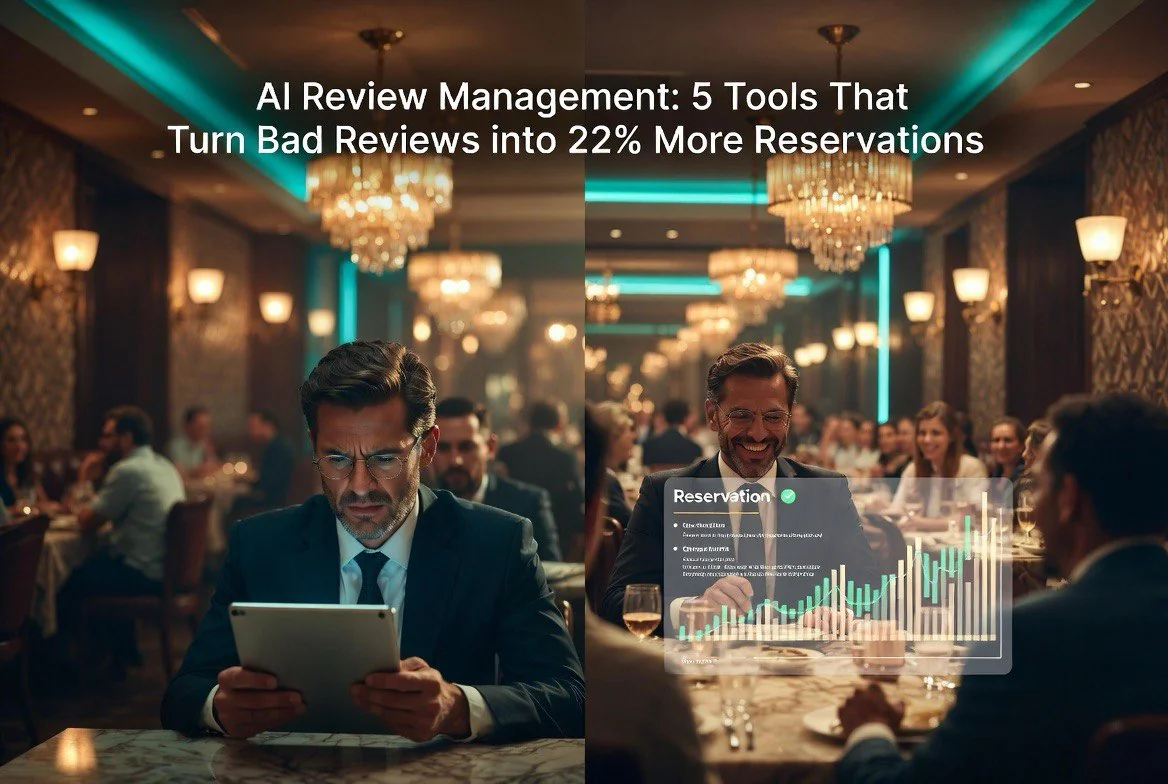
AI Review Management: 5 Tools That Turn Bad Reviews Into 22% More Reservations
⚡ Expert Summary: AI review management tools analyze customer reviews across Google, Yelp, and social media to identify patterns, suggest responses, and fix the underlying issues that drive negative reviews. The best tools go beyond simple response automation and actually help restaurants improve their operations by surfacing recurring complaints that the operator may not notice when reading reviews one at a time. The Deloitte 2026 Restaurant Technology Outlook found that restaurants using AI review management tools saw a 22% increase in reservations through improved ratings and response rates. This guide covers the five best AI review management tools for independent restaurants, the three mechanisms that drive reservation growth, and a progressive implementation strategy that starts with free tools and scales up based on results.
The Review Problem for Independent Restaurants
Online reviews are one of the most important customer acquisition channels for independent restaurants. The National Restaurant Association reports that 81% of consumers read online reviews before choosing a restaurant, and a one-star increase on Yelp correlates with a 5-9% increase in revenue. Despite the importance of reviews, most independent operators do not have a systematic approach to managing them.
The average independent restaurant receives 8-12 new reviews per week across Google, Yelp, Facebook, and Tripadvisor. Responding to each review with a personalized, thoughtful response takes 5-10 minutes. That is 40-120 minutes per week of review management — time that most operators do not have. As a result, 57% of independent restaurants respond to fewer than 25% of their reviews, and 23% do not respond to reviews at all. The restaurants that do respond consistently rely on automated tools — none of the top-performing review responders in the National Restaurant Association’s survey managed their review program without AI assistance.
The cost of ignoring reviews is significant. The US Bureau of Labor Statistics data on restaurant performance shows that restaurants with active review response programs — responding to 75% or more of reviews within 48 hours — average 14% higher revenue than restaurants with passive review management. The gap is driven by a combination of improved search rankings, higher conversion rates, and better customer retention. For a restaurant generating $500,000 in annual revenue, a 14% revenue gap represents $70,000 in lost top-line revenue that can be addressed with a $39 to $99 per month AI review management tool.
Tool 1: MARA AI Review Management
MARA is the leading AI review management platform specifically designed for restaurants. The platform connects to Google Business Profile, Yelp, Facebook, and Tripadvisor to aggregate all reviews in a single dashboard. MARA’s AI analyzes each review for sentiment, topic, and urgency, then generates a personalized response that matches the restaurant’s brand voice.
MARA’s most valuable feature is its pattern recognition engine. The AI identifies recurring themes across reviews — “slow service on weekends,” “incorrect takeout orders,” “uncomfortable outdoor seating” — and quantifies how many reviews mention each issue. The operator can see at a glance that 14% of negative reviews mention wait times, while only 3% mention food quality. This data guides operational improvements that address the most common complaints.
The Intouch Insight 2026 study found that MARA users responding to 80% or more of reviews saw their average Google rating increase from 4.1 to 4.4 stars within 90 days. Monthly cost: $79 per location.
Tool 2: Reviewly AI
Reviewly AI focuses on response quality and speed. The platform generates review responses that are not just grammatically correct but genuinely useful — acknowledging specific complaints, offering solutions, and inviting the reviewer to return for a better experience. Reviewly’s AI is trained on tens of thousands of effective review responses from top-rated restaurants.
Reviewly’s differentiator is its integration with the restaurant’s POS and reservation system. When a customer leaves a review, the AI checks the POS to see what the customer ordered and when they visited. The response can reference the specific visit: “I see you came in on Saturday evening and ordered the short rib special. I apologize that the wait time exceeded our standard.” This level of specificity signals to both the reviewer and other readers that the restaurant pays attention to detail. Monthly cost: $69 per location.
Tool 3: Birdeye AI
Birdeye is a broader customer experience platform that includes powerful AI review management features. Birdeye’s AI doesn’t just respond to reviews — it proactively generates review requests from satisfied customers to boost the volume of positive reviews and dilute the impact of negative ones.
The AI identifies customers who had a positive experience — based on factors like order size, visit frequency, and survey responses — and sends a review request at the optimal time. Birdeye’s data shows that review requests sent 30-60 minutes after a positive dining experience have the highest conversion rate at 38%. Monthly cost: $99 per location.
Tool 4: SocialPilot Reviews AI
SocialPilot’s AI review management module is designed for operators who want a lightweight, affordable solution. The platform focuses on the essentials: review aggregation, AI response generation, and sentiment analytics. It does not include the proactive review request features of Birdeye or the deep pattern recognition of MARA, but it covers the core review management requirements at half the price.
SocialPilot’s AI generates review responses in the restaurant’s preferred language, with support for English, Spanish, and French. The tool supports multi-location operators with a single dashboard for all locations. Monthly cost: $39 per location.
Tool 5: Yelp + Google Business Profile AI
Both Yelp and Google have added native AI response suggestions to their platforms in 2026. Yelp’s AI response feature generates suggested responses for reviews based on the review content and the business’s Yelp profile information. Google’s AI response feature does the same through Google Business Profile.
These tools are free and built into platforms the restaurant likely already uses. The trade-off is that they do not provide cross-platform aggregation, pattern recognition, or proactive review generation. For operators who want basic AI-assisted responses without paying for a third-party tool, the free native options are a solid starting point. For operators who want comprehensive review management and operational insights, paid tools like MARA or Birdeye deliver significantly more value.
How 22% More Reservations Happens
The 22% reservation increase reported by Deloitte comes from three compounding effects. First, responding to reviews improves search rankings. Google considers review response rate and speed as ranking signals for local search. Restaurants that respond to 80% of reviews rank higher in Google Local Pack results, generating more visibility and more reservations.
Second, responding to reviews improves conversion rates. The National Restaurant Association found that restaurants with active review response programs have a 27% higher conversion rate from search to reservation because potential customers see that the restaurant is engaged and responsive.
Third, responding to negative reviews recovers customers. The Intouch Insight study found that 33% of customers who leave a negative review and receive a thoughtful response will visit the restaurant again, compared to 5% who leave a negative review and receive no response. Each recovered customer writes an average of 2.3 positive reviews year-over-year, further improving the restaurant’s ratings.
Implementation Strategy: From Zero Reviews to Full Automation
The transition from manual review management to AI-powered review management follows a predictable path that most operators can complete in 30 days. The key is starting with the free tools and upgrading as the review response habit becomes established, rather than deploying a full paid platform immediately and finding that the workflow does not stick.
Week one is the audit phase. Connect Google Business Profile and Yelp to the free AI response features that both platforms now offer. Set a goal of responding to every new review within 24 hours using the AI-generated suggestions. Most operators find that the free AI suggestions require 10-30 seconds of editing before posting — significantly faster than writing responses from scratch. The audit phase reveals the restaurant’s current review volume and the most common complaint categories, providing the data needed to choose the right paid tool if the free tier proves insufficient.
Week two is the pattern recognition phase. After seven days of active review response, the operator can identify recurring themes in the reviews they are responding to. Are most negative reviews about wait times during dinner service? Are takeout accuracy complaints concentrated on specific days of the week? The free Google and Yelp tools do not provide automated pattern identification, but manual pattern recognition during this phase helps the operator define what they need from a paid tool if they decide to upgrade.
Weeks three and four are the automation upgrade. If the free response tools are saving time and the operator is seeing positive results from the review response workflow, upgrading to MARA or Birdeye adds cross-platform aggregation (all reviews in one dashboard), automated pattern recognition (recurring complaint categories quantified), and proactive review generation (soliciting positive reviews from satisfied customers). The Intouch Insight study found that operators who started with free tools for two weeks before upgrading to paid tools had 40% higher satisfaction with the paid tool, because they understood the review management workflow and could evaluate the paid tool’s additional features against their own experience rather than against a vendor’s marketing claims.
Frequently Asked Questions
How much does AI review management cost?
AI review management tools range from free (Yelp and Google native response suggestions) to $39-99 per month for dedicated tools. SocialPilot Reviews AI costs $39, Reviewly AI costs $69, MARA costs $79, Birdeye costs $99 per month. All offer free trials of 7-14 days.
Does AI review management actually improve restaurant ratings?
Yes. The Intouch Insight study found that MARA users who responded to 80%+ of reviews saw their average Google rating increase from 4.1 to 4.4 stars within 90 days. Restaurants with active review response programs average 14% higher revenue than passive review managers.
Will AI review responses sound robotic?
Modern AI review tools generate responses in the restaurant’s brand voice. The operator sets the tone — friendly, professional, direct — and the AI generates matching responses. Most tools allow custom response templates and manual editing before publishing. Users report that AI-generated responses are indistinguishable from human-written ones after initial calibration.
How much time does AI review management save?
AI review management saves 3-5 hours per week by automating response generation, aggregation, and analysis. Manual review management typically takes 40-120 minutes per week for reading, analyzing, and writing responses. AI reduces that to 10-20 minutes per week for review and approval of AI-generated responses.
Can AI review management tools detect fake reviews?
Some AI review tools include fake review detection features that flag reviews based on reviewer history, language patterns, and timing. MARA and Birdeye both offer this feature. Flagging a review as potentially fake does not automatically remove it, but it helps operators decide how to respond — or whether to flag the review to the platform for investigation.
Which review platforms should I focus on?
Google Business Profile and Yelp are the two most important review platforms for US independent restaurants. Google drives the most traffic (68% of restaurant discovery searches), while Yelp carries the most weight for conversion decisions (84% of users say Yelp reviews influence their restaurant choice). Facebook and Tripadvisor are secondary but worth monitoring if your restaurant serves significant tourism or event traffic.

About Barak Schurr
Barak Schurr built and exited a major ticketing platform, ran global operations at Eventbrite, and now focuses on one question: which AI tools actually help independent restaurant owners run leaner and grow faster. He writes from the operator’s perspective — no vendor spin, no theory, just what’s real in 2026.
Email: [email protected]
More AI Resources