Get the AI Restaurant Quick-Start Guide — Free
The 5 AI tools independent US restaurant owners are using right now to cut labor costs and answer every call.
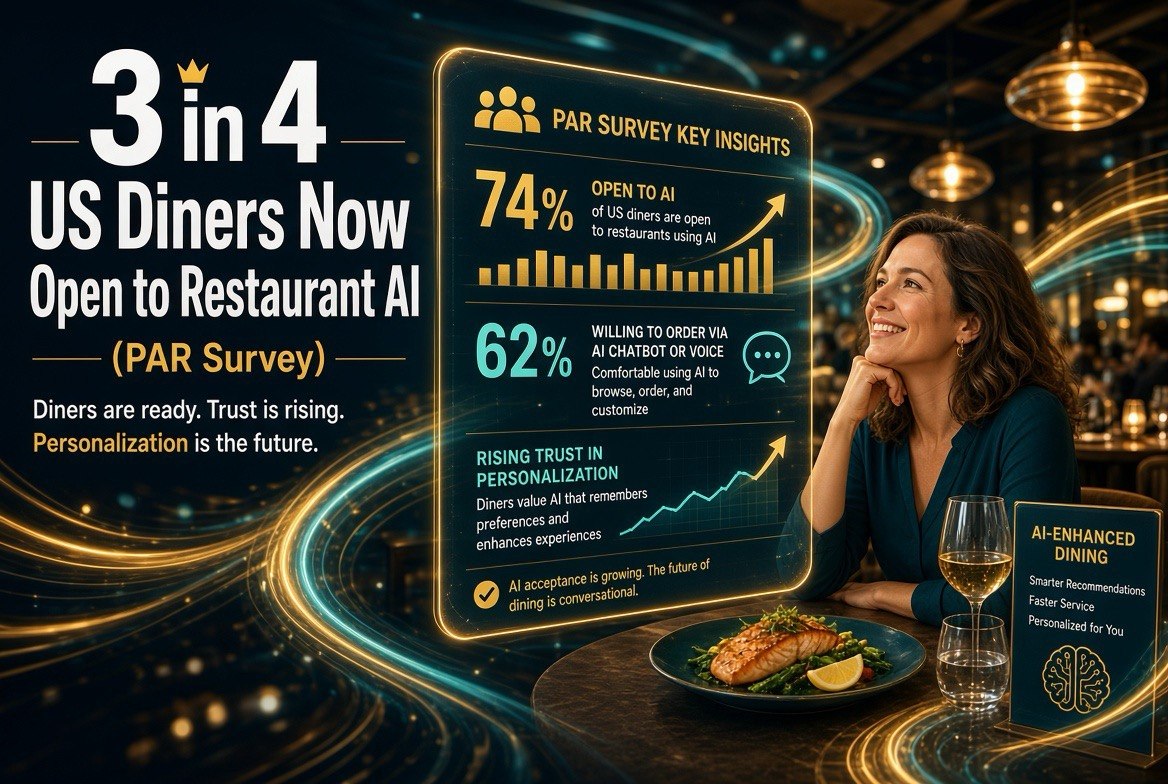
3 in 4 US Diners Now Open to Restaurant AI (PAR Survey)
⚡ Expert Summary: PAR Technology’s new “AI on the Diner’s Terms” survey finds diner discomfort with restaurant AI dropped from 41% to 27% in a year, with nearly 3 in 4 US diners now open to AI playing some role — and 62% willing to order through an AI chatbot or voice assistant given the right offer. The public’s big fear (AI replacing workers) is fading; the new top concern is transparency. For restaurant owners, this is the data that says it’s safe to start testing AI without driving customers away.
If you’ve held off on restaurant AI because you worried your customers would hate it, a new industry-wide survey says that fear is now largely outdated. PAR Technology’s “2026 Industry Report: AI on the Diner’s Terms” — based on a June 2026 survey of 1,000 US adults fielded by Dynata, with year-over-year comparisons to its 2025 study — found that the share of diners who said they’d avoid a restaurant using AI fell from 41% to 27% in just one year.
Nearly three in four US diners (about 74%) now say they’re open to AI playing some role in their restaurant experience. And perhaps most striking for operators: 62% would place an order through a large language model — an AI chatbot or voice assistant — “given the right offer,” with interest highest among Millennials (73%), Gen Z (70%), and parents (74%).
The Headline Shift: Discomfort Is Halving Year Over Year
The single most important number in the report is the collapse in resistance. In PAR’s 2025 survey, 41% of diners said they would choose an AI-free restaurant. In 2026, that figure dropped to 27%. That’s a 14-point swing in a single year — the kind of movement that tells owners the “AI backlash” window is closing, not opening.
The other key stat, the 74% openness figure, means the majority of your customer base no longer treats AI as a dealbreaker. They may not demand it, but they’re not going to walk out the door because you use voice ordering or an AI assistant. That’s the green light independent operators have been waiting for.
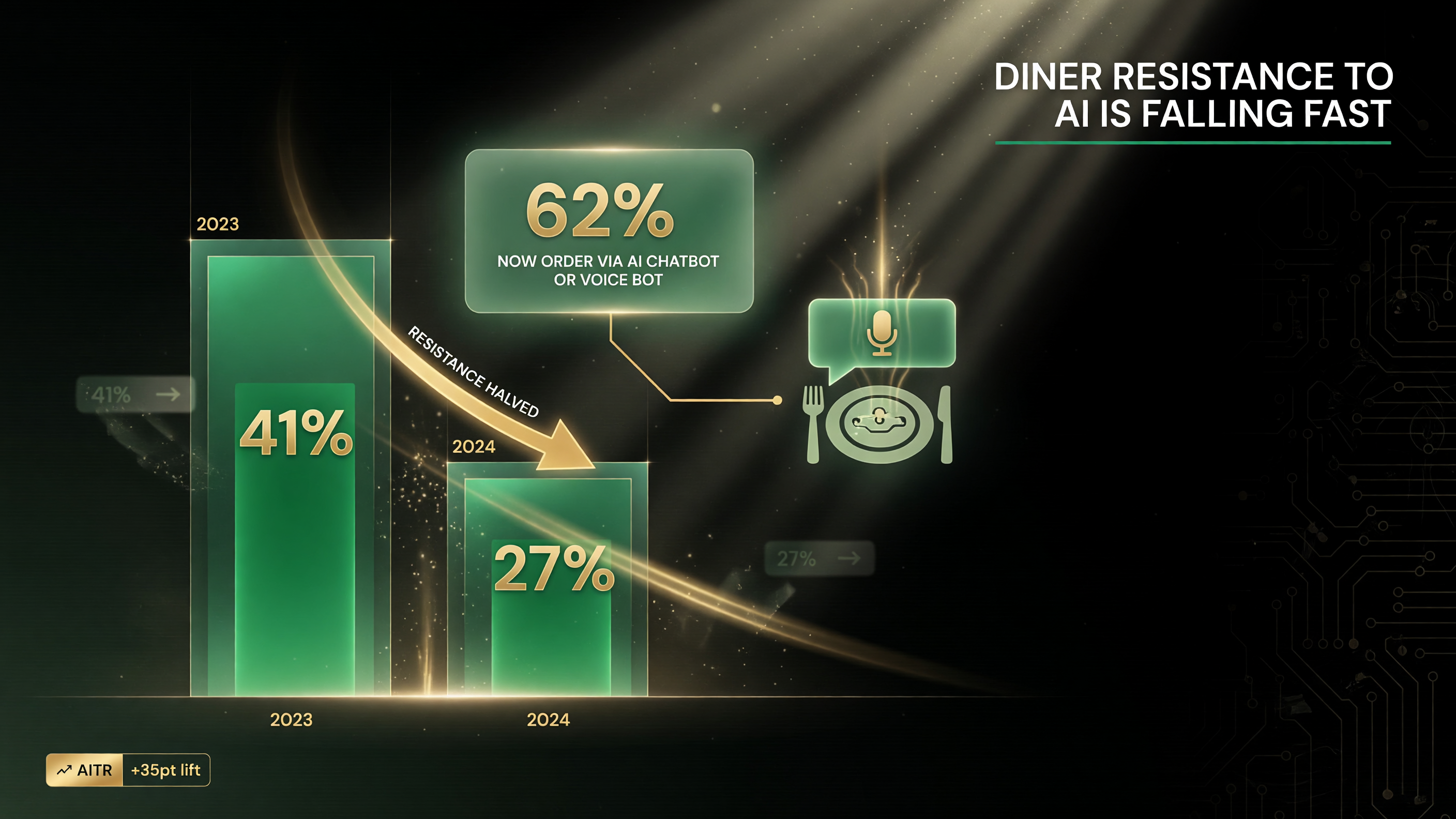
The headline shift from PAR Technology’s survey: the share of diners who’d avoid an AI-using restaurant dropped from 41% to 27% in one year, while 62% now say they’d order through an AI chatbot or voice assistant.
62% Would Order Through an AI Assistant or Voice Bot
This is the number that points to the near future. More than six in ten diners say they’d order through an LLM given the right offer. PAR CEO Savneet Singh said the data supports LLMs becoming a new ordering interface faster than expected — with guests ready if operators move quickly to own that channel.
What does “given the right offer” mean in practice? It means the willingness isn’t unconditional — it’s earned. A restaurant that makes it worth the diner’s while (a discount, a reward, convenience, or consistency) gets the order. Diners aren’t saying they’ll abandon humans; they’re saying they’ll use AI when it’s clearly better for them. For an owner, that’s permission to launch an AI ordering channel as a supplement, not a replacement.
OK With AI Behind the Scenes: Operations Get a Pass
The survey isn’t just about customer-facing AI. Forty-eight percent of consumers are comfortable with AI handling operational decisions — like adjusting labor based on demand or optimizing menus based on inventory. That comfort rises to 51% for uses that improve service consistency or shorten wait times.
This matters because it validates the cost-saving AI a lot of independents actually care about first: the back-of-house automation that trims labor, reduces waste, and tightens scheduling. Diners don’t object to it when the visible result is steadier service and shorter waits. You don’t need to hide the AI that runs your kitchen smarter — you just need to deliver the outcome.
Trust Is Rising, and Transparency Is Now the Top Concern
Trust in AI for personalized offers based on dining history rose to 45% (from 33% in 2025), with parents of children under 25 showing 59% acceptance. At the same time, the report found transparency is now the #1 trust factor (43%), ahead of last year’s leading concern — AI replacing workers.
That’s a meaningful pivot for how you should introduce AI to your guests. The fear that used to scare people (robots taking jobs) has been overtaken by a simpler, more practical request: just be honest about when AI is involved. Diners who are told what’s happening, and who can always reach a human, feel far more comfortable than diners who discover automation by accident.
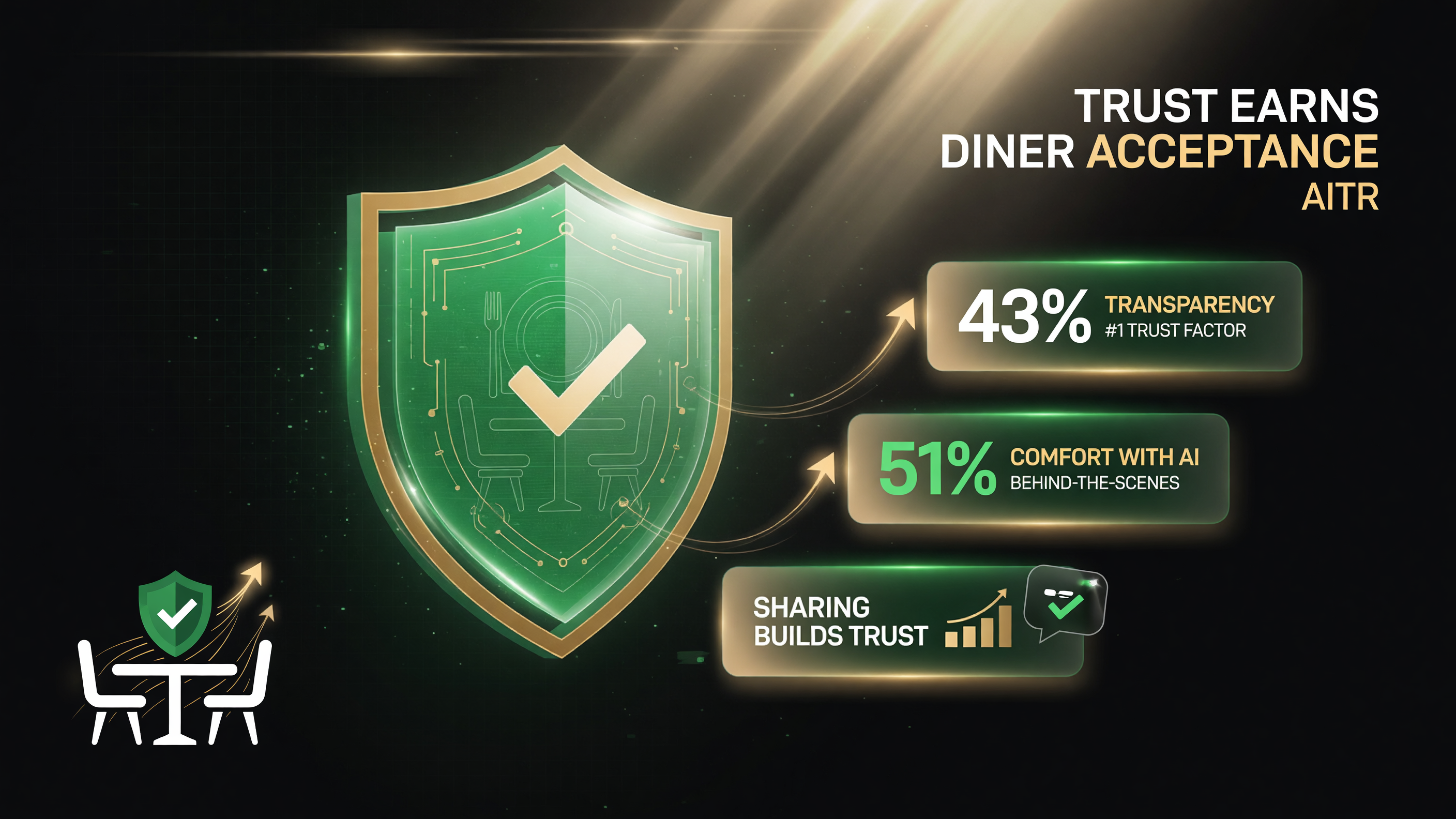
Trust is what earns acceptance: transparency is now the #1 trust factor (43%), and comfort with behind-the-scenes AI using that rises to 51% when it improves consistency or service.
Where the Line Still Is: The Boundaries Diners Draw
The report is not a blank check for automation. Clear boundaries remain, and they’re important to respect:
- 47% say AI goes too far if it replaces most human interaction.
- 44% say the same if they cannot easily reach a human.
- Only 7% believe a restaurant “cannot be too automated.”
Read that closely: about half your diners are comfortable with AI as long as they can still reach a person when they want to. That’s the exact design principle behind the smartest chain rollouts — keep the human escape hatch prominent, and automation becomes acceptable rather than threatening.
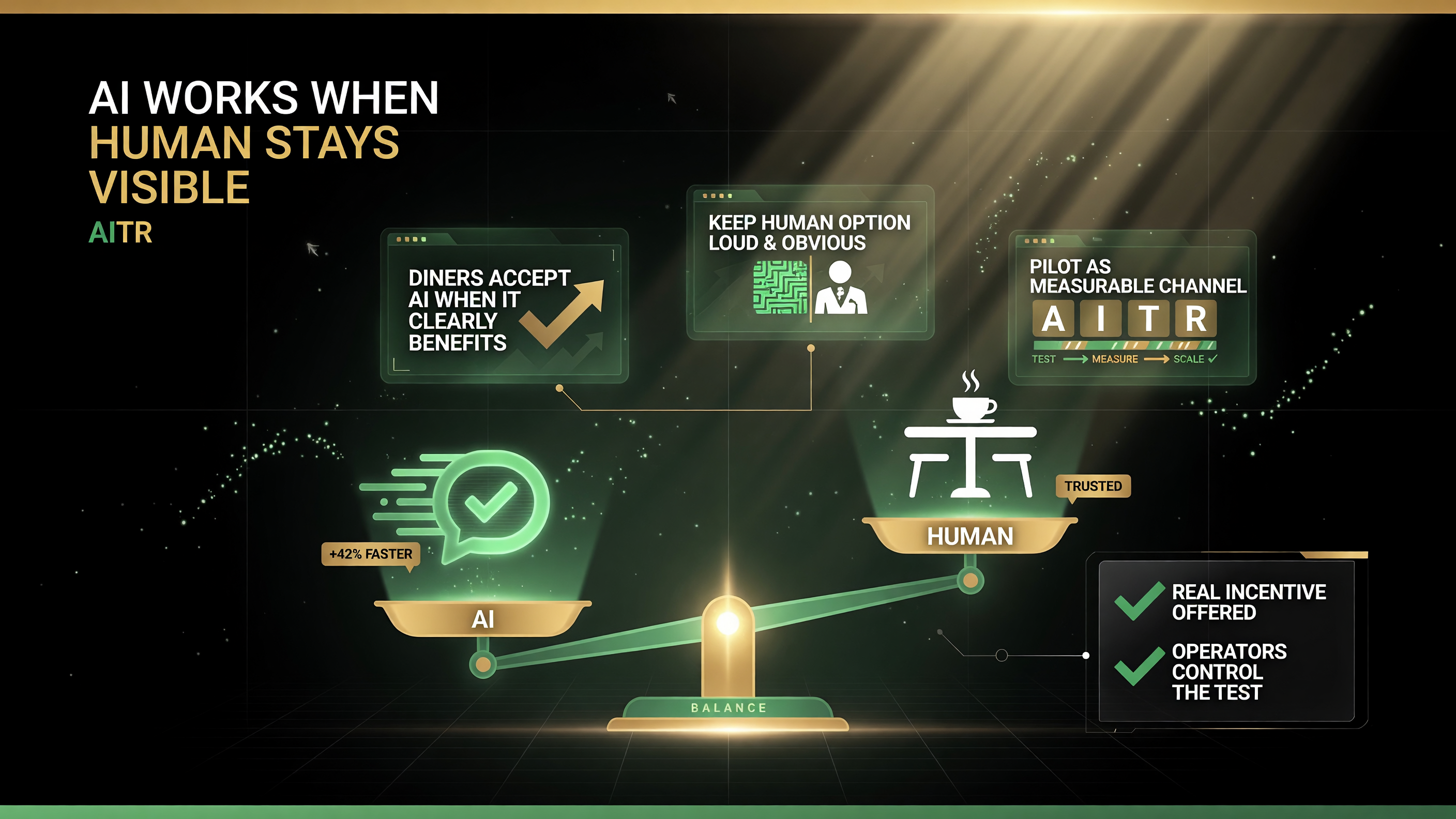
The operator playbook: diners accept AI when it clearly benefits them — keep the human option loud and obvious, offer a real incentive, and run AI as a testable, measurable channel before scaling.
What 74% Openness Means for Your Restaurant, In One Table
Here’s how the survey data translates into concrete, decision-ready takeaways for an independent operator:
| Survey Finding | What It Tells You | Action For Your Restaurant |
|---|---|---|
| Discomfort with AI: 41% → 27% | AI resistance is halving year over year | Safe to pilot AI without a customer exodus |
| ~74% open to AI in their experience | Majority won’t leave because you use AI | Introduce AI as an option, not an ultimatum |
| 62% would order via LLM “given right offer” | AI ordering is accepted when it pays off | Add an AI/chat ordering channel with an incentive |
| 48–51% OK with AI in operations | Back-of-house AI is not a trust problem | Use AI for labor, menu, and inventory decisions |
| Transparency = #1 trust factor (43%) | Honesty beats secrecy, every time | Be upfront about AI; show the human option |
| 47% resist AI replacing most human interaction | Human contact still matters to ~half | Keep staff visible and reachable at all times |
Comparing This Year to Last: How Fast Acceptance Moved
To appreciate how quickly the ground shifted, compare the key numbers side by side between PAR’s 2025 and 2026 surveys:
| Metric | 2025 Survey | 2026 Survey | Change |
|---|---|---|---|
| Diners who’d avoid AI restaurants | 41% | 27% | −14 pts |
| Trust in AI for personalized offers | 33% | 45% | +12 pts |
| Top trust factor | Not replacing workers | Transparency | Concern pivoted |
What the “Right Offer” Really Means (and How to Design One)
The 62% who said they’d order through an LLM were quick to add the qualifier: “given the right offer.” That phrase is doing a lot of work, and it tells you what makes an AI ordering channel succeed or fail. It’s not that diners want a chatbot for its own sake — it’s that a growing share will happily use one when the exchange clearly favors them. The most effective offers in the restaurant-tech world right now combine three things: a friction cut, a visible reward, and a trust signal.
The friction cut is the easiest win. A voice or chat ordering channel that remembers a diner’s usual order, dietary restrictions, and preferred pickup time removes the single biggest annoyance in ordering — repeating yourself. The visible reward is where you turn curiosity into habit: a loyalty point boost, a first-order discount, or a free item on order number five. The trust signal is the rule we keep coming back to — a prominent “talk to a human anytime” button that tells the guest the AI isn’t a wall, it’s an option.
Design your first AI ordering test around those three elements and the 62% stops being a headline number and becomes an actual customer. Launch the channel bare, with no incentive and no obvious way to reach staff, and you’ll be operating in the 27% who’d rather avoid AI entirely.
How to Know If Your AI Pilot Is Actually Working
Once you launch, measure the things that tell you whether your guests are voting with their wallets. Order completion rate is the first signal — are the AI-driven orders actually converting, or are customers dropping off mid-flow? Average ticket size on AI orders versus phone or in-person orders tells you whether the upselling is landing or pushing people away. And the most important one: repeat usage. If the same customers come back to the AI channel a second and third time, you’ve built a habit; if they try it once and never again, the offer or the experience missed.
Don’t forget the sentiment check that no dashboard captures. Ask a handful of regulars what they think. The survey says transparency is the #1 trust factor, so the diners who tell you they like the speed but worry about losing the personal touch are giving you the exact feedback the 44% boundary group cares about. Weigh their words against your data, keep the human option loud and obvious, and iterate. The operators who treat AI as a testable, measurable channel — not a one-time switch — are the ones who’ll convert this year’s acceptance into next year’s loyalty.
Fact Check: The Right Way to Test AI Now
The data supports acting, but acting smartly. Three rules before you launch. First, lead with transparency — the #1 trust factor is honesty, so tell guests where AI helps and make the path to a human obvious. Second, start with behind-the-scenes AI (scheduling, inventory, menu optimization) where comfort runs 48–51% and the win is cost savings diners actually feel as steadier service. Third, offer an AI ordering channel with an incentive — the 62% who’d order via LLM are conditional, so pair the launch with a reward to turn curiosity into orders.
The 41%→27% drop in discomfort is the signal. Your customers have largely gotten comfortable with restaurant AI in the last twelve months — the operators who start testing now are getting in at the right moment, before the acceptance curve matures. For tools that fit this exact playbook, browse the AI for restaurants library.
Frequently Asked Questions
Are diners actually open to AI in restaurants?
Yes. PAR Technology’s 2026 survey found diner discomfort with AI dropped from 41% to 27% in a year, with nearly 3 in 4 US diners (about 74%) open to AI playing some role in their restaurant experience.
Will customers order through an AI chatbot or voice assistant?
62% said they would place an order through a large language model given the right offer — with interest highest among Millennials (73%), Gen Z (70%), and parents (74%). It’s conditional on the offer being worth it.
Are diners OK with AI used behind the scenes?
Yes — 48% are comfortable with AI handling operational decisions like labor and menu optimization, rising to 51% for uses that improve service consistency or shorten wait times.
What’s the #1 thing that builds trust in restaurant AI?
Transparency, at 43%, is now the top trust factor — overtaking last year’s leading concern about AI replacing workers. Being upfront about AI is the strongest trust signal.
How much AI is too much for diners?
47% say AI goes too far if it replaces most human interaction, and 44% say the same if they can’t easily reach a human. Only 7% think a restaurant cannot be too automated — so keeping a human option is essential.