Get the AI Restaurant Quick-Start Guide — Free
The 5 AI tools independent US restaurant owners are using right now to cut labor costs and answer every call.
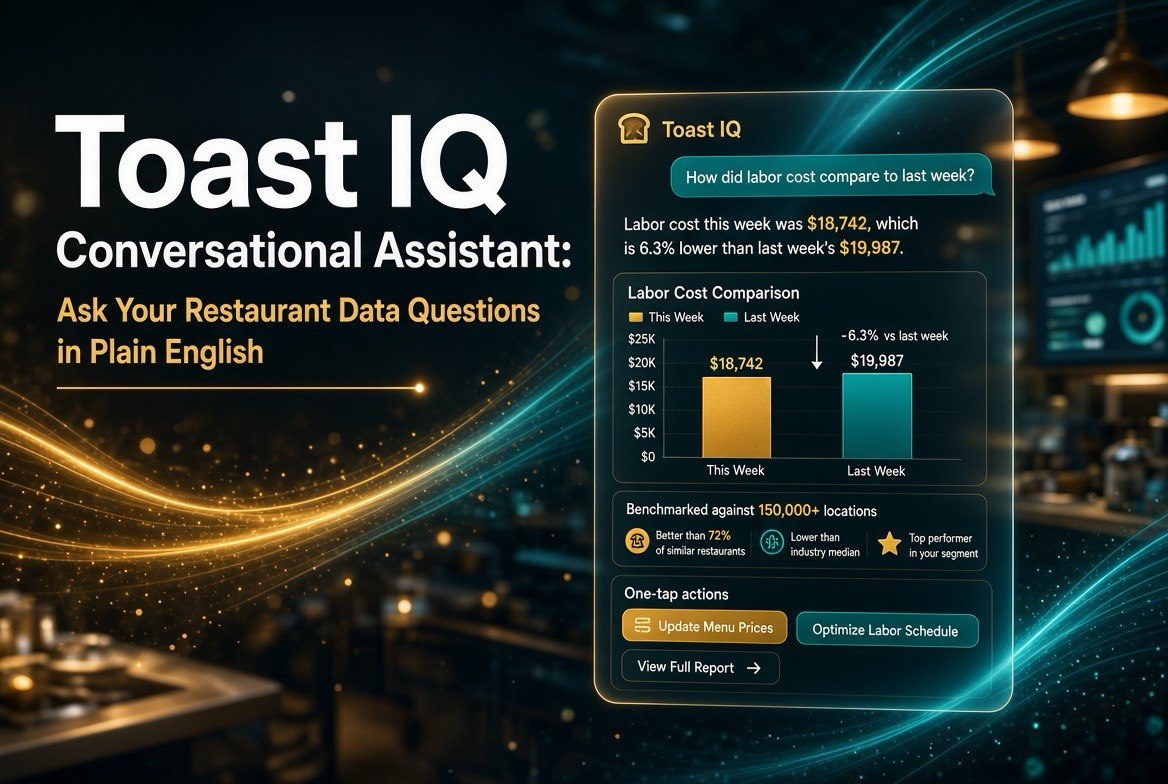
Toast IQ Conversational Assistant: Ask Your Restaurant Data Questions in Plain English
⚡ Expert Summary: Toast IQ is Toast’s built-in conversational AI assistant that lets restaurant operators ask plain-English questions about their own data — “What changed in sales this week?” — and get accurate answers, plus take actions directly in the chat like updating menu prices, marking items out of stock, or drafting a marketing campaign. It’s free for US Toast customers, lives in the Toast Now app and Toast Web, and by Q1 2026 had 40,000+ weekly active users and 21 million+ conversation threads, with sales queries the most common use (~47%).
Every restaurant owner has sat at the kitchen computer on a slow afternoon and asked the same question: “Why were sales down last Tuesday?” The answer used to mean opening four different reports, cross-referencing labor hours with menu sales, and mentally reconciling what those numbers meant. If you are like most independent operators, you did not always bother — the report existed, but the time to read it did not.
Toast IQ is built to end that. It is Toast’s conversational AI assistant, free for US customers, that treats your restaurant data like something you can simply ask about. You type a question in plain English, and it answers from your actual Toast data, then lets you take action on the answer in the same conversation.
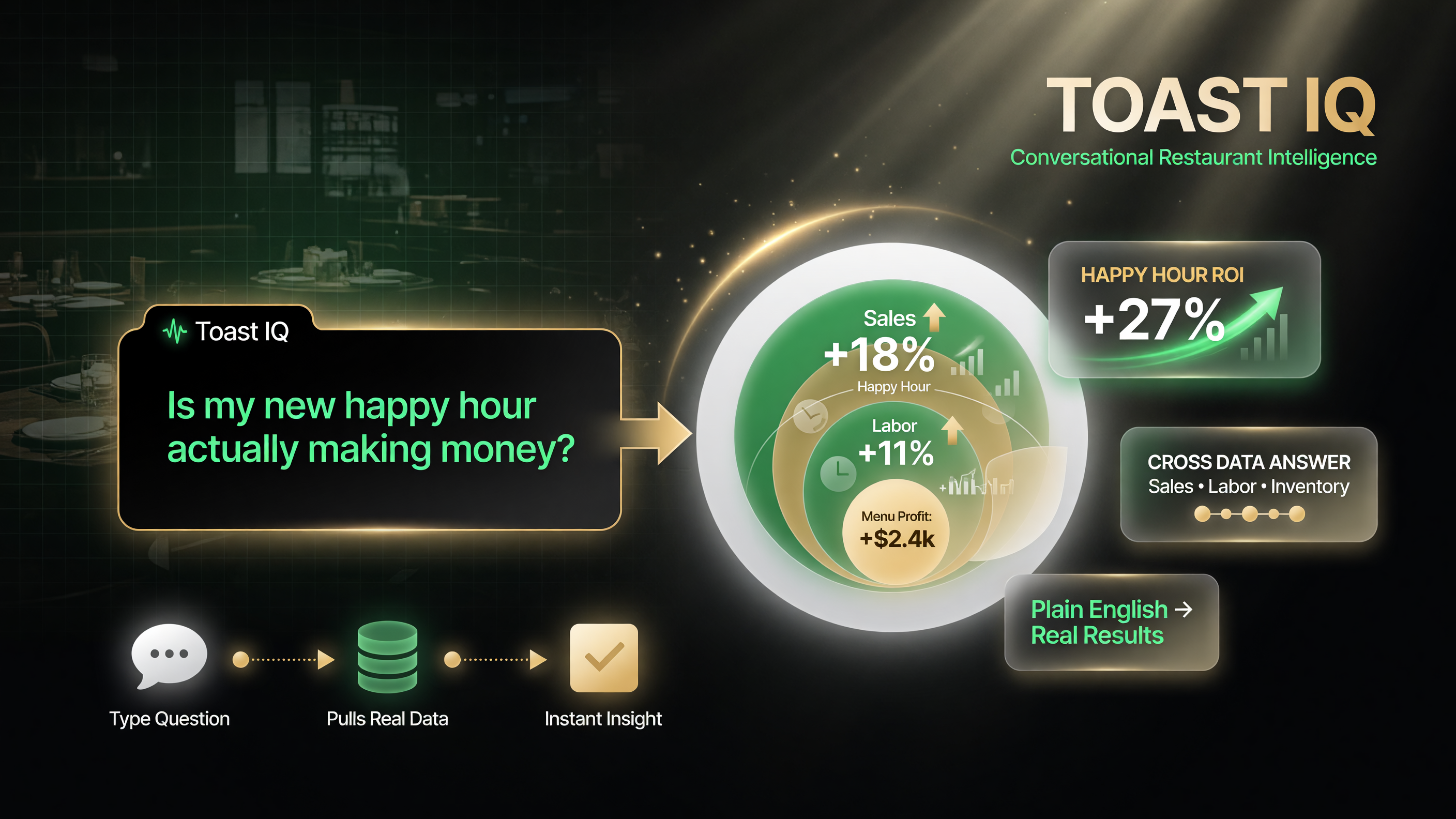
Toast IQ answers plain-English questions from your real restaurant data — cross-cutting queries like “Is my new happy hour actually making money?” pull together menu, labor, and sales in a single answer.
What Toast IQ Actually Does
Toast IQ is not a generic chatbot bolted onto your POS. It is purpose-built for hospitality, which means it understands restaurant language, your menu, your shifts, your house shorthand — and it is connected to your real operational data rather than giving disconnected answers. When you ask it a question, it retrieves and analyzes your actual Toast data through a language model and responds in plain English.
1. Ask Anything in Plain English
The core capability is conversational Q&A. Instead of building a report, you ask:
- “What changed in sales this week?”
- “Which shifts are driving the highest labor cost?”
- “How did the new burger do against last month’s special?”
- “What’s my top-selling appetizer this quarter?”
It pulls across sales, labor, menu performance, guest trends, discounts, voids, upsells, inventory, and marketing campaigns, then answers with context. It can even factor in aggregated benchmarks from Toast’s network of locations — roughly 148,000 to 171,000+ — so your numbers come with a sense of how you compare.
2. Take Action Directly in the Chat
This is the part that separates Toast IQ from a reporting tool. When you ask a question and decide you want to do something about it, you can act right in the conversation, with a confirmation step. That includes updating menu items or pricing, marking items out of stock, 86’ing ingredients, editing shifts, or drafting a marketing campaign (email or SMS). It turns “I wonder why this is happening” into “let’s fix it now” without leaving the chat.
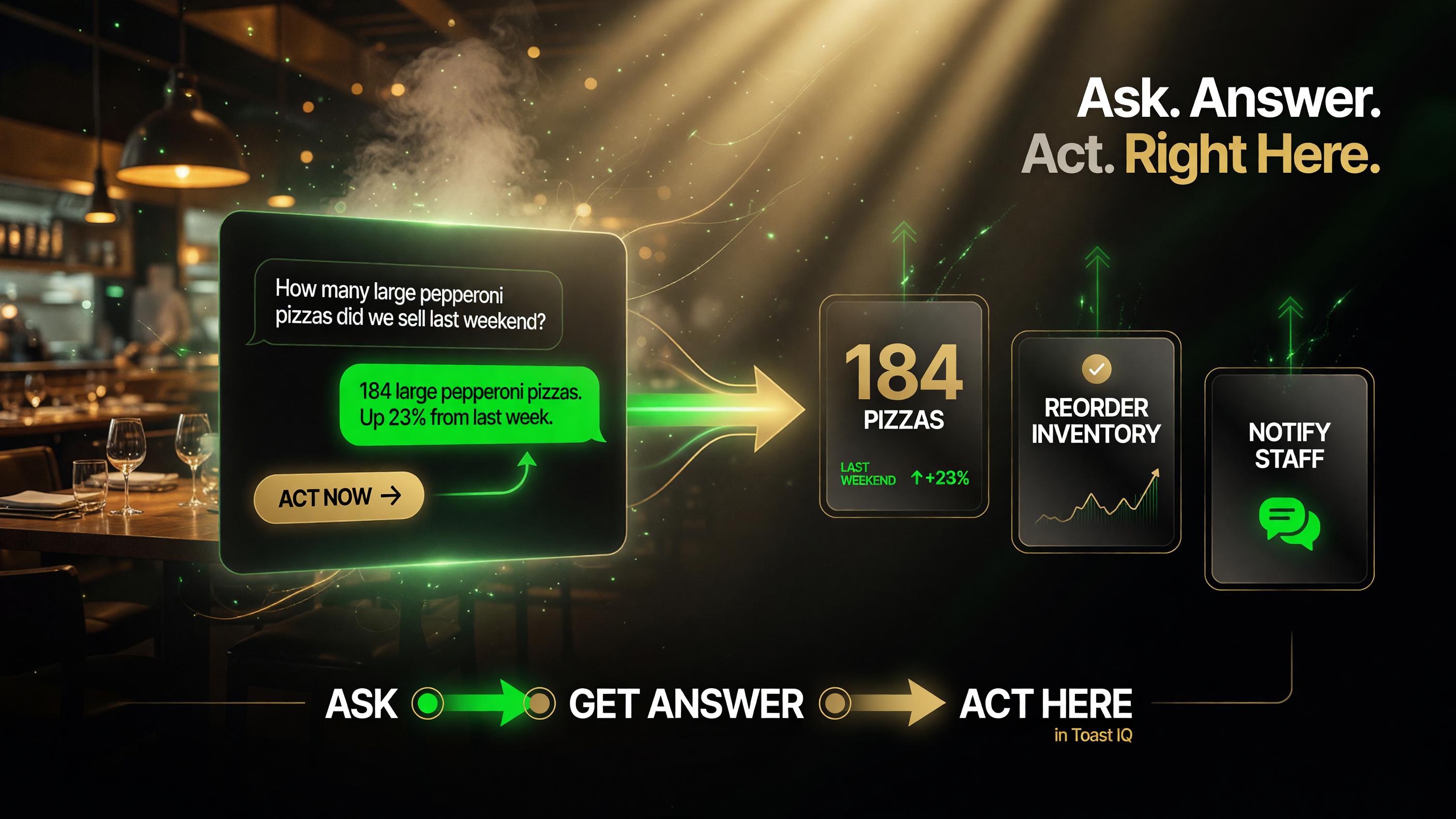
Toast IQ does not stop at the answer — you take action directly in the conversation, reordering inventory or notifying staff on the spot instead of switching to another report or tool.
3. Proactive “For You” Insights
Toast IQ does not wait for you to ask. It surfaces a personalized feed of timely insights — flagging trends, opportunities, or local market factors — so you spot problems or chances before they become apparent on their own. For a busy operator who never gets to the reports, that proactivity is often where the real value hides.
What Data Can You Ask About?
One of the most useful things about Toast IQ is how wide the net is. It is not limited to sales. You can query across nearly every part of your operation, which means the assistant replaces a whole folder of separate reports:
- Sales and revenue — daily, weekly, period-over-period changes.
- Labor — which shifts or employees drive the highest labor cost.
- Menu performance — what is selling, what is dragging, how a new item compares.
- Guest trends — patterns in who is coming in and when.
- Discounts, voids, and upsells — where margin is leaking or being recovered.
- Inventory — usage, stock, and how it tracks against sales.
- Marketing campaigns — performance and drafting for the next push.
That breadth matters because the questions owners actually have rarely stay inside one clean category. “Is my new happy hour actually making money?” cuts across menu, labor, and sales. Toast IQ handles the cross-cutting questions instead of forcing you to stitch together three reports yourself.
Availability, Price, and Adoption
Toast IQ’s conversational assistant launched on October 29, 2025, expanding on Smart features that debuted in spring 2025. It became available immediately to all US customers at no extra cost, through the Toast Now mobile app (iOS and Android) and Toast Web. It remains included with Toast POS.
The adoption numbers are the strongest signal that this is not a feature restaurant owners are ignoring. By Q1 2026, Toast reported 40,000+ weekly active users and more than 21 million conversation threads. Sales and revenue queries were the most common use, at roughly 47% of conversations — which makes sense: that is the number every operator cares about most.
| Capability | What It Lets You Do | Example |
|---|---|---|
| Sales & revenue Q&A | Ask about performance in plain English | “What changed in sales this week?” |
| Labor analysis | Spot the shifts costing you the most | “Which shifts drive the highest labor cost?” |
| Menu actions | Update items or prices with confirmation | “86 the salmon” |
| Inventory | Track usage against sales | “How much chicken did we use this month?” |
| Marketing drafts | Create email/SMS campaigns | “Draft a holiday promo email” |
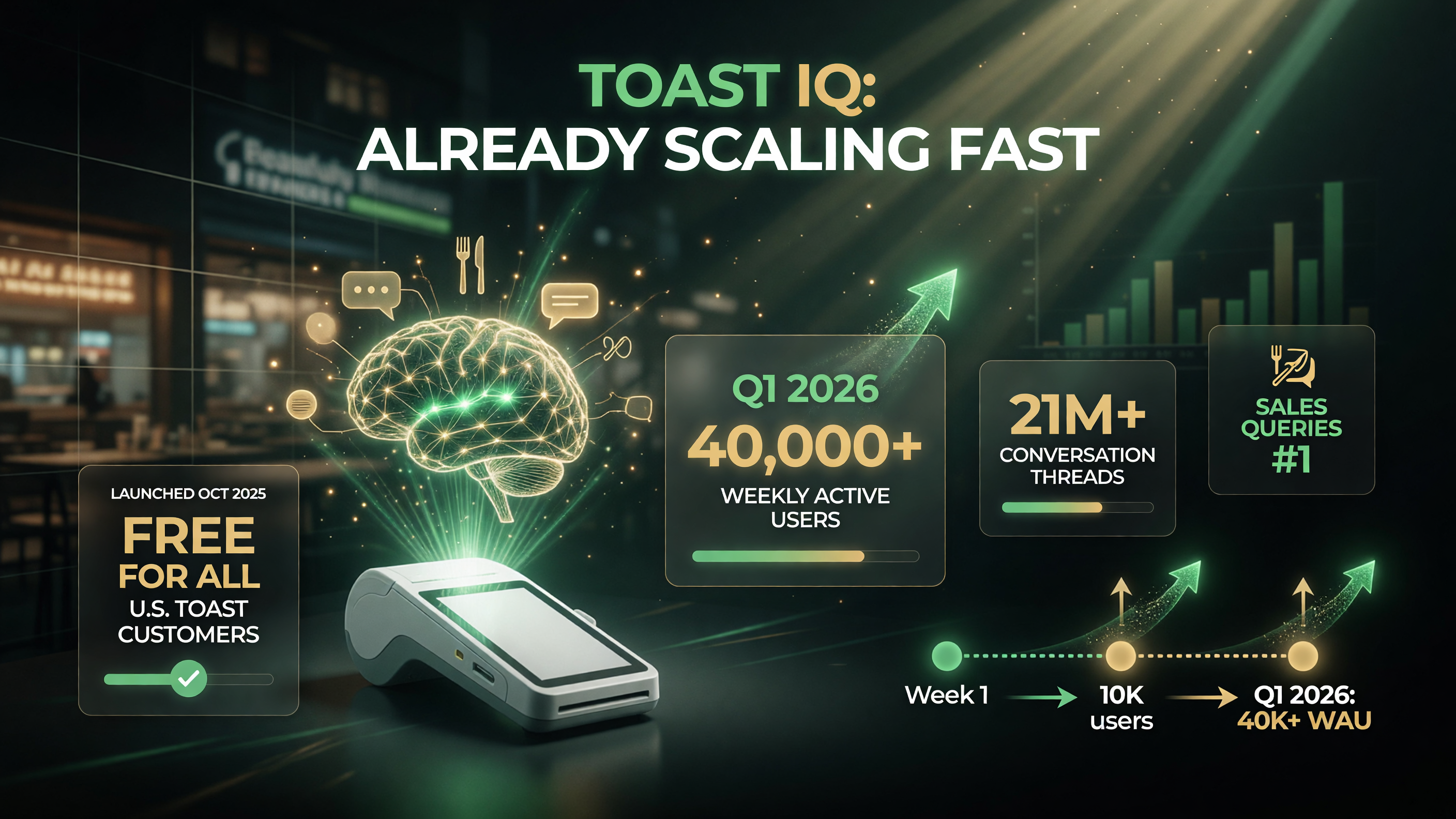
Toast IQ scaled fast after its October 2025 launch — by Q1 2026 it had 40,000+ weekly active users and more than 21 million conversation threads, with sales queries the most common use.
Toast IQ vs. Generic AI Assistants
You may be thinking, “Can’t I just ask ChatGPT about my restaurant?” The honest answer is that generic AI does not have access to your sales, labor, menu, or inventory data. Here is the side-by-side that matters for an operator:
| Factor | Toast IQ | Generic AI Assistant (e.g. ChatGPT) |
|---|---|---|
| Access to your live POS data | Yes — reads your real Toast data | No — no access to your numbers |
| Restaurant-specific language | Yes — understands menu/shift shorthand | Generic, not hospitality-tuned |
| Takes actions (86 item, edit shift) | Yes, with confirmation | No — you do it manually |
| Benchmark comparison | Yes — vs. Toast network | No |
| Cost | Free with Toast POS | Subscription / per-use |
| Proactive insights | Yes — “For You” feed | No — you must prompt it |
The distinction is simple: a generic assistant can tell you how restaurants work in theory. Toast IQ can tell you how your restaurant is working right now, and then help you change it. That is a completely different tool.
Who Should Use It
There is also a staff-training angle worth noting. A new shift manager nervous about handling late-night voids or inventory questions can ask Toast IQ instead of paging the owner. It hands newer team members a safety net that answers the questions they are too embarrassed to ask, which means fewer mistakes during service and less interruption for the operator. Over a busy week, that compounds into real hours saved — and fewer late phone calls about things that could have been resolved in the app.
One more note for owners comparing options: Toast IQ is not an add-on you pay for line-item by line-item. Because it ships inside the platform and reads the sales, labor, menu, inventory, and guest data you already produce, it removes both the monthly subscription and the setup work a separate analytics tool would require. For a small independent restaurant, the math is refreshingly simple: the capability is already there, so the only cost is the five minutes it takes to ask your first question.
Toast IQ is not a separate product you shop for — if you are on Toast POS in the US, it is already on your phone and in your web dashboard, and it costs nothing extra. That lowers the barrier to zero, which is exactly why the adoption numbers took off.
- Owners who skip the reports will get the most out of the proactive “For You” feed, because it surfaces the insight without demanding their time to go hunting.
- Multi-unit operators can ask the same question across locations and get a consolidated picture instead of opening each store’s dashboard separately.
- Managers on the floor can handle menu and shift changes in seconds during service, without leaving the POS to log into a back-office tool.
The Independent Operator’s Reality Check
As with any AI that touches operations, there are things to watch. Let me give you the honest picture before you lean on it heavily.
Double-check anything that changes your menu or pricing. The action-taking is powerful, but “86 the salmon” or “raise the wings by a dollar” affects what your guests see and what your kitchen cooks. Toast requires confirmation before these actions run — use that confirmation as a real check, not a reflex tap. Verify the change landed correctly before service gets busy.
Benchmarks are useful, not gospel. Being compared to a 148,000-location network tells you where you sit, but your local market, your menu concept, and your crowd are specific to you. Use benchmarks for context, not as a scoreboard you must match.
Start with questions before actions. The safest way to build trust in the assistant is to spend your first week just asking questions — sales, labor, menu performance — and verifying the answers against reports you already trust. Once you see it getting the data right, graduate to using the action features.
None of this is a reason to avoid Toast IQ; it’s already in your pocket and costs nothing. It is the standard discipline of trusting an AI assistant the way you’d trust a new manager — with your eyes on it until it earns your confidence.
The Bottom Line
Toast IQ is one of the most useful AI features a restaurant owner can get for $0, because it is embedded in the data you already produce and it acts on it instead of just talking about it. By early 2026 it had already become a habit for tens of thousands of operators — 40,000+ weekly active users asking over 21 million questions — and nearly half of those questions are about the number that matters most: sales.
If you run a Toast restaurant in the US and have not opened it yet, that is the fastest free upgrade you are leaving on the table. Open the app, ask it one question about last week’s sales, and see what the answer teaches you about your own operation.
Frequently Asked Questions
What is Toast IQ?
Toast IQ is Toast’s built-in conversational AI assistant for restaurant operators. It answers plain-English questions about your sales, labor, menu performance, inventory, and marketing data, and lets you take actions like updating menu prices or marking items out of stock directly in the chat.
Is Toast IQ free?
Yes. The Toast IQ conversational assistant launched October 29, 2025 and is included at no extra cost for US Toast customers through the Toast Now app (iOS and Android) and Toast Web.
What questions can I ask Toast IQ?
You can ask about sales, labor, menu performance, guest trends, discounts, voids, upsells, inventory, and marketing campaigns — for example, “What changed in sales this week?” or “Which shifts are driving the highest labor cost?”
Can Toast IQ take actions on my restaurant?
Yes. Toast IQ can complete tasks with confirmation, such as updating menu items or pricing, marking items out of stock, 86’ing ingredients, editing shifts, or drafting marketing campaigns for email or SMS.
How many restaurants use Toast IQ?
By Q1 2026, Toast IQ had 40,000+ weekly active users and over 21 million conversation threads. Sales and revenue queries were the most common use, at roughly 47% of conversations.

About Barak Schurr
Barak Schurr built and exited a major ticketing platform, ran global operations at Eventbrite, and now focuses on one question: which AI tools actually help independent restaurant owners run leaner and grow faster. He writes from the operator’s perspective — no vendor spin, no theory, just what’s real in 2026.
Email: [email protected]
More Resources for Restaurant Operators