Get the AI Restaurant Quick-Start Guide — Free
The 5 AI tools independent US restaurant owners are using right now to cut labor costs and answer every call.
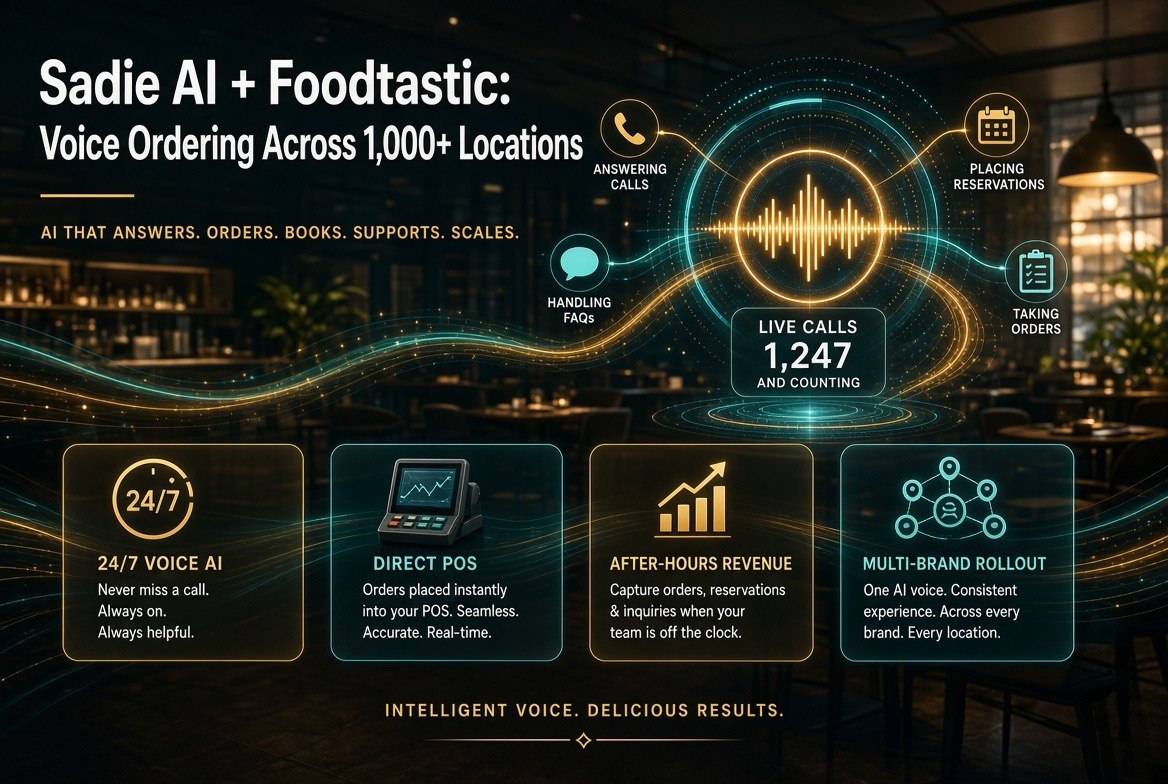
Sadie AI + Foodtastic: Voice Ordering Across 1,000+ Locations
Quick answer: A 1,200-location restaurant group just bet big on voice AI, and independent owners should pay attention. Foodtastic — a major Canadian franchisor running 27 restaurant banners including Milestones, Second Cup, and Freshii — named Sadie AI its preferred Voice AI partner on March 2, 2026. Sadie answers inbound calls 24/7: it takes reservations, handles takeout and delivery orders straight into the POS, answers guest questions, and covers after-hours calls so nothing goes unanswered. The model matters for independents because it shows voice AI as a real revenue driver — Sadie cites roughly $6,500 per month per location in incremental gains — not just a cost-cutting novelty.
Every restaurant owner knows the two missed-call problems. The phone rings during a rush and nobody picks up. Or it rings at 2 a.m. and the answering machine eats a takeout order that would have gone to a competitor in the morning. Phone orders are real money, and they have historically been the hardest revenue stream to capture — you cannot schedule staff to answer every call at every hour without wrecking your labor budget.
Voice AI is the answer the industry has been circling for years, and it just got one of its biggest real-world validations. On March 2, 2026, Montreal-based Foodtastic — which operates more than 1,200 locations across 27 restaurant banners with roughly $1 billion in sales — named Sadie AI its preferred Voice AI partner across the entire network. The move is significant not because Foodtastic is a household name, but because it shows a large, sophisticated restaurant operator choosing voice AI as a core infrastructure decision rather than a pilot test.
What Foodtastic Chose Sadie AI to Do
Foodtastic is not using Sadie for a single gimmick. The platform is being deployed to handle the full volume of inbound phone traffic across participating brands, in four distinct jobs:
- Reservations — table bookings handled by the voice assistant.
- Takeout and delivery ordering — with direct POS integration so orders flow straight into the restaurant’s system.
- Guest FAQs and inquiries — hours, location, menu, wait times, and common questions answered instantly.
- After-hours support — calls that used to go to voicemail now get answered and actioned around the clock.
The core promise is simple: no call goes unanswered. A voice AI that can take a reservation, place a takeout order into your POS, and answer a guest’s question at 11 p.m. is not replacing the phone — it is finally making the phone work for the restaurant instead of against it.
The Rollout Timeline Shows a Careful, Methodical Approach
Foodtastic did not flip a switch across 1,200 stores overnight. The rollout reads like a textbook for how a large operator should adopt voice AI:
- Fall 2025 — a successful pilot at the Milestones brand proved the platform in a live full-service environment.
- February 2026 — launch began at Milestones locations.
- Q1 2026 — broader rollout across participating full-service brands.
- Ongoing — expansion to other banners, including casual and quick-service concepts like Second Cup and Freshii, will follow over time.
That staged approach — pilot one brand, prove it, then expand — is exactly the playbook an independent owner or a small multi-unit operator should copy. You do not need to bet the whole business on one technology; you test it where it can prove value, measure the results, then scale what works.
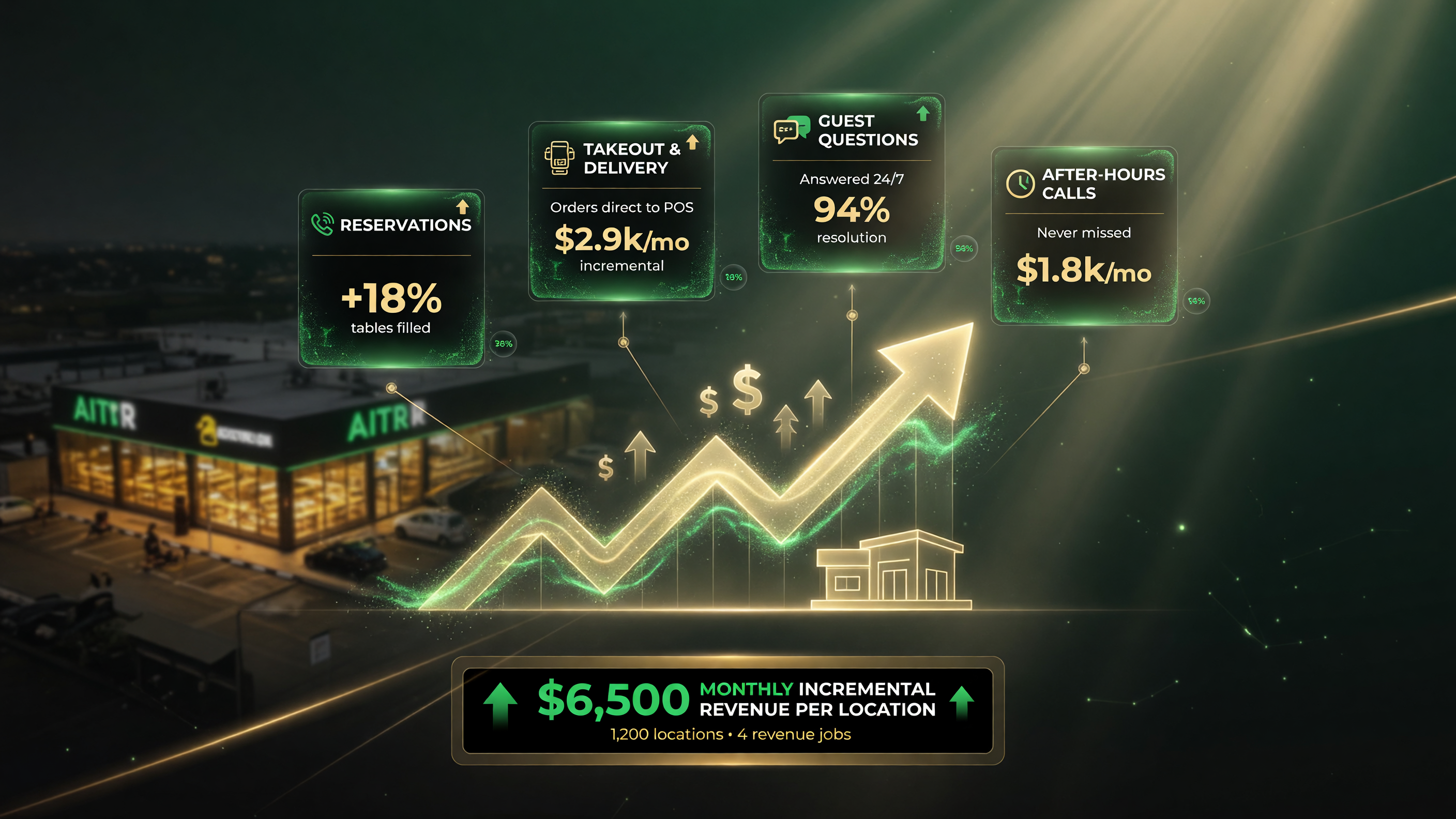
Sadie is deployed across participating brands in four jobs: reservations, takeout and delivery orders direct to the POS, answering guest questions, and covering after-hours calls. The model treats voice AI as a revenue driver, not just a cost saver.
How Sadie AI Drives Revenue, Not Just Answer Rates
The most useful number in this story for a working owner is the revenue figure. Sadie reports roughly $6,500 per month per location in incremental gains in certain metrics, with particularly strong impact from after-hours calls. That flips the usual conversation about AI in restaurants.
Too often, restaurant tech is framed as a cost saver — spend money on AI to shave labor or reduce waste. Voice AI is different because it works on the revenue side. A missed takeout order after hours is not an expense to trim; it is income that was never captured. When an AI answers that call, takes the order, and drops it into your POS, the restaurant earns money it would otherwise have lost to competitors. For operations with thin margins and high fixed labor costs, that distinction between saving money and making money is the whole ballgame.
| Phone Ordering Approach | Legacy: Human-Only Phones | With Voice AI (Sadie) |
|---|---|---|
| Coverage | Only during staffed hours; busy shifts = missed calls | 24/7, including after-hours when no staff can answer |
| Order capture | Staff writes it down; risk of error and dropped calls | Placed directly into POS; fewer errors, no dropped calls |
| Reservations & FAQs | Consumes staff time during the rush | Handled instantly, freeing staff for guests in front of them |
| After-hours revenue | Lost to voicemail and competitors | Captured — a real incremental income stream |
| Revenue impact | Capped by staffing and hours | Reported ~$6,500/mo/location incremental in some metrics |
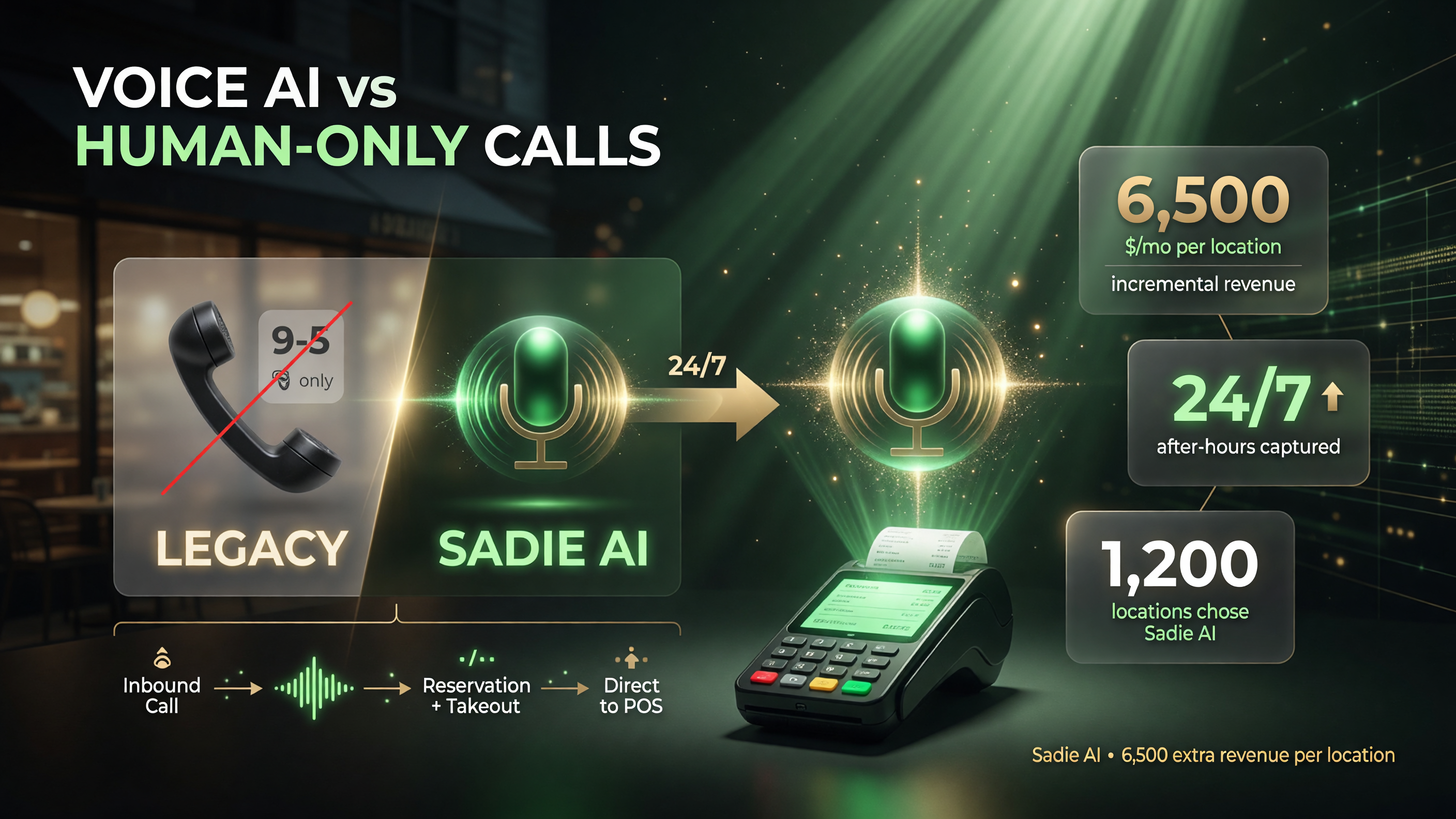
A 1,200-location restaurant group named Sadie AI its preferred voice AI partner. Compared with legacy human-only phones, Sadie answers inbound calls 24/7 and places reservations and takeout orders straight into the POS, capturing roughly $6,500 per month per location in incremental revenue.
Why a Multi-Location Voice AI Platform Matters to Independents
You might be thinking: Foodtastic runs 27 banners and a billion in sales — what does that have to do with my single restaurant? The answer is that the economics of voice AI do not require a giant network to work. The same value proposition — capture after-hours calls, place orders into the POS, answer FAQs without using staff time — applies to a one-unit independent almost identically.
The difference for an independent is priority. A large group adopts voice AI to standardize phone behavior across that many locations. An independent adopts it to stop losing the specific orders and reservations that walk out the door every week because the phone was not answered. Both are chasing the same thing: phone calls converting to revenue instead of competitors.
Voice AI also carries a consistency advantage that scales down as much as up. A well-configured voice assistant answers every call the same way — the same greeting, the same order accuracy, the same courtesy — regardless of how busy the kitchen is or whether the owner is on shift. That consistency is something even a great human staff cannot guarantee during a Friday-night rush.
How Voice AI Compares to Other Ordering Channels
To decide whether voice AI belongs in your mix, it helps to see it against the ordering channels you likely already offer.
| Channel | What It Captures | Cost / Friction |
|---|---|---|
| Phone (human) | Reservations, takeout, questions — only when staffed | Ties up staff; misses after-hours and busy-period calls |
| Online ordering | Takeout/delivery — 24/7 but requires the guest to visit your site | Relies on guest behavior; often pays app commissions |
| Third-party delivery apps | Discovery + ordering for new customers | High commissions eat margin; little data control |
| Voice AI (Sadie) | Phone orders + reservations 24/7, straight to POS | Low marginal cost per call; no commission on orders it captures |
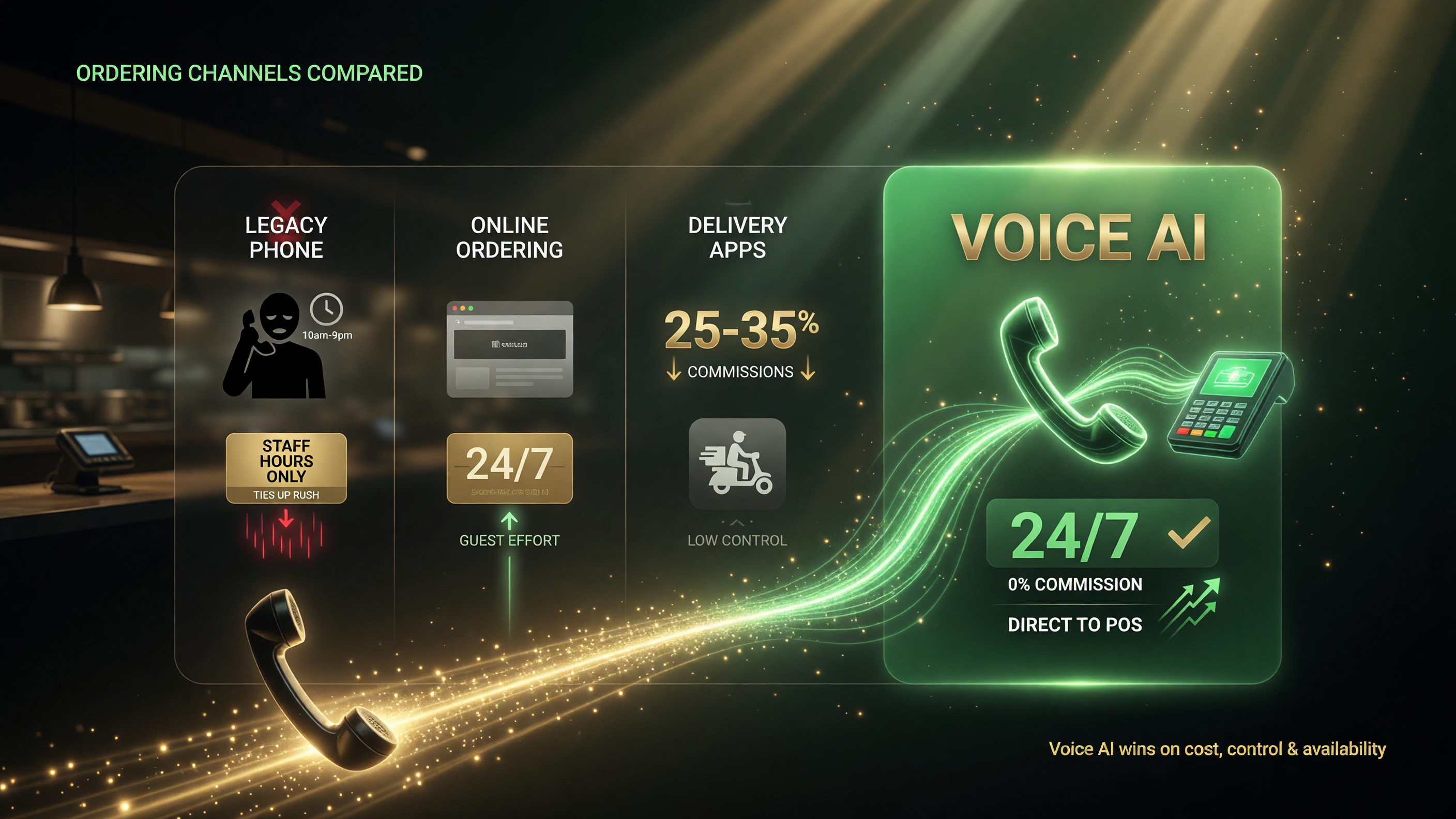
Voice AI wins on cost, control, and availability versus the other ordering channels: phones only capture calls while staffed, online ordering depends on the guest visiting your site and often pays app commissions, and third-party apps take a cut with little data control — while voice AI answers 24/7 straight into the POS.
Why a Canadian Deal Is a Signal for US Independent Owners
Foodtastic is a Canadian franchisor, and it is fair to ask whether a deal across the border tells you anything about your US restaurant. It does, for three reasons.
Voice AI is not geography-bound. The technology Sadie deploys — answering phones, understanding a takeout order, dropping it into the POS, handling a reservation — works identically in Miami, Denver, or Toronto. There is nothing about voice ordering that is uniquely Canadian. When a sophisticated operator proves the model works at scale in one market, that proof travels. US managers have already seen this with drive-thru voice AI from companies like those rolling out across American QSRs, and the mainstream-traps set in the same way.
Franchise economics translate directly. Foodtastic runs 1,200+ locations across 27 banners, including full-service (Milestones), casual, and quick-service concepts (Second Cup, Freshii). That breadth matters because it demonstrates voice AI is useful in very different service models, not just one format. An independent full-service restaurant and a quick-service counter face the same missed-call problem and the same after-hours revenue leak. What works for a multi-concept group is a strong indicator it will work for a single concept, too.
It signals where the restaurant-technology market is heading. When a billion-dollar operator standardizes on voice AI as core infrastructure, it tells every other vendor and investor that phone automation is a mainstream priority, not an experiment. That drives more competition, better pricing, and faster feature development — all of which eventually benefits the independent owner who adopts earlier rather than later.
The Operational Realities: What Adoption Actually Looks Like
It is also worth being honest about what deploying voice AI in a real restaurant involves, because the marketing rarely covers the friction. Three operational realities matter if you are going to follow Foodtastic’s lead.
First, setup is not plug-and-play. A voice assistant needs to understand your menu — every item, modifier, pronunciation, and exception. That means an onboarding period where the system is trained on your actual operations, not a generic restaurant template. Budget for that configuration time and for a rough first weeks while the AI settles in.
Second, POS integration quality decides the outcome. The whole revenue argument collapses if orders flow back into your system only loosely. The Foodtastic-Sadie value is built on orders entering the POS directly, which eliminates re-keying and the errors that come with it. When you evaluate any voice AI provider, make integration depth the first question, not an afterthought — and note that Sadie separately announced a February 2026 integration with Payfacto covering hospitality POS systems like Maître’D, showing how seriously the platform treats this layer.
Third, staff buy-in determines real-world success. The kitchen and front-of-house team has to trust the orders coming through. If staff see voice AI as a competitor to be ignored or questioned, the system will not deliver its potential. The best rollouts frame voice AI as a relief valve — it takes the calls that pulled staff off the floor during a rush — and track the revenue it captures so the team can see it working, not just take management’s word for it.
What Voice AI Means for Your Restaurant’s Phone Strategy
If you are watching the Foodtastic-Sadie rollout and wondering whether to move, here is a practical way to think about it. For operators exploring the practical side of restaurant AI, the restaurant AI coverage on this site lays out the broader tool landscape; voice ordering is one of the fastest-payback areas. A few principles to guide you:
- Start with the missed-call problem, not the technology. Before you research tools, know what your phone is currently costing you. How many takeout orders and reservations are you losing because nobody picked up? That number is your budget ceiling and your ROI target.
- Make sure it connects to your POS. A voice AI that takes an order verbally but does not feed your POS still creates re-entry work and error risk. The Foodtastic value is built on direct POS integration — insist on it, whether you choose Sadie or another provider.
- Pilot before you expand. Follow Foodtastic’s own playbook: run it on one location or one shift, measure the captured revenue, then scale what proves itself. You do not need to bet the whole business on day one.
- Keep a human escape hatch. Voice AI should handle routine calls and after-hours volume, but a guest who genuinely needs a person should reach one. The best implementations route intelligently between AI and staff rather than forcing every caller through a bot.
The direction is clear. Voice AI is moving from a novelty to a standard piece of restaurant phone infrastructure, and the Foodtastic deal is one of the clearest signs yet that large, sophisticated operators treat it as such. The good news for independents is that the same capability — and the same revenue logic — is available at your scale.
Frequently Asked Questions
What is the Foodtastic-Sadie AI partnership?
Foodtastic, a Canadian franchisor operating 1,200+ locations across 27 restaurant banners, named Sadie AI its preferred Voice AI partner on March 2, 2026. Sadie handles inbound phone calls 24/7 — reservations, takeout/delivery ordering with POS integration, guest FAQs, and after-hours support — across participating brands including Milestones, Second Cup, and Freshii.
What does Sadie AI’s voice platform do for restaurants?
Sadie answers inbound calls around the clock, takes reservations, places takeout and delivery orders directly into the POS, answers guest questions, and covers after-hours calls. Its “Orders” tier supports full takeout ordering with POS injection, and it has produced reported incremental gains of roughly $6,500 per month per location in some metrics.
Is voice AI only for large multi-location groups?
No. The same economics that make voice AI valuable for a 1,200-location group apply to a single independent restaurant: capturing after-hours calls, placing orders into the POS, and answering FAQs without using staff time. Independents can pilot it on one shift and scale what proves itself.
How does voice AI make money vs save money?
Most restaurant AI is framed as a cost saver, but voice AI works on the revenue side. A missed takeout order after hours is income lost to competitors; voice AI captures that order and drops it into the POS. That is why the revenue impact can be measured in incremental income, not just reduced labor.
Should my restaurant adopt voice ordering AI?
If your phone currently loses takeout orders or reservations — after hours or during rushes — voice AI is worth a pilot. Prioritize a solution that connects directly to your POS to avoid re-entry work, and keep a human escape hatch so guests who need a person can reach one.

About Barak Schurr
Barak Schurr built and exited a major ticketing platform, ran global operations at Eventbrite, and now focuses on one question: which AI tools actually help independent restaurant owners run leaner and grow faster. He writes from the operator’s perspective — no vendor spin, no theory, just what’s real in 2026.
Email: [email protected]
More AI Resources for Your Business