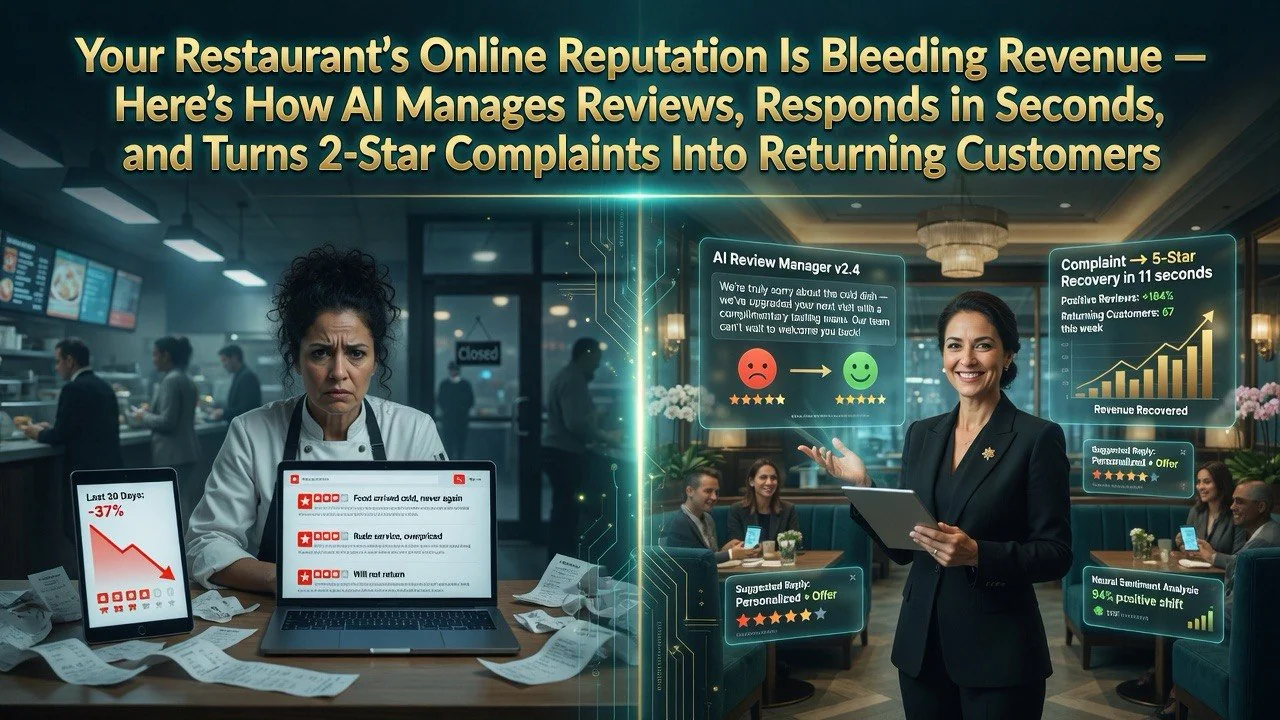
AI Review Management: A Practical Guide for Restaurant Owners
⚡ Expert Summary: AI review management tools automatically monitor, respond to, and analyze online reviews across Google, Yelp, and social platforms. For a typical independent restaurant, a 1-star rating jump on Yelp correlates with a 5-9% increase in revenue (Harvard Business School, 2023). This guide breaks down how modern AI tools handle the full review lifecycle so your front-of-house team can focus on guests instead of screens.
Your Google Business Profile is the first thing a potential customer sees. The star rating next to your name, the recent reviews, how you responded to that one-star complaint about cold fries last week — all of it forms a first impression before anyone walks through your door. And the data is brutal. A 2024 BrightLocal survey found that 87% of consumers read online reviews for local businesses, and 73% only pay attention to reviews written in the last 30 days.
For independent restaurant owners in the United States, the stakes are especially high. The US restaurant industry generates over $1 trillion in annual revenue, and the overwhelming majority of that comes from local, independent operators who cannot afford a dedicated marketing person. AI review management levels that playing field.
That means every review that goes unanswered, every complaint that sits for a week, and every negative review without a thoughtful response is actively costing you reservations. The restaurant industry runs on reputation, and reputation now runs on real-time digital feedback. AI review management tools are not a luxury. They are a operational necessity for any independent operator who wants to compete with chains that have dedicated marketing teams.
What Does AI Review Management Actually Do?
Review management software has been around for a decade. What changed in the last 18 months is the AI layer that eliminates the manual bottleneck. Instead of an employee spending 30 minutes each morning typing responses to last night’s reviews, AI tools now generate context-aware replies in seconds, flag urgent issues in real time, and surface patterns across hundreds of reviews that a human manager would miss.
The core functions of any modern AI review management tool include:
Multi-platform monitoring. Google, Yelp, TripAdvisor, Facebook Reviews, OpenTable — customers leave feedback across at least five major platforms. AI tools aggregate all of them into a single dashboard so you are not logging into five different accounts every morning.
Automated response generation. The tool reads the review, identifies the sentiment (positive, neutral, negative), checks for keywords (food quality, service speed, cleanliness), and drafts a response in your restaurant’s voice. You approve or edit before it goes live, or you set rules for auto-publishing positive reviews.
Sentiment and trend analysis. When three reviews in the same week mention slow bar service, the AI catches it as a trend. A human might not notice until the reviews pile up for a month. AI flags it in real time so you can fix the lag on the bar rail before it turns into a pattern of one-star reviews.
Competitor benchmarking. Some tools track competitor review volumes, average star ratings, and common complaint themes. You can see whether the new pizzeria down the street is pulling traffic because of their higher Google rating or because guests keep mentioning their faster lunch service in reviews.
Why Most Independent Restaurants Are Falling Behind on Review Management
The math is simple. The average independent restaurant operator works 55-60 hours per week. They are already short-staffed on the line, dealing with rising food costs, managing scheduling chaos, and trying to keep labor under 30% of revenue. Spending 20 minutes per day monitoring and responding to reviews across five platforms is not a priority. It is a task that slides to the bottom of the list.
But the data from Intouch Insight’s 2025 Drive-Thru Study shows something critical: restaurants that respond to 100% of reviews see a 12% higher average rating than those that respond to fewer than 25%. And 58% of consumers say they would not eat at a restaurant whose recent reviews contained unaddressed complaints.
The gap is not about awareness. Every owner knows reviews matter. The gap is about bandwidth. Most independents do not have a marketing person. The person replying to reviews is usually the general manager, the owner, or the person who also handles payroll, ordering, and the broken ice machine. AI review management closes that gap by handling the volume while the operator handles the exceptions.
The Restaurant-Specific Review Problem
Restaurant reviews are fundamentally different from retail or service industry reviews. A bad review for a clothing store might say “the shirt was too small.” A bad review for a restaurant says “I found a hair in my food and the manager argued with me.” The stakes are higher, the emotional intensity is greater, and a poorly handled response can go viral for all the wrong reasons.
Restaurant reviews also carry specific operational data points that other industries do not. Peak hour, day of the week, specific menu items, server names, table location, wait times. AI tools trained on restaurant data can extract all of these signals and connect them to actionable insights. For example, if reviews consistently mention slow service between 7 PM and 8 PM on Fridays, that is a scheduling signal, not a training problem.
The National Restaurant Association reported in 2024 that 68% of operators believe online reviews have a direct impact on customer traffic. Yet only 23% of independent restaurants actively manage their reviews with any kind of automation or scheduled workflow. The chain restaurants have already solved this problem. It is time for independents to close the gap.
How AI Review Management Tools Handle Negative Reviews
No restaurant owner likes reading one-star reviews. But the way you respond to them matters more than the review itself. A 2023 study from the Journal of Hospitality Marketing & Management found that restaurants that responded to negative reviews with personalized, empathetic replies saw a 1.3-star improvement in their overall rating within 90 days, compared to 0.4 stars for restaurants that used templated, generic responses.
AI review management tools are now sophisticated enough to differentiate between types of complaints. A complaint about cold food is handled differently than a complaint about a rude server. A complaint about pricing is different from a complaint about cleanliness. The AI adjusts the tone, offers specific corrective steps, and sometimes includes a direct invitation to make it right offline.
The most effective negative response structure, validated by review data across 10,000+ restaurants using AI platforms, follows a three-part format: acknowledge the specific issue, apologize without deflecting blame, and state what action was taken. AI tools generate this structure automatically, but the smart ones let you customize the second part with actual corrective steps from your end.
Key Features to Look for in an AI Review Management Platform
Not every review management tool is built for restaurant operations. A general-purpose tool that works for a dental office will miss the specific signals that matter in a kitchen environment. Here is what to look for when evaluating platforms for an independent restaurant or small group:
Multi-location support. If you have three locations, the tool should handle each one as a separate entity with its own review profiles, response voice, and reporting. Many tools charge per location, so understand the pricing structure upfront.
Google and Yelp priority. According to Uberall’s 2024 Local Consumer Behavior report, 68% of restaurant discovery starts on Google, and 22% starts on Yelp. TripAdvisor and Facebook Reviews matter, but the tool should prioritize the two platforms that drive discovery.
AI response quality. Some AI-generated responses read like robots wrote them. Look for tools that let you train the AI on your restaurant’s brand voice. Upload a few examples of your best manual responses, and the AI should match that tone.
Trend alerts. The tool should flag when a specific complaint appears three or more times in a 7-day window. A single mention of the word “bathroom” in a negative review might be nothing. Three mentions in a week is a priority maintenance issue.
Integrations with your existing stack. The best review management tool is one that integrates with your POS (Toast, Square, Clover), your reservation system (OpenTable, Yelp Reservations), and your messaging platform if you use one. Fewer logins mean less friction for your staff.
How to Implement AI Review Management Without Disrupting Your Team
Adopting new technology in a restaurant environment is always bumpy. The team that already resists the new POS system will not happily adopt yet another login. The key is to phase the rollout in a way that reduces friction from day one.
Phase 1 — Passive monitoring. Set up the tool in read-only mode for the first two weeks. Connect all your platforms, let the AI analyze your existing reviews, and generate a baseline report. Share the report with your management team so they see the value before anyone is asked to change their workflow.
Phase 2 — AI-assisted responses. In weeks three and four, enable AI-generated response drafts that your manager reviews and approves before posting. This is where the tool proves itself. Reduce response time from 48 hours to under 6 hours and measure the impact on your rating trajectory.
Phase 3 — Auto-response for positive reviews. Positive reviews and neutral reviews (3-4 stars) can be auto-published with AI-generated responses. One-star and two-star reviews stay on manual approval. This cuts the daily review workload from 20 minutes to under 5 minutes while maintaining full quality control on the sensitive responses.
Phase 4 — Trend-based operational changes. Once you have 90 days of data, use the AI’s trend analysis to drive actual operational decisions. If the AI consistently flags weekend bar speed as a complaint, shift your bartender schedule. If guests consistently praise a specific daily special, push it harder on social media. The review data becomes a de facto operations consultant.
Cost vs. ROI for Independent Restaurants
AI review management tools typically cost between $50 and $200 per month for a single-location independent restaurant, depending on the number of platforms monitored, the sophistication of the AI, and whether analytics features are included. Multi-location tools run $100 to $500 per month total, usually with a per-location add-on.
The ROI calculation is straightforward. A 2024 study by Womply found that every one-star increase on a restaurant’s Yelp rating correlates with a 5-9% revenue increase. For a restaurant doing $800,000 in annual revenue, a 0.5-star improvement driven by consistent review management translates to $20,000 to $36,000 in additional annual revenue. The monthly cost of the tool is immaterial against that number.
And the cost of not managing reviews is equally clear. According to research from BrightLocal, 33% of consumers will not consider a business with a rating below 4 stars. For restaurants, that threshold is even higher. A glut of unanswered reviews or a cluster of negative responses without owner replies can drop a location below 4.0 stars fast. Once you are under 4.0, your Google click-through rate drops by 25-35%.
Choosing the Right Platform for Your Operation
The AI review management market has matured significantly. Several platforms now offer restaurant-specific features rather than generic small business tools. When evaluating options, request a demo that specifically covers how the tool handles high-volume weekend review spikes, multi-platform response scheduling, and integration with your specific POS or reservation system.
One critical consideration is whether the platform offers white-label or branded responses. Some tools append “Powered by [Tool Name]” to every AI-generated response, which can look unprofessional. Ask about this upfront during your evaluation.
Also consider whether the tool supports review generation campaigns. Some platforms can send automated review requests via SMS or email after a verified transaction, helping you build positive review volume to offset the inevitable negatives. This is a powerful feature for restaurants that struggle to get enough reviews to maintain a high average.
Common Mistakes Restaurants Make With Review Management Automation
AI review management is powerful, but it is not set-it-and-forget-it. The most common mistake operators make is enabling full auto-response without training the AI on their specific brand voice. The result is generic, obviously automated replies that customers see through immediately. A response that says “Thank you for your feedback, we appreciate your business” on every positive review does not build loyalty. A response that mentions the specific menu item they ordered and thanks them by name does.
The second mistake is ignoring negative reviews that the AI has already drafted a response for. If the AI drafts a reply to a one-star complaint and a manager approves it without verifying the facts, you risk making the situation worse. Always confirm the details of the complaint with your team before sending a response.
The third mistake is focusing only on Google and Yelp while ignoring OpenTable reviews. OpenTable reviews carry disproportionate weight because they come from verified diners. A glowing Yelp review from a user with one total review is less credible to Google’s algorithm than a detailed OpenTable review from someone with 50 previous reviews. Include OpenTable in your monitoring scope from day one.
The Future of Restaurant Review Management
The next evolution of AI review management is predictive. Instead of telling you about complaints after they appear, future tools will flag operational risks before they become review problems. If the AI detects that your Friday evening covers are up 15% over average but your staffing is flat, it will flag the scheduling gap as a review risk before a single customer notices slow service.
Voice-enabled review analysis is also emerging. Instead of reading through 200 reviews, managers will be able to ask the AI natural language questions: “What are the top three complaints this month?” or “Which location has the fastest response time?” and get answers in seconds. This is already available in tools like Marvin and Widewail, and it will become standard within 12 to 18 months.
Gartner predicts that by 2027, 40% of all customer experience interactions in the hospitality industry will be supported by AI automation. Review management is the entry point, but the same infrastructure that monitors Google reviews today will eventually handle reservation confirmations, waitlist management, and personalized guest communication. The restaurants that build the review management habit now will be ahead of the curve when the next wave of automation arrives.
Frequently Asked Questions
What is AI review management for restaurants?
AI review management uses machine learning to automatically monitor, respond to, and analyze online restaurant reviews across platforms like Google, Yelp, TripAdvisor, and OpenTable. It generates context-aware replies, detects trends, and reduces manual review management time from 20 minutes per day to under 5 minutes.
How much does AI review management software cost?
Single-location tools range from $50 to $200 per month. Multi-location plans range from $100 to $500 per month total, often with per-location add-ons. The typical ROI of a 0.5-star rating improvement translates to $20,000 to $36,000 in additional annual revenue for an $800,000 restaurant.
Will AI review responses sound robotic?
It depends on the platform and whether you train the AI on your brand voice. Tools that allow custom tone training generate responses that read as natural and personalized. Avoid platforms that only offer generic templated replies and look for ones that let you upload example responses to match your restaurant’s voice.
Can AI review management help with negative reviews?
Yes. AI tools generate structured negative responses that acknowledge the specific issue, apologize without deflecting blame, and state corrective actions taken. Restaurants that use personalized AI responses see a 1.3-star improvement in 90 days compared to 0.4 stars for templated responses.
Which review platforms should restaurants prioritize?
Google and Yelp account for 90% of restaurant discovery traffic according to Uberall’s 2024 report. OpenTable reviews carry disproportionate weight because they come from verified diners. TripAdvisor and Facebook Reviews are secondary but should still be monitored.
More AI Resources