Get the AI Restaurant Quick-Start Guide — Free
The 5 AI tools independent US restaurant owners are using right now to cut labor costs and answer every call.
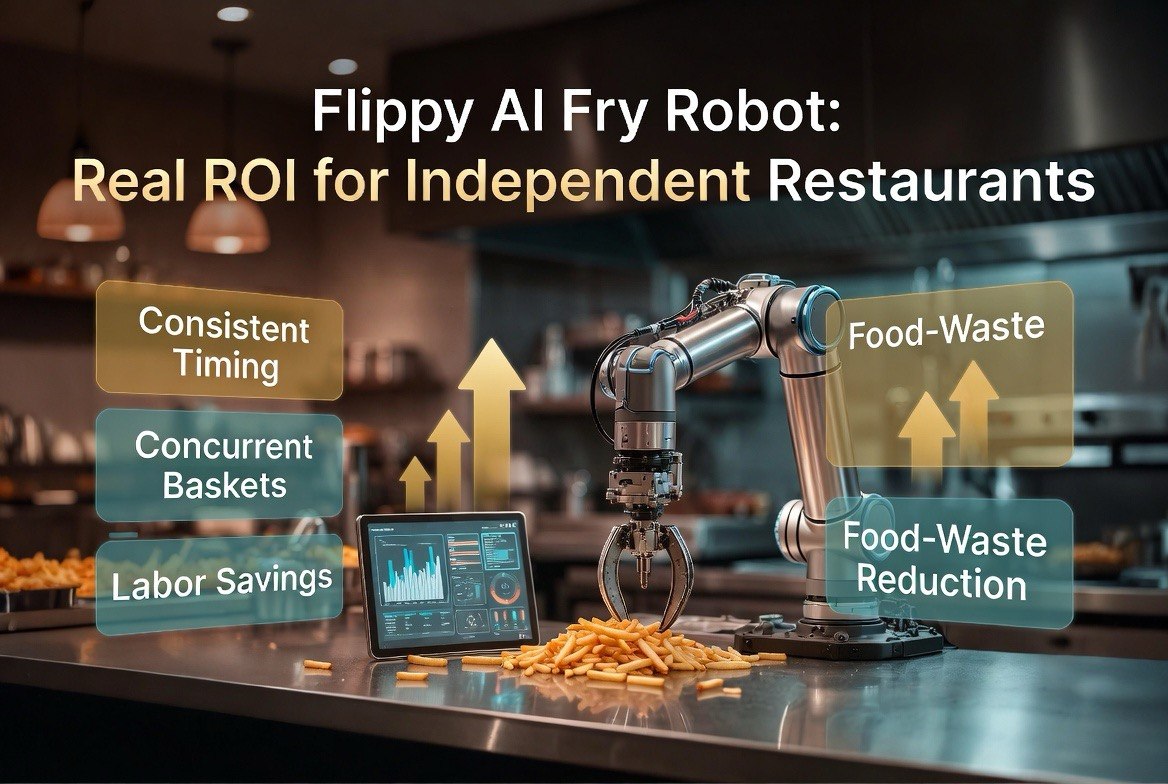
Flippy AI Fry Robot: Real ROI for Independent Restaurants
⚡ Expert Summary: Flippy by Miso Robotics is an AI-driven fry-station robot that rents for roughly $5,400 a month. It is built on millions of real baskets of fryer data, installs faster, and takes over the highest-turnover station in the kitchen. For an independent operator paying labor out of already-thin margins, the question is not whether the technology works — it is whether the monthly robot cost beats the true cost of a fry cook across a service.
Labor is the biggest line on most restaurant P&Ls, and the fry station is where that labor gets eaten alive. In a busy US kitchen, the fry station is nonstop — baskets dropping, oil timing, handoffs to the window. It is also one of the hardest positions to staff and one of the first to break down mid-service. That is exactly the job Miso Robotics built Flippy to take over, and the newest version is aimed less at the big chains and more at operators running one, two, or five locations.
This is not a demo-unit fantasy. Flippy’s AI was trained on millions of real baskets cooked across White Castle, Jack in the Box, and other deployments, then shipped back into a smaller, faster, easier-to-install robot. For a US independent operator, the real question is whether the numbers work when you put the robot next to the cost of a human shift after shift.
What Flippy Actually Does in the Kitchen
Flippy is not a general-purpose robot that wanders the kitchen. It is a purpose-built fry-station machine with a clear scope: it handles the cook cycle from raw to basket to tray so the human team can focus on plating, assembling, and the parts of service that actually need judgment.
Walk through a real order and the division of labor is obvious. A ticket comes in for fries and wings. The AI identifies the product, drops the right basket, sets the accurate cook time and temperature, and pulls it at the right moment. It does this across multiple baskets concurrently, keeping track of which product is in which position and when each one comes up. The kitchen team handles the seasoning, the plating, and the handoff — the fast, tactile work — while Flippy owns the repetitive, timing-sensitive frying.
That split matters because the fry station is where consistency dies. A human cook on a busy Friday drifts — 20 seconds here, 30 seconds there — and the product quality slides with the ticket times. A robot does not drift. Every basket gets the same time and temperature, which is what makes the ROI story possible in the first place: consistent output with fewer human hours tied to the fryer.
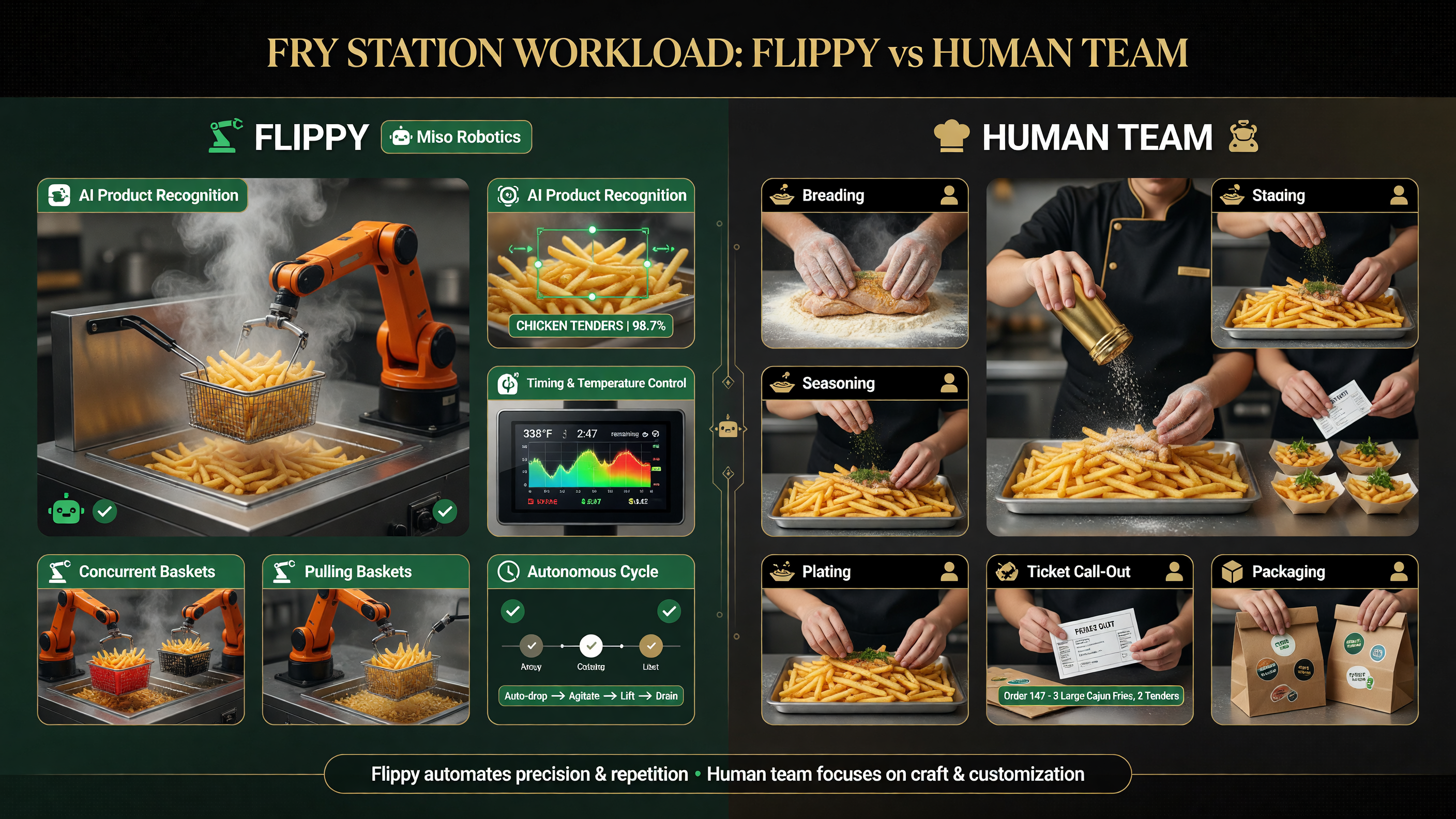
Flippy owns the precision work — product recognition, timing, temperature, concurrent baskets. The human team keeps the craft: breading, seasoning, plating, and ticket call-out.
The Real Cost Equation for Independent Operators
The headline number is a rental model around $5,400 a month, and that figure needs to be stress-tested against what an independent operator actually pays for fry-station labor, not against a chain’s cost structure.
| Cost Line | Typical Monthly Figure (US) |
|---|---|
| Fry cook wages (full-time, incl. taxes & benefits) | $3,200–$4,000 per cook |
| Overtime on busy shifts | $300–$900 |
| Hiring & training a new fry cook | $1,500–$3,000 (per hire) |
| Food waste from burned/undercooked baskets | $200–$600 |
| Flippy rental | ~$5,400 |
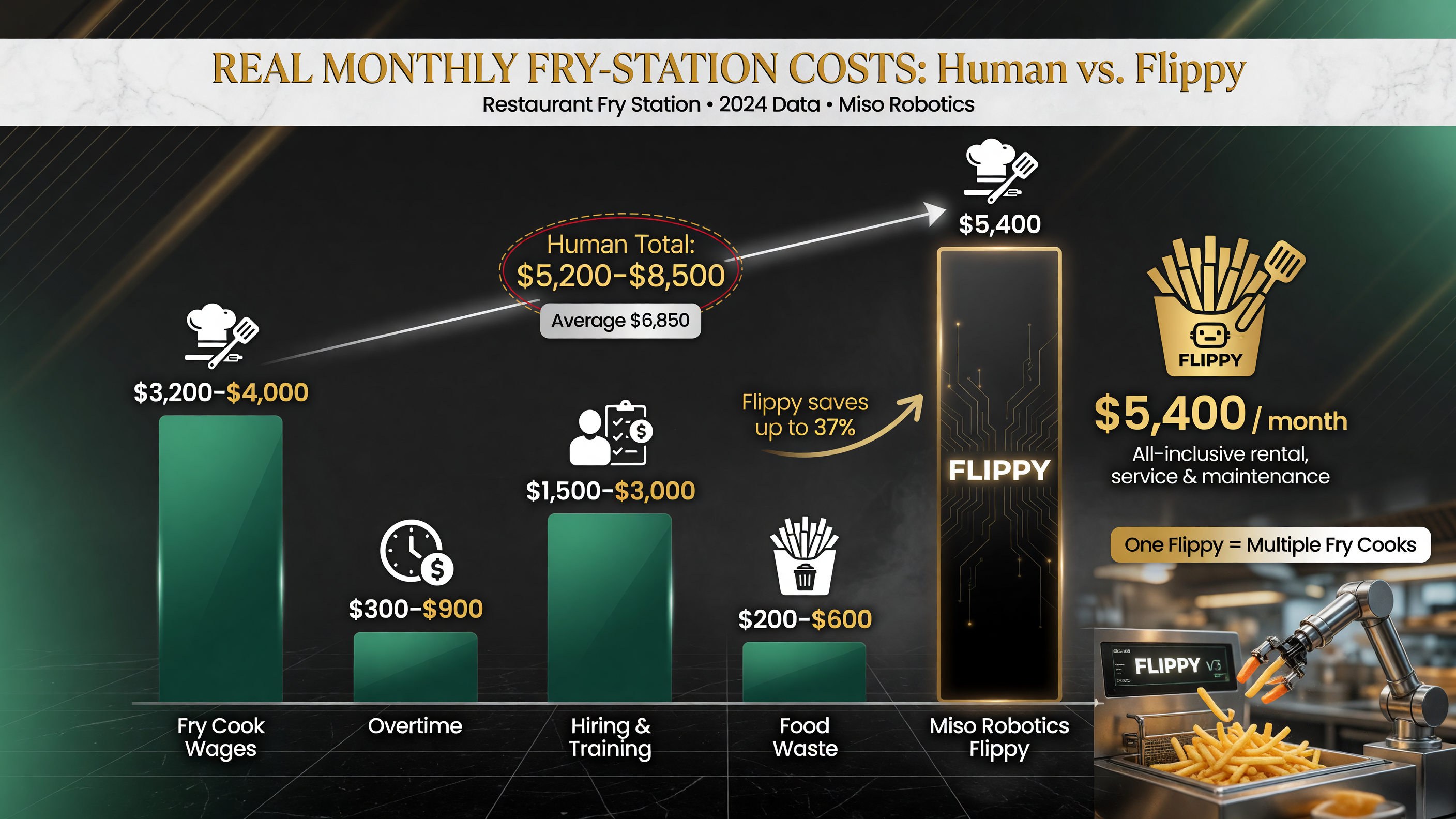
A full-time fry cook costs $3,200–$4,000 a month before overtime, hiring, and waste. Flippy’s $5,400 all-inclusive rental beats the real combined cost of covering that station in a high-volume kitchen.
Read that table honestly and the case is not a slam dunk for every kitchen. A single full-time fry cook costs less on paper than the robot’s rental. The margin math only flips when you add the hidden costs: the overtime on Friday and Saturday, the constant re-hiring and re-training cycle, the waste from inconsistent baskets, and the coverage gaps when a cook calls out in the middle of a rush.
Where Flippy wins is in throughput and time-to-payback on the labor it replaces across multiple shifts. A robot that covers the fryer for 12 to 14 hours a day replaces more than a single cook’s hours. It displaces the equivalent of one and a half to two shift positions at the fry station, which is where the $5,400 monthly rental starts to look defensive. Add the typical staffing reality in the United States — turnover and unfilled shifts, not ideal full staffing — and the robot becomes a hedge against the labor you cannot reliably hire.
Where Flippy Fits (and Where It Does Not)
It is tempting to read “kitchen robot” and picture it replacing your whole crew. That is not the pitch, and it is not how the ROI works. Flippy is a single-station specialist, and the operator who treats it as such gets the most out of it.
Strong fit for Flippy
- High-volume fry business — wings, fries, fried apps at peak
- Multiple fryers running concurrently and poorly staffed
- Shifts where overtime is routine because fry coverage is thin
- Consistency problems — a product spec the team cannot hold under pressure
Weak fit for Flippy
- Low fry volume where one cook handles it easily between other tasks
- Menus where frying is a minor side act, not a core revenue line
- Kitchens with no space or no consistent electrical/fryer layout
- Operators who cannot absorb a fixed $5,400 monthly commitment in slow months
That last point is the one independent operators should hold onto. The rental is a fixed cost in a business that flexes with seasons and weekends. If your fry business is steady and high-volume, Flippy smooths out your single most chaotic station and pays for itself by cutting overtime and waste. If your fry volume spikes and collapses, the fixed monthly cost can bite in the slow months. The decision is a volume question first, not a technology question.
The Labor Reality Behind the Robot
Independent restaurant operators in the US have spent three years dealing with a staffing market where the fry-cook position is chronically hard to fill. The search results and industry surveys keep landing on the same number: hiring is the top challenge for a third of operators, and back-of-house roles are the hardest to staff. When a position stays open, the work does not disappear — it gets absorbed by whoever is on the line, which pushes ticket times up and quality down.
Flippy does not eliminate the fry cook position entirely, but it redefines it. Instead of a cook chained to the fryer for the whole shift, the cook becomes someone who manages the station alongside the robot — handling breading, seasoning, packaging, and calling out tickets. That is a more survivable job, which in turn helps with retention. For an operator drowning in call-outs and turnover, the robot is less about replacing people and more about de-risking the most fragile station on the line.
How to Test the ROI Before You Commit
You do not have to take the $5,400 figure at face value. Run a simple 30-day audit first, and the decision becomes arithmetic instead of marketing.
Step 1: Log your real fry-station labor cost
Add up wages, overtime, and the hours spent covering the fryer for a full month. Include the hours a manager or another cook spends filling in when the fry position is empty.
Step 2: Count your waste and mistakes
Estimate baskets thrown out for being over- or under-cooked, plus product lost to timing errors. A percent or two of food cost is a real number over a month, not a rounding error.
Step 3: Add the hiring math
Every fry-cook hire carries a cost — recruiting, training, and the downtime before they are fast. Amortize that across the months a position typically lasts.
Step 4: Compare against $5,400
If steps 1 through 3 add up to more than the monthly rental, the robot pays for itself and frees your team for higher-value work. If they come in well under, keep the human and revisit when volume grows.
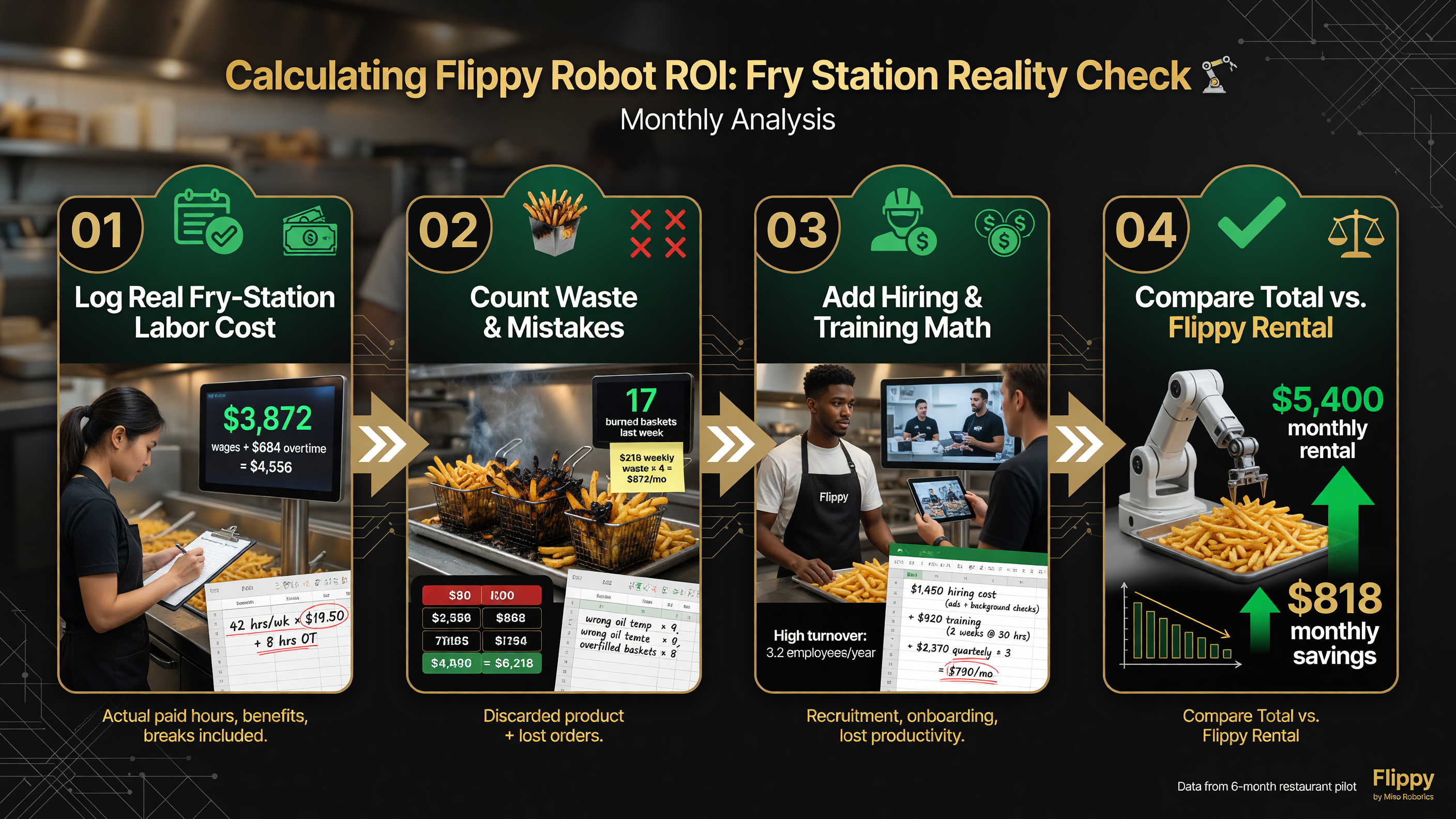
A four-step 30-day audit: log labor, count waste, add hiring math, then compare against the $5,400 monthly rental. The decision becomes arithmetic instead of marketing.
Frequently Asked Questions
What does Flippy cost per month for a restaurant?
Miso Robotics markets Flippy on a rental model at roughly $5,400 per month. The exact figure depends on the configuration, the number of fryers covered, and the service agreement. There is no large upfront capital purchase in the rental model, which lowers the barrier for independent operators.
Does Flippy replace a cook or help them?
Flippy is a fry-station specialist, not a general kitchen worker. It takes over the timing and cooking of fryer baskets so the human team handles breading, seasoning, plating, and ticket call-outs. In practice it redefines the fry-cook role and reduces the hours chained to the fryer, rather than eliminating the position outright.
Is Flippy reliable during a busy dinner rush?
Flippy’s AI was trained on millions of real baskets cooked across deployments at brands like White Castle and Jack in the Box. It tracks multiple fryer positions concurrently and holds consistent cook times under volume, which is the exact failure point where human consistency degrades. Reliability in your kitchen still depends on install quality and your fryer setup.
How long does it take to install Flippy?
The newest generation of Flippy is built to be smaller and faster to install than earlier units. Operators should still budget for your kitchen’s specific layout, fryer configuration, and electrical requirements. Ask Miso for a site survey before you commit, because installation conditions vary by kitchen.
Is Flippy worth it for a small or independent restaurant?
It depends on fry volume and the true cost of your fry-station labor. If you run high, steady fry volume and pay meaningful overtime or keep hiring and re-training fry cooks, Flippy’s ~$5,400 monthly rental can beat the real cost of covering that station. If your fry business is light or seasonal, a human cook is likely the better call. Run a 30-day labor-and-waste audit before committing.

About Barak Schurr
Barak Schurr built and exited a major ticketing platform, ran global operations at Eventbrite, and now focuses on one question: which AI tools actually help independent restaurant owners run leaner and grow faster. He writes from the operator’s perspective — no vendor spin, no theory, just what’s real in 2026.
Email: [email protected]
More Resources for Restaurant Operators