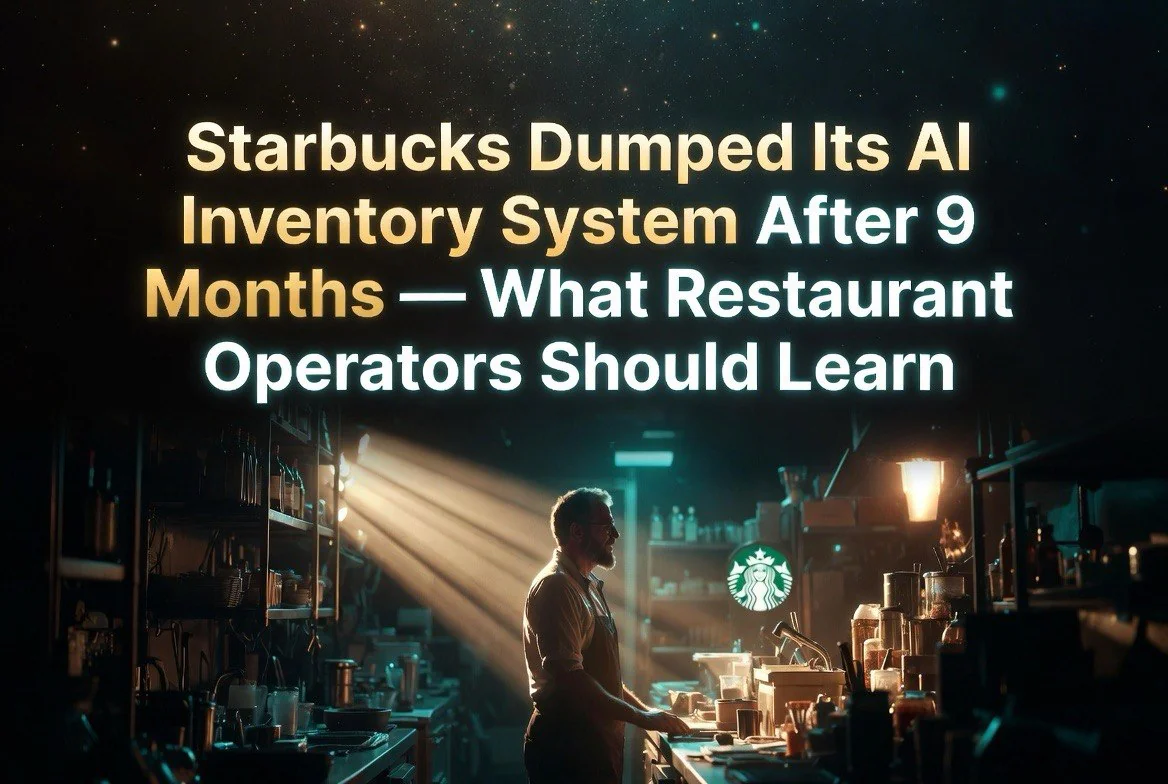
Starbucks Dumped Its AI Inventory System After 9 Months — What Restaurant Operators Should Learn
⚡ Expert Summary: Starbucks killed its computer vision AI inventory management system in July 2026 after just nine months of testing. The system, designed to track stock levels and predict restocking needs using cameras and machine learning, failed to deliver operational improvements in real restaurant conditions. For independent operators evaluating AI tools, the failure reveals exactly what questions to ask before writing a check.
Starbucks has more data, more engineers, and more money than any independent restaurant operator in America. If their AI inventory system failed, yours probably would too.
The coffee giant discontinued its computer vision AI inventory management tool in mid-2026 after roughly nine months of live testing. The system used overhead cameras and machine learning algorithms to track product levels, predict when items would run out, and automatically trigger restocking orders. On paper, it solved a problem every restaurant faces: the perpetual tension between having enough stock and throwing away excess.
In practice, the system could not handle the messiness of real restaurant operations. Packaging changes, employee workarounds, and the chaos of a working kitchen created edge cases the AI was not trained for. The cameras saw what they were programmed to see. The kitchen was not cooperating.
This failure matters far beyond Starbucks. It is the clearest signal yet that the path from AI demo to AI production in restaurants is longer and harder than vendors admit. Here is what actually went wrong and what independent operators should learn from it.
Why Computer Vision Inventory Failed in Real Kitchens
The core promise of computer vision inventory is elegant. Cameras watch what goes in and out of storage. Machine learning models identify every item, track quantities, and predict when you will run out. Orders get placed automatically. Waste drops by double digits. Labor spent on manual inventory counts disappears.
The reality is messier.
Product packaging changes frequently. A supplier switches from a red box to a blue box, and the AI model that was trained on red boxes no longer recognizes the product. A new seasonal item arrives, and the model has no reference data. A cook sets a box down in the wrong spot, and the count is off until someone physically corrects it.
These are not edge cases. They are the daily reality of every restaurant kitchen. Starbucks encountered all of them in nine months of testing and concluded that the system was not delivering reliable enough data to justify the operational complexity of maintaining it.
The deeper problem is structural. Computer vision works brilliantly in controlled environments with standardized packaging, fixed lighting, and predictable workflows. It struggles in environments where every day is slightly different. Restaurant kitchens are the opposite of controlled environments. They are designed for speed and flexibility, not consistency of presentation.
The Lesson for Independent Restaurant Operators
Independent operators should take three specific lessons from the Starbucks failure.
Lesson 1: Your operational chaos is not a bug the AI will fix. The vendors selling you AI inventory systems will show you demos of their software tracking products flawlessly in a test kitchen. Your kitchen is not a test kitchen. Your staff does not follow standard operating procedures to the letter every time. No restaurant does. The AI will inherit your chaos, not eliminate it.
Lesson 2: If the AI requires manual correction, the net benefit is negative. Every hour your manager spends fixing AI inventory counts is an hour they are not spending with customers, training staff, or improving the guest experience. AI that produces 80 percent accurate data requiring 20 percent manual correction is not saving time. It is creating a new job: correcting the AI.
Lesson 3: The maintenance burden is real and ongoing. A computer vision system needs continuous model retraining as products change, packaging changes, and kitchen layouts change. This is not a one-time setup. It is an ongoing cost that vendors often understate. Starbucks has a dedicated data science team. You do not. If they could not make the maintenance work, the economics are worse for independent operators.
The Restaurant Dive coverage of the NRA Show 2026 captured SpotOn chief marketing officer Kevin Bryla framing this exactly right: “AI at its best is going to serve up an option to an operator to make an informed decision.” It does not replace the operator. It does not replace the manager who knows their kitchen. It provides input. The decision remains human.
What AI Inventory Systems Actually Work Right Now
The failure of computer vision inventory does not mean AI has no role in restaurant inventory management. It means the right approach is different from what the hype suggests.
Predictive analytics for ordering is the proven alternative. Instead of watching what is in stock through cameras, these systems analyze historical sales data, weather patterns, local events, and seasonal trends to predict what you will need. Restaurant365 data from 2026 shows 61 percent of US restaurant operators report lower food costs using AI-powered analytics. The difference is that these systems work with your existing purchasing data rather than trying to see through cameras what is on your shelves.
Waste tracking through scale integrations is another working approach. Systems like Winnow and Leanpath use connected scales and dashboards to track what gets thrown away. The data is precise because it is measured by weight, not guessed by cameras. Operators report waste reductions of 40-54 percent with these systems. The input is exact, not probabilistic.
Demand forecasting integrated with POS data is the most accessible option for independent operators. Your POS already tracks what you sell. AI systems that analyze that data to predict future demand require no cameras, no additional hardware, and no manual data entry. Toast IQ and similar tools are already delivering this capability to thousands of independent restaurants across the United States.
The Real Cost of Betting on the Wrong AI System
The direct cost of a failed AI system is obvious: the monthly subscription, the setup fees, the hardware purchases. The indirect costs are larger.
Every dollar and every hour spent on an AI system that does not deliver is a dollar and an hour not spent on solutions that work. Restaurants operate on thin margins. The average independent restaurant runs 3-6 percent net profit. A $500 monthly AI subscription that does not deliver measurable savings is not a small experiment. It is a meaningful percentage of your profit disappearing every month.
More critically, a failed AI implementation breeds skepticism that blocks future investment. Operators who get burned on computer vision inventory are less likely to try AI-powered demand forecasting, even though the latter has proven results. The bad experience contaminates the whole category.
This is why the NRA Show 2026 message from restaurant tech leaders matters so much. Square, Toast, SpotOn, and Popmenu executives were not telling operators to avoid AI. They were telling them to be specific about the problem they are solving and to demand evidence that the AI solves it better than the existing solution.
How Independent Operators Should Evaluate AI Inventory Tools
Before buying any AI inventory system, ask these questions:
Does the system work with data you already have, or does it require new hardware? Systems that integrate with your POS and existing purchasing data have a much higher success rate than systems requiring cameras, sensors, or dedicated hardware installations.
What happens when the AI is wrong? The vendor should be able to tell you the error rate of their predictions and what happens operationally when the prediction misses. If the answer is “the system flags it for manual review,” the net time savings may be zero.
Can you test it on one menu category first? The best AI deployments in restaurants start small. Test produce forecasting before full inventory. If it works, expand. If it does not, your downside is limited to produce, not your entire walk-in.
What is the measurable expected improvement? Not “reduce waste.” A specific number based on your current operations. If the vendor cannot estimate your improvement based on your specific data, they do not understand your problem.
What Smart Operators Should Do Instead
Starbucks failure confirmed what experienced operators already know: technology that works in a demo kitchen does not always survive contact with a real restaurant. The smart play in 2026 is not to avoid AI. It is to invest in the AI systems that work with your existing data and processes, not the ones that require your kitchen to conform to the AI.
Invest in predictive analytics for demand forecasting. Invest in AI-powered labor scheduling. Invest in marketing personalization. These are the use cases where AI is delivering measurable returns to independent operators across the country. Leave the computer vision experiments to the chains with data science teams and budgets for failed experiments. Your margin cannot absorb a nine-month test that produces nothing but lessons.
Frequently Asked Questions
Why did Starbucks kill its AI inventory system?
Starbucks discontinued its computer vision AI inventory management system after approximately nine months because it could not handle the variability of real restaurant operations. Product packaging changes, employee workarounds, and unpredictable kitchen conditions created too many edge cases for the AI to handle reliably.
What is the difference between computer vision inventory and predictive analytics?
Computer vision inventory uses cameras and machine learning to watch what is physically on shelves. Predictive analytics uses historical sales data and external factors like weather and events to forecast demand. Predictive analytics has a stronger track record in restaurant operations because it works with existing data rather than requiring perfect physical conditions.
Should independent restaurants avoid AI inventory tools entirely?
No. But they should prioritize AI systems that work with existing data sources rather than requiring new hardware or perfect conditions. Demand forecasting integrated with POS data is proven and accessible. Computer vision systems are still experimental for independent operators.
How much can AI reduce restaurant food waste?
Operators using AI-powered demand forecasting and waste tracking report reductions of 12-54 percent depending on the system and implementation. The median improvement across multiple vendors is approximately 22 percent reduction in food waste.
What is the safest AI investment for a restaurant in 2026?
AI-powered demand forecasting integrated with your existing POS system. It requires no hardware, no new data collection, and no changes to kitchen workflows. The ROI is measurable in reduced waste and optimized purchasing within 30-60 days of implementation.

About Barak Schurr
Barak Schurr built and exited a major ticketing platform, ran global operations at Eventbrite, and now focuses on one question: which AI tools actually help independent restaurant owners run leaner and grow faster. He writes from the operator’s perspective — no vendor spin, no theory, just what’s real in 2026.
Email: [email protected]
More AI Resources