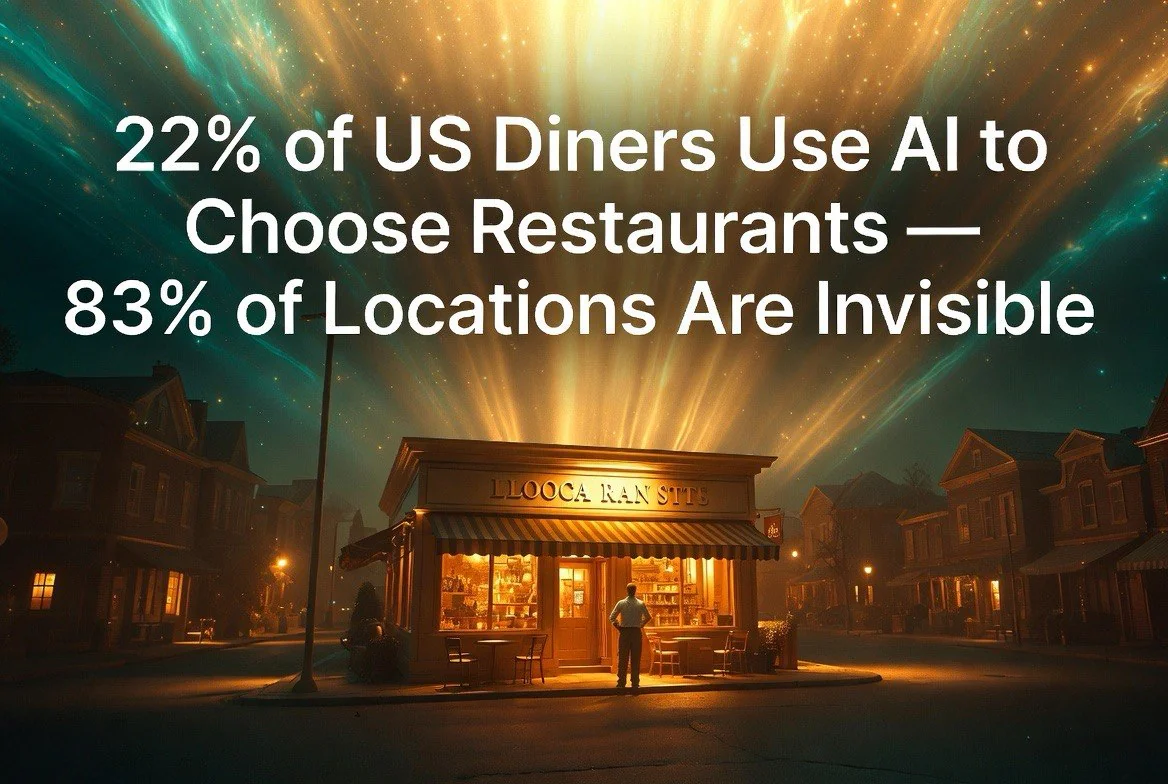
22% of US Diners Use AI to Choose Restaurants — 83% of Locations Are Invisible
⚡ Expert Summary: A July 2026 report from Bloom Intelligence found that 22% of US diners now use AI tools like ChatGPT and Gemini to choose restaurants — up sharply from previous years. But 83% of restaurant locations never appear in AI recommendations. Restaurants with average ratings below 4.3 stars and incomplete online listings are being systematically excluded from the fastest-growing discovery channel in the industry.
If your restaurant is invisible to Google, it hurts. If your restaurant is invisible to ChatGPT and Gemini, it is becoming a business-threatening problem.
Bloom Intelligence released a report on July 2, 2026, analyzing how AI search is reshaping customer acquisition for restaurants across the United States. The data is stark: 22% of American diners now use generative AI tools to decide where to eat. That percentage is heavily skewed toward younger demographics — among diners under 35, it is closer to 35%.
And yet, 83% of restaurant locations do not appear in AI-generated recommendations at all.
What Makes a Restaurant Visible to AI Search Engines
Bloom’s analysis identified three factors that determine whether an AI tool will recommend a restaurant: average rating, listing completeness, and structured data. These are not the same factors that drive traditional Google SEO.
AI recommendation engines heavily favor restaurants with average ratings of 4.3 stars or higher. Below that threshold, the probability of inclusion drops sharply. The logic is simple: AI models trained on review data learn that 4.3+ restaurants consistently deliver positive experiences, so they become the default recommendation for queries like “best Italian restaurant in Chicago” or “where to eat with a group in Austin.”
Beyond ratings, listing completeness matters more than most operators realize. A restaurant with a Google Business Profile that includes hours, photos, a menu, a phone number, and recent reviews is far more likely to be indexed by AI search tools than one with a sparse or outdated listing. The AI does not treat an incomplete listing as better than nothing — it treats it as a signal of unreliability and skips it.
Structured data — specifically FAQPage schema, LocalBusiness schema, and Review schema on the restaurant’s website — directly increases the probability of inclusion. Bloom’s report found that restaurants with schema markup appeared in AI recommendations at roughly 2.4 times the rate of those without it.
AI Search Is Replacing General Search for Restaurant Discovery
According to a 2025 survey from Google cited in the report, 32% of US consumers aged 18-34 now use AI chatbots for restaurant discovery at least once per week. The same survey found that 58% trust AI recommendations for restaurants “as much or more than” traditional search results. For independent operators, this shift matters because AI search behaves differently from Google search.
Google search returns many results. It shows a map pack with three restaurants, a list of organic results, ads, and local guides. Even a restaurant ranking on page two of Google gets some traffic. AI search returns one to three recommendations in a conversational format. If the AI recommends three restaurants for “date night” in your city and your restaurant is not one of them, the AI does not show a “see more” link. You simply do not exist in that query.
Bloom’s analysis also found that traditional analytics tools — including Google Analytics — significantly undercount AI-referral traffic. When a user asks ChatGPT for a restaurant recommendation and then visits the restaurant’s website directly, the referral source is logged as “direct traffic” rather than as an AI referral. This means many operators who are already getting AI traffic have no idea it is happening.
What Independent Operators Can Do About It
The fix is not complicated, but it requires deliberate work across three areas:
Online reputation management. Every review response matters. AI models weigh recent reviews more heavily than old ones. A push to hit and maintain a 4.3+ average across Google, Yelp, and TripAdvisor is the single highest-leverage move. This means responding to every review — positive and negative — within 48 hours and actively soliciting reviews from satisfied customers.
Listing optimization. Google Business Profile, Yelp, TripAdvisor, and OpenTable listings must be complete and accurate. This is not a one-time setup; it requires monthly audits for hours, holiday changes, menu updates, and photo freshness. A single outdated listing is enough for an AI to skip the recommendation.
Website schema implementation. The restaurant’s website should have LocalBusiness schema, FAQPage schema for common questions (hours, parking, dietary options), and Review schema. Bloom’s data showed these schemas directly correlate with AI inclusion rates. This is a technical fix that costs nothing in ongoing maintenance — just a one-time implementation by a developer or a plugin.
Bloom Intelligence recommends that operators start with the Google Business Profile audit, as it is the highest-traffic source for AI training data. A complete, active Google profile with a 4.3+ rating and at least 50 recent reviews gives an independent restaurant a realistic path to appearing in ChatGPT and Gemini recommendations — even against chains with larger marketing budgets.
The Gap Between Early Adopters and Everyone Else Is Growing
The 5W AI Visibility Index, covered in our previous report, showed similar findings from the agency perspective. Bloom’s data adds the consumer-angle confirmation: diners are actively using AI to decide where to eat, and most restaurants are not showing up.
The window for independent operators to capture AI discovery traffic is still open, but it is closing. As more diners adopt AI search — projected to reach 35% of all US consumers by early 2027 according to industry estimates cited in the report — the competition for those three recommendation slots in each query will intensify. Chain restaurants are already investing in AI visibility optimization through agencies and internal teams. Independents who start now have a head start over those who wait until 2027.
How AI Search Differs From Search Engines for Restaurant Discovery
The difference between AI search and traditional search is not subtle — it is structural. When a user searches Google for “best Italian restaurant in Chicago,” Google returns a map pack with three results, paid ads, and a long list of organic results. Even restaurants ranking on page two get some visibility. Users scroll. They compare. They click through multiple options.
When that same user asks ChatGPT or Gemini for Italian restaurant recommendations in Chicago, the AI returns one to three recommendations in a conversational format. There is no page two. There is no “see more” link. If your restaurant is not among the three the AI chooses, you do not exist in that query. The AI will not say “here are three recommendations, and here are seven more if you click” — it gives a concise answer and moves on.
This structural difference means that traditional restaurant SEO strategies — optimizing for local keywords, building backlinks, maintaining a blog — are becoming less relevant for AI discovery. The factors that drive AI recommendations are simpler and more concentrated: star rating, review volume, listing completeness, and structured data. A restaurant with a 4.5-star average and a complete Google profile will appear in AI recommendations far more consistently than a 4.0-star restaurant with better SEO but thinner review data.
Why 83% of Restaurants Are Invisible to AI
Bloom Intelligence’s 83% invisibility statistic is alarming until you understand the mechanics behind it. The vast majority of restaurants do not meet the threshold for AI inclusion because they fall short on one or more of the key factors. The most common gap is star rating. The US restaurant industry average on Google is approximately 4.1 stars. The AI inclusion threshold is 4.3 stars. That 0.2-star gap excludes a significant portion of restaurants from AI consideration.
The second most common gap is listing completeness. Bloom’s analysis found that many restaurant Google Business Profiles lack recent photos, updated hours, or complete menus. AI models interpret incomplete listings as signals of unreliability — if a restaurant cannot maintain its profile, can it maintain its kitchen? The model does not penalize the restaurant explicitly, but it ranks competing restaurants with complete listings higher.
The third gap is review recency. AI models weigh recent reviews — those from the past 3-6 months — more heavily than older reviews. A restaurant with 200 reviews from two years ago but only five reviews from the past six months looks stagnant to an AI training on current data. Active restaurants that generate a steady stream of recent reviews signal ongoing relevance.
The good news is that all three gaps are fixable. Star rating improves through systematic review solicitation and thoughtful response management. Listing completeness is a one-time audit followed by monthly checks. Review recency requires a consistent process, but it is a process, not a campaign.
AI Visibility as a Competitive Advantage for Independent Operators
The reason this matters specifically for independent restaurants is that chains already have an advantage in traditional search. Chains have dedicated SEO teams, larger marketing budgets, and brand recognition that generates backlinks. But AI search levels the playing field in some important ways. If an independent restaurant achieves a 4.5-star rating with 100 recent reviews and a complete listing, it can appear alongside — or ahead of — a chain restaurant in AI recommendations.
Bloom Intelligence’s report noted that the 17% of restaurants visible to AI include a disproportionate number of independent and regional operators compared to what traditional search rankings would suggest. The AI does not rank by brand recognition. It ranks by data signals that independents can match or exceed if they prioritize them.
For independent operators, this represents a time-limited opportunity. As more restaurants optimize for AI visibility — and they will, as awareness of this gap grows — the window narrows. Restaurants that invest in AI optimization now capture discovery traffic that competitors who wait until 2027 will pay agencies to chase.
FAQ
How many US diners use AI to choose restaurants?
According to Bloom Intelligence’s July 2026 report, 22% of US diners now use AI tools like ChatGPT and Gemini to choose restaurants. Among diners under 35, that figure rises to approximately 35%.
What percentage of restaurants appear in AI recommendations?
Only 17% of restaurant locations appear in AI-generated recommendations. The remaining 83% are invisible to tools like ChatGPT and Gemini when diners ask for restaurant suggestions.
What makes a restaurant visible to AI search engines?
Three factors determine AI visibility: average rating of 4.3 stars or higher, complete and accurate online listings (Google Business Profile, Yelp, TripAdvisor), and structured data markup (LocalBusiness, FAQPage, and Review schema) on the restaurant’s website.
Can independent restaurants compete with chains for AI visibility?
Yes. A complete Google Business Profile with a 4.3+ rating and fresh reviews gives independent restaurants a realistic path to AI recommendation inclusion. The factors that drive AI visibility are all achievable for independent operators.
How is AI restaurant discovery different from Google search?
Google search returns many results including a map pack, organic links, and ads. AI search returns one to three conversational recommendations per query with no “see more” option. Restaurants outside the top recommendations are completely invisible.

About Barak Schurr
Barak Schurr built and exited a major ticketing platform, ran global operations at Eventbrite, and now focuses on one question: which AI tools actually help independent restaurant owners run leaner and grow faster. He writes from the operator’s perspective — no vendor spin, no theory, just what’s real in 2026.
Email: [email protected]
More AI Resources