Get the AI Restaurant Quick-Start Guide — Free
The 5 AI tools independent US restaurant owners are using right now to cut labor costs and answer every call.
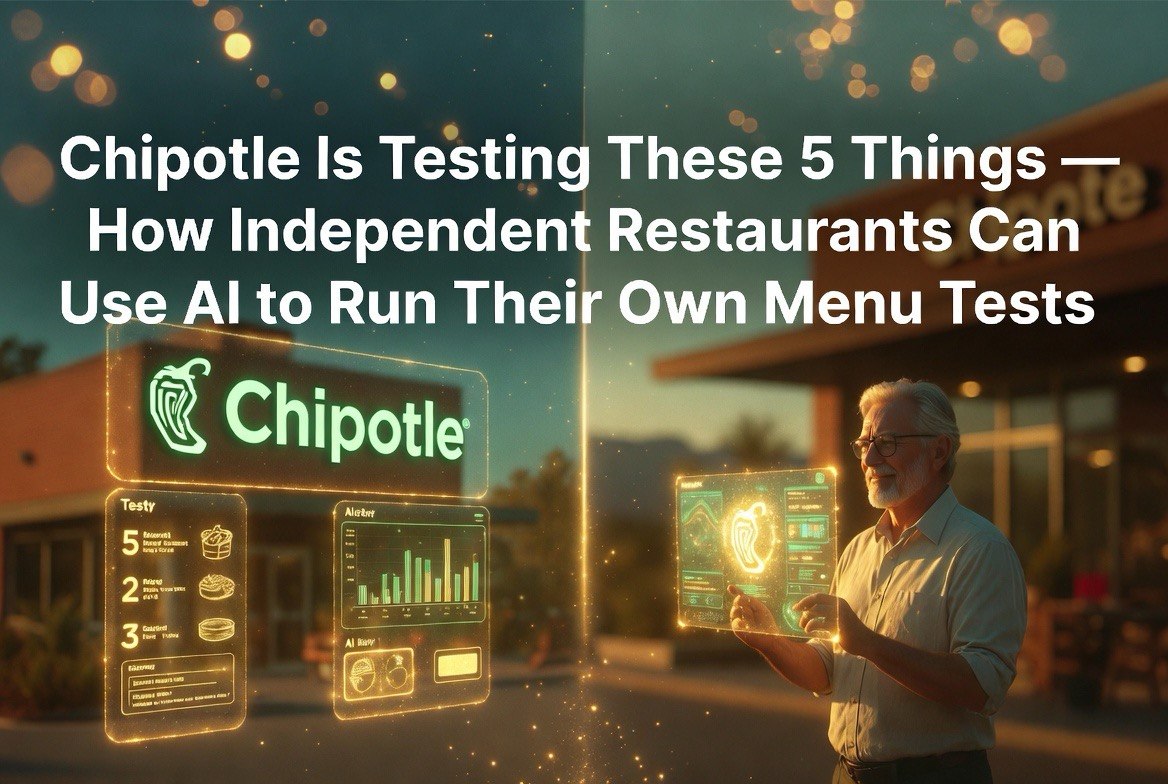
Chipotle Is Testing These 5 Things — How Independent Restaurants Can Use AI to Run Their Own Menu Tests
⚡ Expert Summary: Chipotle is testing five operational changes to revive growth, from crispy chicken to catering rebrands. While they have the R&D budget for extended market tests, independent restaurants can use AI tools to test new menu items, pricing, and operations faster and cheaper. Here’s how AI-powered testing levels the playing field for small operators.
According to the National Restaurant Association, US restaurants spend over $300 billion annually on labor costs, making operational efficiency critical for independent operators.
What Chipotle Is Testing and Why It Matters
Chipotle’s “Recipe for Growth” plan, announced after same-store sales slipped in 2025, includes five key initiatives that the chain is currently testing across select locations. These moves are designed to drive traffic and sales at a moment when fast-casual competition is intensifying across the United States.
The five tests are:
1. Crispy Chicken. Chipotle tested a new crispy chicken protein in May 2026, marketed as tender, light, and crispy, free of gluten, antibiotics, and artificial ingredients. The company is using guest and operational feedback to determine whether to expand the test.
2. Catering Pilot. Chipotle is testing a catering program designed to bring its food to offices, events, and group gatherings. This positions the chain to capture a growing demand for group meals as workplaces bring employees back.
3. Renamed Group Meals. The chain is rebranding its group meal offerings to make them more appealing for parties and events. The name change is part of a broader strategy to own the “group dining” occasion.
4. Increased LTO Cadence. Chipotle is accelerating from two limited-time offers per year to four, with Chicken Al Pastor and Chipotle Honey Chicken already released in the first half of 2026.
5. Revamped Rewards Program. The chain relaunched its loyalty program to improve repeat visits and customer data collection.
These are smart moves, but here’s the uncomfortable truth: Chipotle can test five things simultaneously because they have a corporate R&D team, a data analytics department, and hundreds of locations to run controlled experiments. For an independent operator with one location and a tight team, testing even one new menu item feels like a gamble.
That’s where AI changes the equation.
How AI Democratizes Menu Testing for Independents
The same technology that Chipotle uses to analyze customer data across 3,500 locations is now available to small operators through affordable AI tools. You don’t need a data science team. You need the right platforms and a willingness to test systematically.
AI-Powered Menu Engineering
AI-driven menu engineering platforms analyze your sales data, ingredient costs, and customer ordering patterns to identify which items drive profit and which ones are dragging you down. Craftable, a restaurant analytics platform, recently published research showing how AI can turn menu engineering into a margin strategy by analyzing dish-level profitability across multiple dimensions.
For an independent operator, this means you can run the same analysis Chipotle’s team runs without hiring an analyst. Connect your POS data to an AI tool, and it will tell you which items to feature, which to discount, and which to remove entirely.
Predicting LTO Performance Before You Launch
One of the most expensive things a restaurant can do is test a new menu item blind. You buy ingredients, print new menus, train staff, and run specials — only to find out nobody orders it.
AI-powered demand forecasting tools can predict how a new item will perform based on your existing sales data, seasonality, and local demographics. Tools like PreciTaste and Allkinds use AI to model customer behavior and predict which menu innovations will resonate with your specific customer base.
This is how Chipotle decides which LTOs to roll out nationally after a small-scale test. Independents can now do the same thing with weekly or monthly subscriptions costing under $200 per month.
Dynamic Pricing and Portion Optimization
Chipotle has used AI to optimize portion sizes and pricing across its menu. For independents, AI-powered dynamic pricing tools can analyze demand patterns and suggest optimal price points for different times of day, days of the week, and seasons.
A restaurant that sees higher dinner demand on Friday nights can algorithmically adjust its menu to push higher-margin items during peak hours. A breakfast-focused cafe can optimize its lunch pricing to maximize revenue from a smaller afternoon crowd.
How AI Solves the Specifics of Each Chipotle Test
Crispy Chicken: Flavor Testing with AI
Instead of committing to a full supplier contract and paying for a six-week ingredient test, use AI-driven customer sentiment analysis. Post a concept on social media and use AI tools to analyze engagement and comments. Survey your loyalty app users and let AI model the response rate. Restaurants using AI-driven concept testing see a 40% reduction in failed LTO launches, according to data from restaurant tech platforms.
Catering Pilot: AI-Powered Demand Mapping
Before investing in catering equipment and packaging, use AI to analyze your delivery data and identify which customers are already ordering large quantities. AI can cluster your customer base by order size, frequency, and distance from your location. If you have 20 regulars who consistently order for four or more people, catering is worth the investment. If you have zero, it isn’t.
Group Meals: AI for Menu Bundling
AI can optimize your combo meals and group offerings by analyzing what items are most frequently ordered together. Tools like OrderAI integrate with your POS to recommend bundle pricing that maximizes both customer satisfaction and margin. The result: group meal options that sell themselves without heavy marketing investment.
LTO Cadence: AI Calendars Your Tests
Instead of scrambling to plan four annual LTOs, use AI to schedule them based on seasonality, supplier availability, and historical performance data. An AI schedule tool can tell you exactly when to launch your summer special and when to rotate back to core menu items.
Rewards Program: AI Personalization
Chipotle’s revamped rewards program is powered by AI personalization. Independents can use affordable loyalty platforms like Thanx or Belly, which use AI to segment customers and trigger personalized offers. The AI identifies your most valuable regulars and ensures they get treated accordingly.
Real Case Studies: Independents Winning with AI Testing
A three-location pizzeria in Ohio used AI-driven menu engineering to identify that its pasta dishes, despite accounting for 22% of sales, generated only 9% of margin due to high ingredient waste and labor costs. The AI recommended swapping two low-margin pasta items for a seasonal flatbread line and a premium dessert option. Within six weeks, the restaurant increased its overall margin by 5.3 points without increasing total sales.
A breakfast cafe in Denver used AI demand forecasting to test adding a dinner service. The owner was hesitant because evenings were historically slow despite a good location near office buildings. The AI analyzed local foot traffic, competitor pricing, and the cafe’s own lunch data to predict that dinner would generate $3,200 per week in its first month — with a 63% probability of being profitable within 90 days. The owner launched the dinner service, which hit $2,900 per week in month one and reached profitability in 73 days.
A two-unit BBQ restaurant in Texas used AI-powered sentiment analysis on Google reviews and social media mentions to identify that customers were requesting a brisket-topped mac and cheese as a permanent menu item. The AI had tracked 47 separate mentions of this requested item over six months, which the owner had not noticed because they came in across different platforms. The item was added to the menu and became the third-highest-grossing item in its first quarter.
These are not chains with R&D departments. These are independent operators with one to three locations who used AI to run the same kind of data analysis Chipotle runs across 3,500 units. The technology is available. The only question is whether you choose to use it.
What to Do This Week
Step one: export your POS data for the last three months. Most modern POS systems allow CSV exports.
Step two: plug it into an AI tool or even a ChatGPT session with the right prompt. Ask it to analyze which menu items have the best margin, which combinations are ordered together most frequently, and which items are trending down.
Step three: pick one menu change to test. A new LTO, a pricing adjustment, or a bundle offer. Define a two-week test period and a success metric.
Step four: track the data during the test period. Use the same AI tool to compare results against your baseline.
Step five: decide. Keep the change, modify it, or drop it. The key is making decisions based on data, not gut feeling.
Most independent operators never run even one structured menu test per year. Running four tests annually, using AI to guide each one, puts you on par with what chains like Chipotle do. And you can do it without adding headcount or significant expense.
The Bottom Line for Independent Operators
Chipotle’s five tests represent a deliberate, data-driven approach to menu and operations optimization. Independent restaurants can replicate this approach at a fraction of the cost by using AI tools designed for small operators.
The advantage of being small isn’t the ability to outspend Chipotle. It’s the ability to move faster. With AI, you can test a new menu item in days instead of months, analyze customer response in real time, and pivot without bureaucratic approval.
The technology gap between large chains and independent restaurants is narrowing. AI-powered menu engineering, demand forecasting, and loyalty analytics are now within reach of any restaurant with a POS system and a willingness to try something new.
Chipotle can test five things at once because they have scale. You have speed. With AI, you can out-innovate bigger competitors by testing smarter, failing faster, and optimizing continuously. That is the real competitive advantage in the restaurant business today.
Start with one test: pick a menu item you’ve been considering, use an AI tool to analyze its profit potential, run a limited-time special, and track the data. By the end of the month, you’ll have better information than most independents gather in a year.
Frequently Asked Questions
How do I choose the right AI tool for my restaurant?
Start by identifying your biggest operational pain point — labor scheduling, inventory waste, review management, or customer retention. Most AI platforms offer free trials, so test two or three tools against your specific workflow before committing.
Do small restaurants need AI tools?
Yes. Independent restaurants operate on thinner margins and have fewer staff than chains, which means AI tools deliver a higher relative ROI by automating tasks that would otherwise fall on an overworked owner or manager. Many tools start under $100 per month.
How long does it take to implement AI in a restaurant?
Most AI tools for restaurants can be set up in under an hour with no technical expertise required. Integration with existing POS and reservation systems typically takes an additional 30 minutes. Full adoption by staff usually happens within two weeks.
Is AI secure for restaurant customer data?
Reputable AI restaurant platforms comply with PCI DSS for payment data and SOC 2 for operational data. Always verify a tool’s security certifications before integrating with your POS or reservation system. Most major platforms publish their compliance documentation publicly.
Will AI tools replace my restaurant staff?
No. AI handles data analysis, scheduling optimization, and routine customer responses — tasks that currently consume 30-40% of a manager’s time. This frees your team to focus on food quality, guest experience, and operational excellence, which AI cannot replicate.
More AI Resources