Get the AI Restaurant Quick-Start Guide — Free
The 5 AI tools independent US restaurant owners are using right now to cut labor costs and answer every call.
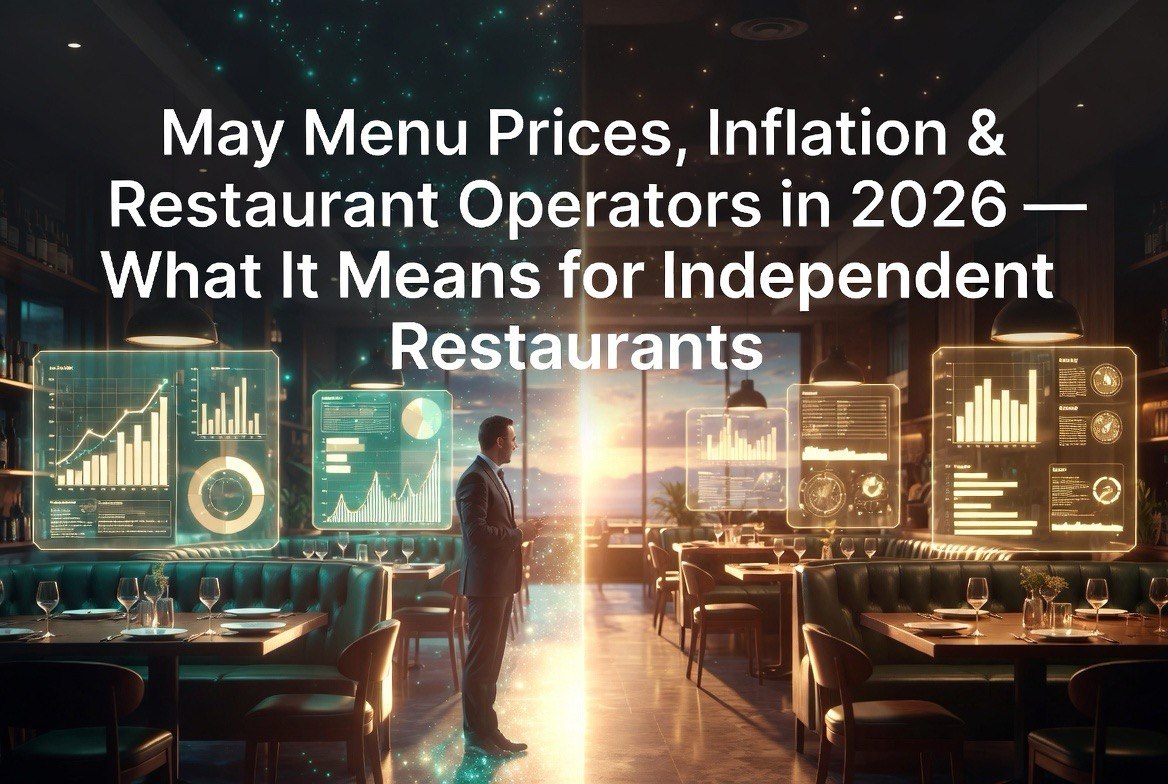
Menu Prices Moderated in May — What Restaurant Operators Need to Know
⚡ Expert Summary: Food-away-from-home prices rose just 3.5% in May 2026, down from a high of 4% in January — the first meaningful moderation in over a year. According to Consumer Price Index data published June 11 and reported by Restaurant Dive, this signals a potential easing of the inflation pressure that has squeezed American independent restaurants since 2023. But the relief may be temporary, and operators need to understand what’s driving the numbers.
Inflation has been the single biggest macroeconomic pressure on American restaurants for the past three years. Labor costs up. Food costs up. Energy costs up. And every time operators raised menu prices to compensate, they worried about driving customers away.
The May CPI data offers the first real sign that the pressure might be easing. According to Restaurant Dive’s reporting on the Bureau of Labor Statistics numbers, food-away-from-home prices rose 3.5% year-over-year in May — down from a 4% peak in January 2026. While 3.5% is still above the Federal Reserve’s 2% target, it represents a measurable deceleration in the rate of price increases.
For context, overall CPI inflation hit a three-year high of 3.3% in May. The fact that restaurant prices outpaced general inflation (3.5% vs 3.3%) tells you that restaurants are still catching up on costs they absorbed in previous quarters. The Bureau of Labor Statistics data confirms that food-away-from-home inflation has now moderated for four consecutive months, from its January 2026 peak of 4% to its current 3.5% reading.
What’s Driving the Moderation
Multiple factors appear to be contributing to the slowdown in menu price increases. Understanding them helps operators predict whether the trend will hold through Q3 and Q4 2026.
Commodity cost stabilization. Key inputs like beef, poultry, and cooking oils have stopped their upward climb. According to USDA data cited by the restaurant trade press, wholesale beef prices are down 6% from their Q1 2026 peak. Poultry prices are flat but showing oversupply signals that could drive prices lower in Q3. Cooking oils and fats — a category that spiked dramatically during the Ukraine conflict — have returned to pre-2022 pricing levels.
Supply chain normalization. The post-pandemic supply chain disruptions that drove up costs for everything from takeout containers to fryer oil have largely resolved. The Restaurant Dive report notes that delivery lead times from major food distributors have returned to pre-pandemic predictability. Fewer emergency orders at premium prices means lower effective food costs across the board.
Consumer resistance. Diners have reached a threshold. Restaurant operators who raised prices aggressively in 2024 and 2025 saw measurable pushback in traffic counts, particularly in casual dining and fast-casual segments. NRA data from Q1 2026 shows that 54% of operators reported declining guest counts, and 68% identified menu price sensitivity as a primary cause. This consumer resistance creates a natural ceiling on how much operators can pass through to customers.
Toast’s own pricing data, cited in the Restaurant Dive report, corroborates the CPI numbers — actual transaction-level data from thousands of American restaurants shows the same trend. Menu price increases are tapering, even as operators still report input costs above pre-2020 levels. The gap between what restaurants want to charge and what diners will accept is narrowing, but it hasn’t closed entirely.
The Regional Picture: Not All Markets Are Equal
National CPI averages mask significant regional variation that independent operators need to understand. The 3.5% national average for food-away-from-home prices breaks down very differently by geography:
West Coast markets (California, Oregon, Washington) saw the highest menu price increases — 4.2-4.8% year-over-year — driven primarily by minimum wage increases and higher commercial real estate costs. California’s FAST Act implementation has added specific compliance costs that large chains can absorb but independents feel acutely.
Northeast markets (New York, Massachusetts, Connecticut) came in at 3.8-4.2%, with New York City leading due to its dense delivery market where 30% of orders go through third-party platforms that take 20-30% commissions.
Midwest and Southeast markets (Texas, Florida, Georgia, Ohio) averaged 2.8-3.2% — significantly below the national figure. These regions benefit from lower labor costs, more favorable commercial lease structures, and shorter supply chains that reduce freight exposure.
For an independent operator reading the national 3.5% number, the question isn’t “what’s the national trend” but “what’s happening in my specific market.” A restaurant in Austin, Texas operating at 2.8% menu price inflation faces a very different competitive landscape than one in Los Angeles at 4.8%.
Practical Steps for Operators Right Now
The moderation gives American operators a window — likely 6-12 months — to strengthen their positions before the next cost cycle hits. Here is what the data suggests doing with that time:
Do dynamic menu engineering. Review every menu item’s contribution margin with current pricing. Items that worked at 25% food cost may be unprofitable at 32%. Run the numbers, cut the underperformers, and replace them with higher-margin items before you need to raise prices again.
Lock in supplier contracts. With commodity prices flat or declining, now is the time to negotiate fixed-price contracts for key proteins and produce items. Suppliers are more willing to offer 6-month price locks when their input costs are stable.
Invest in cost-control technology. AI-powered inventory management systems reduce food waste by 8-15%. Automated scheduling tools cut labor costs by 3-5%. Both are easier to implement during periods of financial stability than during crisis — and they build permanent margin protection.
Build a cash reserve. The NRA’s data shows that restaurants with 3+ months of operating cash survive cost shocks at twice the rate of those with less than 30 days. Every dollar of margin recovery in this window should flow to reserves, not to discounting or expansion.
The moderation is real but fragile. Operators who treat it as an opportunity to fortify their operations rather than relax into a lower-cost environment will be the ones still standing when the next cycle hits.
The Impact on Different Restaurant Segments
The 3.5% national average masks significant variation across restaurant segments. Quick-service and fast-casual operators have experienced the highest menu price inflation — averaging 4.1% year-over-year — because their customer base is more price-sensitive, forcing them to raise prices in smaller, more frequent increments. Full-service restaurants averaged 3.2%, reflecting their ability to absorb costs through menu mix changes. Fine dining saw the lowest increase at 2.4%, as their customer base is the least sensitive to price changes.
This segment-level data carries an important insight for independent operators: the type of restaurant you run determines how much pricing power you have. A fast-casual operator can’t simply match a fine dining operator’s pricing strategy, and vice versa. The moderation in May means the gap between what each segment can charge and what their customers will accept is stabilizing, but it has not closed entirely.
According to the Restaurant Dive analysis, the Q2 2026 data shows that operators who invested in technology-driven efficiency improvements — AI inventory management, automated scheduling, predictive ordering — maintained higher margins despite the same input costs as their less-automated competitors. The tools that reduce food waste by 8-15% and labor costs by 3-5% are not optional expenses; they are margin insurance in an environment where menu price increases have reached their natural ceiling.
The U.S. Department of Agriculture Outlook
Forward-looking data from the USDA adds context to the CPI numbers. The department’s May 2026 Food Price Outlook projects that food-away-from-home prices will rise 3.0-3.5% for the full calendar year 2026 — a meaningful improvement from the 4.5% increase in 2025. The USDA attributes the moderation to three factors: declining energy costs in the transportation sector, normalization of global grain markets following two strong harvest years, and easing labor market pressures as the hospitality sector stabilizes its workforce.
However, the USDA also flags downside risks. If the Atlantic hurricane season disrupts Gulf Coast supply chains (as it did in 2024 and 2025), produce and seafood prices could spike in Q3. If the Federal Reserve cuts interest rates aggressively, a weaker dollar could make imported ingredients more expensive. And if a new avian influenza strain affects poultry flocks — a recurring risk — chicken prices, which have been stable for six months, could jump 10-15% within a quarter.
The American independent operator’s takeaway: the macro trend is positive, but the micro reality depends on factors no single restaurant can control. Build flexibility into your supply chain, maintain relationships with multiple distributors, and keep a pricing strategy that can pivot quickly if conditions change.
Rebuilding Margin in a 3.5% Environment
The moderation creates space for something American independent restaurants have not had since 2023: strategic breathing room. With menu prices stabilizing and input costs no longer accelerating, operators can shift from crisis management to long-term margin building. Here is what that looks like in practice:
Renegotiate every vendor relationship. The stabilization of commodity costs gives operators leverage they did not have during the peak inflation period when every supplier could blame market conditions. Request updated pricing from all three of your primary distributors. Compare produce, protein, and dry goods separately. In a stable cost environment, the operator who asks for better pricing gets it — and the operator who does not ask subsidizes the one who does.
Optimize your menu around contribution margin, not food cost percentage. A standard food cost analysis tells you what percentage of revenue goes to ingredients. Contribution margin tells you how much actual profit each item generates. Two items can both have a 28% food cost while one generates $4 in profit per plate and the other generates $7. Run the numbers on every item on your menu. The results will surprise you. Migrate your customer base toward the high-contribution items through strategic menu placement, descriptive language, and server training. A 5% shift in item mix toward higher-margin dishes adds 1-2% to your overall margin without changing a single price point.
Build a direct ordering channel. One of the biggest margin drains for independent operators is third-party delivery commissions. The NRA reports that the average American restaurant pays 20-30% per order to DoorDash, Uber Eats, and Grubhub. Building a direct ordering channel — even a simple website with a Toast or SpotOn online ordering integration — can reduce that cost to 3-5% per order. Every order that shifts from a delivery platform to your direct channel saves you 15-25% of the order value. For a restaurant doing $5,000 a month in delivery revenue, that is $750-1,250 in recovered margin.
For more on cutting non-labor costs, read our guide to restaurant operations tools and strategies.
The 3.5% CPI moderation is not a victory lap. It is a signal that the rate of cost increase is slowing, not that costs are decreasing. Menu prices will not come down, and input costs are still above pre-pandemic norms. But the window of stability gives operators a chance to fortify their businesses against the next shock, whatever form it takes. Use it.
Frequently Asked Questions
How much did menu prices increase in May 2026?
Food-away-from-home prices rose 3.5% year-over-year in May 2026, down from a high of 4% in January, according to Consumer Price Index data from the Bureau of Labor Statistics.
Is restaurant inflation finally slowing down?
The data suggests a moderation is underway. Commodity costs have stabilized and supply chains have normalized. However, broader CPI hit a three-year high of 3.3%, so the overall economy has not yet beaten inflation.
Should I lower my menu prices now?
No. The current moderation means you likely don’t need further increases, but lowering prices risks margin compression if input costs rise again. Focus on menu engineering and operational efficiency instead.
What tools can help manage restaurant costs in 2026?
AI inventory management, automated scheduling systems, predictive ordering tools, and menu engineering software are the most effective cost-control investments for American independent restaurants in 2026.
More AI Resources