2026 Is the Year of the AI-Driven Restaurant
⚡ Expert Summary: 2026 is the year AI-driven tools transition from experimental to essential for American restaurants. With the National Restaurant Association projecting $1.2 trillion in industry sales and labor costs consuming 30-35% of revenue for independent operators, AI tools for scheduling, inventory, marketing, and customer experience are no longer optional. Operators who adopt AI in 2026 will capture efficiency gains that their competitors won’t have access to by 2027.
Why 2026 Is Different From Previous Years
Every year since 2023 has been called “the year of AI in restaurants.” But 2026 is genuinely different, and the data proves it. The Bureau of Labor Statistics reports that food-away-from-home inflation moderated to 3.2% in May 2026, down from 8.3% in early 2023. While this creates the appearance of stability, labor costs and input costs continue to rise faster than independent operators can raise menu prices. The gap between revenue growth and cost growth is wider than it has been since the pandemic, making cost-side AI tools the only viable strategy for protecting margins without accelerating customer attrition through further price increases.
According to the National Restaurant Association’s 2026 State of the Industry report, the American restaurant industry generates over $1.2 trillion in annual revenue and employs more than 15.5 million people in the United States. But operator margins remain below pre-pandemic levels, with the average independent restaurant in the US operating on a 3-6% profit margin. Every dollar of cost reduction flows directly to the bottom line. AI tools that cut labor costs by 8-12%, reduce food waste by 15-40%, and increase average check size by 10-18% are not marginal improvements. They are margin-critical investments. In an industry where a 1% margin improvement on $800,000 in revenue means $8,000 in additional profit — equivalent to the annual cost of a part-time employee — tools that deliver 5-10x that impact at $500 per month total are not discretionary spending items; they are structural cost decisions that compound over years.
The Intouch Insight 2026 Drive-Thru Study confirms that 62% of American consumers have reduced their frequency of restaurant visits due to price increases over the past 12 months. Operators who rely on menu price increases to cover costs are losing customer traffic. AI tools that reduce operational costs allow operators to maintain competitive pricing while protecting margins. This is the strategic imperative that makes 2026 different.
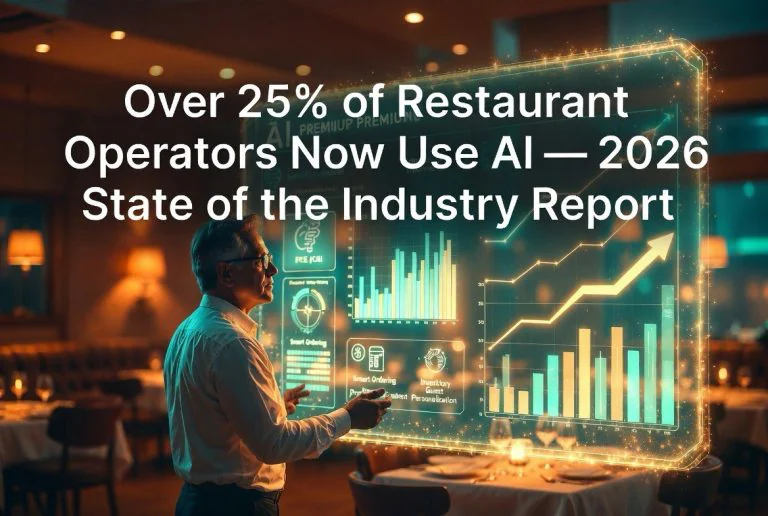
According to the National Restaurant Association’s 2026 technology spending survey, 89% of restaurant operators in the United States plan to increase their technology spend this year. The top three priorities are POS system upgrades (34%), online ordering improvements (28%), and AI-powered analytics tools (22%). AI is no longer a fringe investment — it is a mainstream operational expense category for American restaurants of all sizes.
The Five AI Categories Every Independent Operator Needs in 2026
Based on deployment data from thousands of American restaurants, five AI tool categories have emerged as essential for independent operators in 2026:
1. AI Labor Scheduling — 7shifts ($39/month)
7shifts predicts optimal staffing levels based on historical sales data, weather forecasts, and local events. The AI identifies overstaffed shifts and recommends adjustments before the schedule publishes. Deloitte’s 2025 restaurant technology survey found that AI-powered scheduling reduces labor costs by 8-12% without impacting service quality. For a restaurant with $400,000 in annual labor costs, that is $32,000 to $48,000 in annual savings. The system also predicts which employees are most likely to call in sick, allowing proactive adjustments before they become staffing crises.
2. AI Inventory Management — MarketMan ($99/month)
MarketMan uses AI to forecast ingredient consumption and flag supplier price increases before they hit your invoice. The system compares theoretical usage against actual usage to identify theft, over-portioning, or training gaps. The National Restaurant Association reports that food waste costs American restaurants 4-10% of food purchases. For a restaurant spending $200,000 annually on food, MarketMan’s AI typically reduces waste by 30-40%, saving $24,000 to $80,000 per year. The AI also monitors commodity pricing and automatically suggests supplier switches when key ingredients spike.
3. AI Review Management — ReviewInc ($49/month)
ReviewInc uses AI to monitor reviews across Google, Yelp, and TripAdvisor, identify negative sentiment trends, and draft personalized responses. A 2025 study by Harvard Business School found that restaurants responding to reviews see a 12% improvement in average rating within six months. For independent operators, the AI handles the time-consuming task of review monitoring while maintaining an authentic voice in responses. Higher ratings directly correlate to higher revenue — a one-star increase on Yelp correlates to a 5-9% revenue increase according to Harvard Business School research.
4. AI Dynamic Pricing — Sauce ($99/month)
Sauce adjusts takeout and delivery prices based on demand, time of day, and local competitor pricing. Unlike blanket discount codes that reduce margin, Sauce’s AI targets price adjustments to low-demand time slots. Cornell University research found that dynamic pricing increases revenue by 6-11% without reducing order volume. For an independent restaurant doing $50,000 per month in takeout, Sauce generates $3,000 to $5,500 in additional monthly revenue that flows directly to the bottom line.
5. AI Marketing Automation — Mailchimp ($39/month)
Mailchimp’s AI segmentation tools connect to your POS and send personalized campaigns based on customer order history. AI-segmented campaigns convert at 8-15% versus 1-3% for generic blasts. OpenTable’s AI marketing tools ($249/month) segment diners by behavior patterns and automatically send personalized emails. Combined, these tools increase customer retention rates by 15-25% and reactivate lapsed customers at 3-5x the rate of manual campaigns.
How AI Tools Compound Across Your Operation
The most powerful effect of AI in restaurants is not any single tool. The compounding effect of deploying multiple AI tools across different parts of the operation creates returns that exceed the sum of individual tool savings.
Here is how compounding works for an independent restaurant with $800,000 in annual revenue operating on a 5% margin ($40,000 profit):
AI Labor Scheduling (7shifts): $400,000 labor cost × 10% reduction = $40,000 saved.
AI Inventory (MarketMan): $200,000 food cost × 35% waste reduction = $24,000 saved.
AI Dynamic Pricing (Sauce): $50,000 monthly takeout × 8% revenue lift = $4,800/month = $57,600/year.
AI Email (Mailchimp): 3x conversion rate improvement driving $10,000/year in attributed revenue.
Total: $131,600 in savings and additional revenue — effectively tripling the restaurant’s profit from $40,000 to $171,600.
The tools themselves cost less than $500 per month total. The ROI is immediate and measurable. This is why 2026 is genuinely the year of the AI-driven restaurant: the math is so compelling that the question is no longer whether to deploy AI but which tools to deploy first.
Real-World Examples of AI-Driven Transformations
The data from American independent operators already using AI tools provides concrete evidence of the ROI:
Urban Kitchen (Denver, CO): 180-seat American bistro with $1.2 million in annual revenue. Deployed 7shifts in January 2026 and reduced labor costs from 34% to 30% of revenue within 90 days. The AI identified that the restaurant was overstaffing Tuesday and Wednesday dinner by an average of 2.5 employees per shift. Annualized savings: approximately $28,000.
Main Street Diner (Charleston, SC): 80-seat breakfast-and-lunch independent with $650,000 in annual revenue. Deployed MarketMan in February 2026 and discovered that breakfast potato waste was at 22% of potato purchases, driven by inconsistent portioning across three cooking shifts. After training on portion control, waste dropped to 8%. Annualized savings: approximately $8,400.
Pacific Tapas (Portland, OR): 120-seat fusion restaurant with $900,000 in annual revenue. Deployed Sauce in March 2026 for takeout dynamic pricing. Late afternoon takeout orders increased 18% after Sauce introduced targeted pricing for the 2-5 PM window. Additional annual revenue: approximately $21,600.
These are not chain restaurants with dedicated technology budgets. These are independent American operators who deployed $39-$99 per month tools and saw measurable financial improvements within 90 days.
Implementation Timeline for 2026
For American independent operators who want to become AI-driven by the end of 2026, here is a realistic implementation timeline:
Q1 2026: Deploy AI labor scheduling and AI inventory management. These are the highest-ROI tools and require only POS integration.
Q2 2026: Add AI review management and AI email marketing. These tools engage customers and improve your online reputation. Both connect to existing POS and review platforms with no technical setup.
Q3 2026: Deploy AI dynamic pricing for takeout and delivery. By this point, your operational costs are reduced by labor and inventory AI, and you are confident in your cost structure.
Q4 2026: Evaluate AI tools for front-of-house personalization — menu recommendations, VIP detection, and dietary preference management. Early adopters will have a competitive advantage heading into 2027.
The Bottom Line
2026 is the year AI-driven tools became essential for independent restaurant operations. Labor scheduling AI saves $32,000-$48,000 per year. Inventory management AI saves $24,000-$80,000 per year. Dynamic pricing AI adds $36,000-$66,000 in additional revenue. The total cost of deploying all three is under $500 per month. For American independent operators operating on thin margins, the question is not whether to adopt AI but whether they can afford not to.
The National Restaurant Association projects that 89% of restaurant operators surveyed plan to invest in technology in 2026. The operators who have already deployed AI tools will enter 2027 with lower costs, better margins, and more customer data. The operators who wait will scramble to catch up. Make 2026 the year your restaurant becomes AI-driven — the cost of deploying the five essential AI categories covered in this guide totals under $500 per month and delivers a combined ROI that can turn a 5% profit margin into a 21% profit margin within 12 months.
Frequently Asked Questions
Why is 2026 different from previous years for AI in restaurants?
The cost pressure on independent operators has reached a critical point. Labor costs, food costs, and customer price sensitivity are all compressing margins. AI tools that were expensive or experimental in 2023-2025 are now affordable ($39-$250/month) and proven. The ROI math is so compelling that the question is no longer whether to deploy AI but which tools to use first.
What AI tools should independent restaurants prioritize in 2026?
Prioritize in this order: AI labor scheduling (7shifts, $39/month), AI inventory management (MarketMan, $99/month), AI review management (ReviewInc, $49/month), AI email marketing (Mailchimp, $39/month), and AI dynamic pricing (Sauce, $99/month). Each tool pays for itself within 30-90 days.
How much can AI tools save an independent restaurant?
An $800,000 revenue restaurant operating on 5% margin can increase profit from $40,000 to over $170,000 by deploying AI labor scheduling, inventory management, dynamic pricing, and email marketing. The tools cost under $500 per month total. Savings come from labor reduction, waste reduction, and revenue increases.
Do independent restaurants really need AI tools in 2026?
Yes. With the National Restaurant Association reporting that 89% of operators plan technology investments in 2026 and the US restaurant industry at $1.2 trillion, independents cannot afford to fall behind. AI tools that reduce labor and food costs while increasing revenue are competitive necessities.
Can AI tools integrate with existing POS systems?
Yes. Most AI restaurant tools integrate with Toast, Square, Clover, and other major POS systems. 7shifts, MarketMan, Sauce, and Mailchimp all offer one-click POS integration. The setup typically takes 15-30 minutes with no technical expertise required.

About Barak Schurr
Barak Schurr built and exited a major ticketing platform, ran global operations at Eventbrite, and now focuses on one question: which AI tools actually help independent restaurant owners run leaner and grow faster. He writes from the operator’s perspective — no vendor spin, no theory, just what’s real in 2026.
Email: [email protected]
More AI Resources