Get the AI Restaurant Quick-Start Guide — Free
The 5 AI tools independent US restaurant owners are using right now to cut labor costs and answer every call.
The Five Money Leaks AI Won’t Find in Your Restaurant
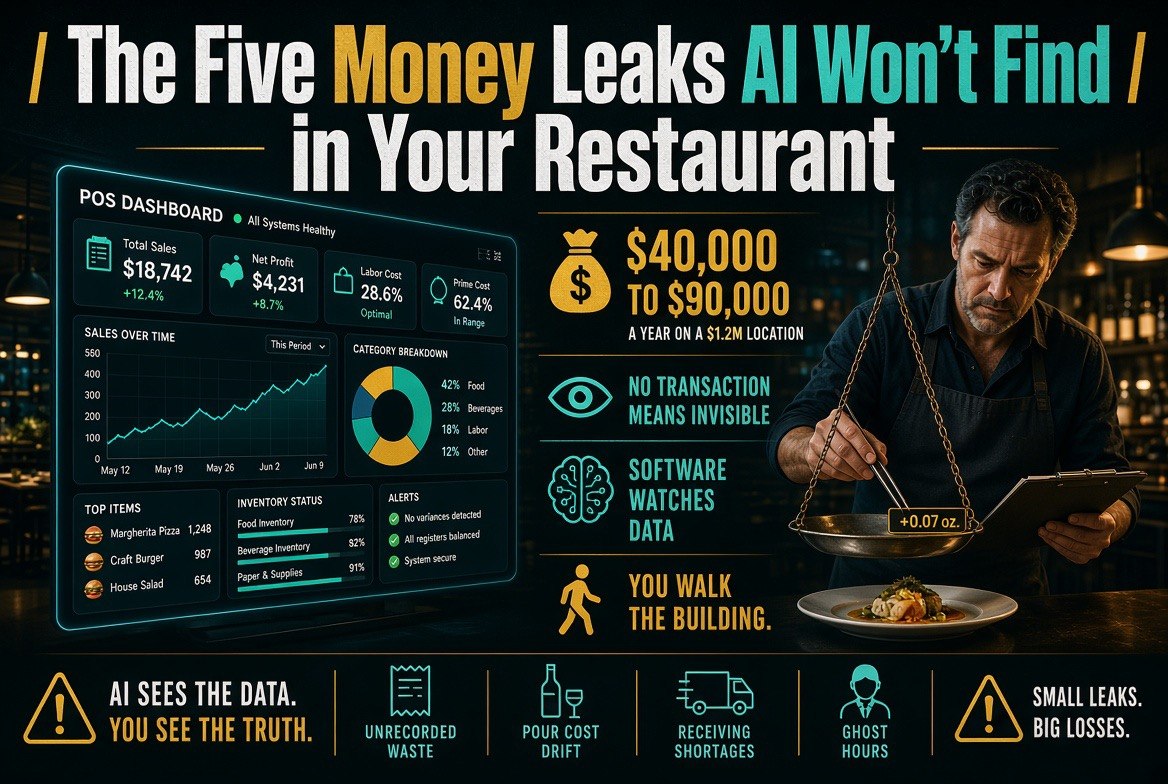
⚡ Expert Summary: Restaurant AI is very good at the leaks it can see in your POS, your invoices and your schedule. It is close to useless on the five leaks that actually decide whether an independent restaurant survives the year — the ones that never generate a transaction, never create a report, and never show up in any dashboard you can buy. On a $1.2M location, these five typically account for $40,000 to $90,000 a year. None of them need software. All of them need a number.
Every restaurant AI sales deck makes the same promise: connect the tools, and the software will find the money. And it does find money — real money, in food cost, labour, invoice overcharges and waste. This site has covered that stack extensively because it works.
But there is a category of leak that no system will ever flag, and it is usually larger than the ones AI catches. Not because the technology is weak, but because of how it is built. AI tools watch transactions. They read your POS, your invoices, your schedules, your reservations. If a loss never becomes a transaction and never lands in a system, no amount of model quality will surface it.
Those are the five below. They are the leaks an operator has to find personally, because the only instrument that can detect them is a human standing in the building with a clipboard and a specific question.
Why AI Cannot See These Leaks
The failure is structural, not technical. Restaurant AI runs on data that already exists in digital form: order records, item-level sales, invoice line items, clock-in times, delivery platform statements. Its entire value comes from cross-referencing those streams faster and more consistently than a manager can.
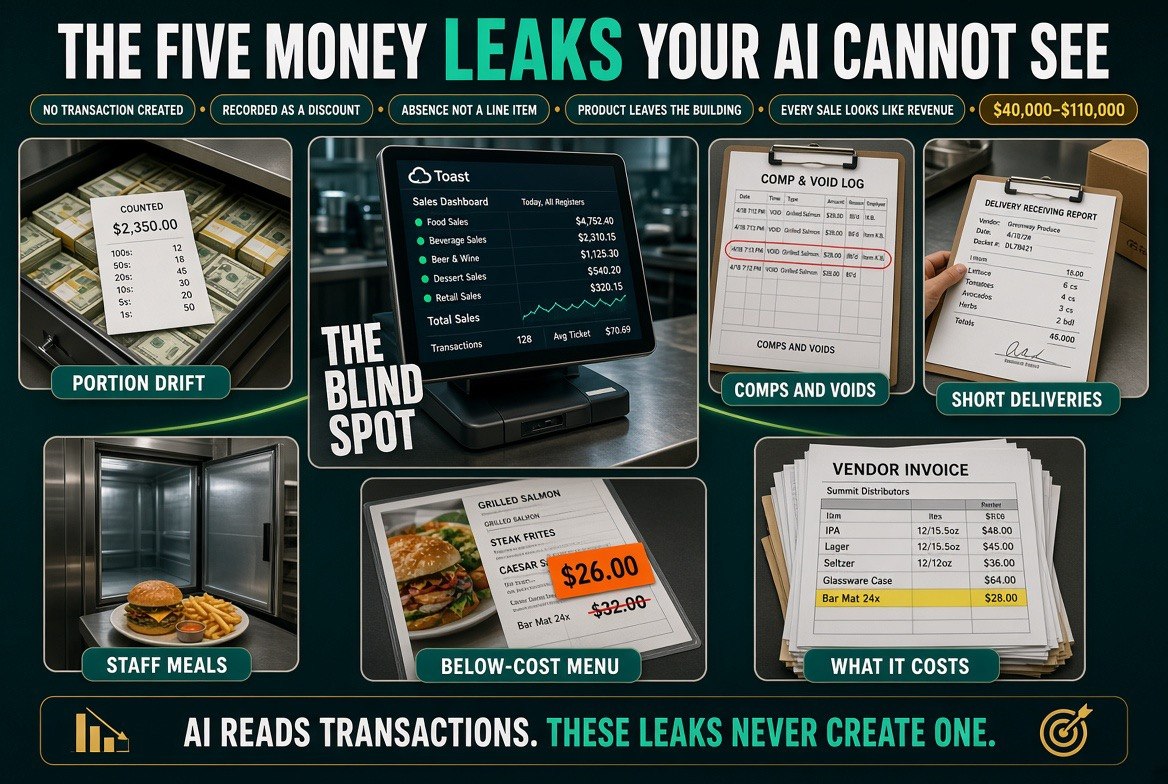
A leak that never enters any of those streams is invisible by definition. Portion drift does not create a transaction. A comped meal goes into the POS as a discount, not as a loss. A vendor short-ship is reconciled on a delivery sheet nobody re-reads. Free staff meals look identical to items that were never ordered. And a menu item priced below its true cost generates a perfectly healthy-looking transaction every single time it sells.
| Leak | Why AI Misses It | What It Costs a $1.2M Location | Who Can Actually Find It |
|---|---|---|---|
| Portion drift | No transaction is created by an extra ounce | $8,000-$22,000 | Owner with a scale, during service |
| Untracked comps and voids | Recorded as a discount, not as a loss | $6,000-$18,000 | Owner reconciling voids to who authorised them |
| Short deliveries and invoice drift | Only catches price changes, not missing weight | $7,000-$20,000 | Whoever signs for the truck |
| Staff meals and waste that is never logged | Product simply leaves the building | $9,000-$24,000 | Owner walking the walk-in on a random day |
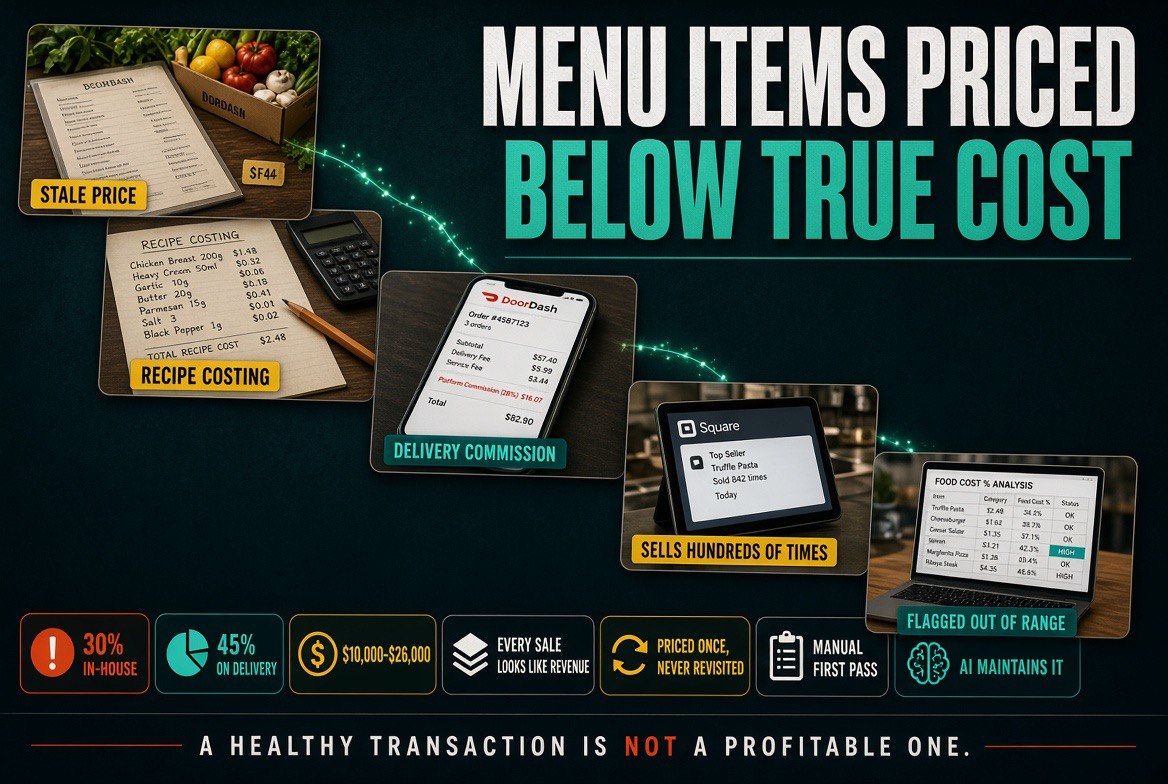
| Menu items priced below true cost | Every sale looks like revenue | $10,000-$26,000 | A full recipe costing, done by hand |
| Combined | — | $40,000-$110,000 | A two-week manual audit |
That is not an argument against restaurant AI. It is an argument for putting it in the correct slot. Software is superb at the leaks that live in data. It is not a substitute for the operator walking the building. The mistake is assuming that buying the tool means the search is over.
Leak One: Portion Drift
Portion drift is the slow, invisible widening of every scoop, pour and slice in the kitchen. Nobody decides to over-serve. It happens because a new cook is trained by someone who was already over-portioning, and because a busy Friday night rewards speed over precision.
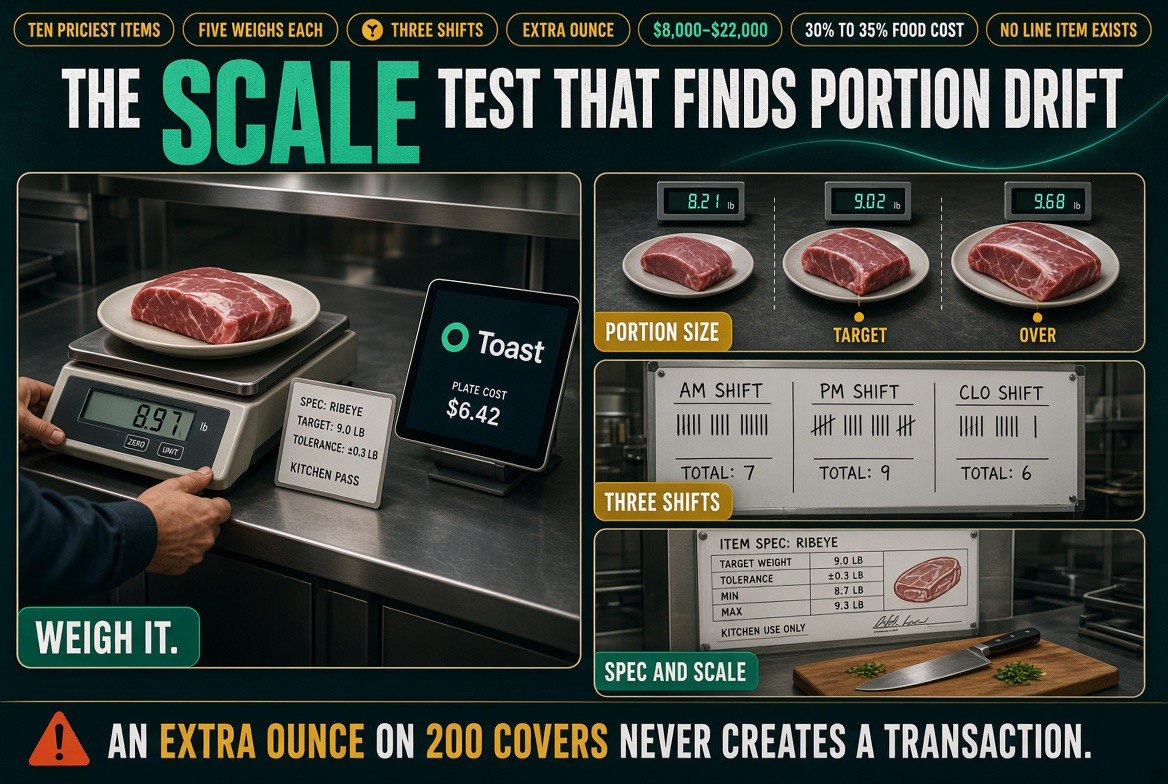
It never generates a transaction. An extra ounce of protein on 200 covers a day is a cost with no line item anywhere, and it compounds quietly until the plate that used to run a 30% food cost runs a 35% one. Over a year at a $1.2M location, that is commonly $8,000 to $22,000.
The detection method is deliberately old-fashioned. Weigh the ten most expensive items on your menu five times each across three different shifts, and compare what actually lands on the plate to the spec. Owners who run this exercise for the first time almost always find something. The fix costs nothing: a scale at the station, a spec sheet that is visible, and a training refresh for whoever is newest.
Leak Two: Comps and Voids Nobody Reconciles
Every POS can report comps and voids. What almost no independent restaurant does is reconcile them to a person and a reason. The report exists, the number is printed, and nobody asks who authorised the $340 of voids on Saturday.
Genuine comps are a cost of doing business and should not be punished. The problem is the grey zone: the friend-of-a-staff-member meal, the item that gets voided instead of remade, the discount applied because it was easier than explaining. In a location without a reconciliation habit, this reliably runs $6,000 to $18,000 a year.
What makes this invisible to AI is that most of these are recorded as legitimate transactions in the system. A discount is not an error. It does not look anomalous to a model that was never told what a normal comp rate is for your building.
The fix takes an hour a week. Pull the void and comp report, and for every entry above a threshold you set yourself, write the name of who approved it. You are not hunting for thieves. You are creating the mild, universal friction that makes casual loss stop being casual.
Leak Three: Short Deliveries and Invoice Drift
Invoice AI is genuinely good at one thing: catching the price of an item changing between the quote and the bill. It is much weaker at subtler problems, and the biggest of those is that what arrived is not what you were billed for.
Invoice AI catches price drift well and weight shortfalls poorly, because a missing four pounds is not a line item. It is an absence. The person who signs for the truck is the only one who can catch it, and they can only catch it if they are given the time and the instruction to count high-value items rather than just signing.
The fix is a receiving rule with teeth: for your top ten cost items by spend, count or weigh before signing. Everything else can go through on trust. Ten items, thirty seconds each, every delivery.
Leak Four: Staff Meals and Unlogged Waste
Staff meals are a legitimate cost and a good one, and this is not an argument against feeding your team. It is an argument for knowing what it costs. In locations where meals are never logged, the gap between what management believes is spent on staff food and what is actually consumed is frequently 40% or more.
Unlogged waste has the same shape. The batch that got dropped, the tray that went out of date, the mise that was thrown at close. If waste only gets recorded when someone remembers to write it down, the waste log is not a measurement. It is a selection of the waste that was least inconvenient to admit.
AI inventory tools depend on a physical count and a waste entry to detect variance, so anything that never gets entered is invisible to them. Combined, this leak runs $9,000 to $24,000 a year at a $1.2M location, and the largest single contributor is usually the walk-in at the end of the week.
The fix is a log that takes ten seconds, plus one random walk-in audit a week done by someone who does not normally work that station. The audit is the part that changes behaviour, because it makes the log checkable.
Leak Five: Menu Items Priced Below True Cost
This is the one that hides in plain sight, and it is the most expensive on the list. An item with a stale price and a fresh ingredient cost sells hundreds of times a month, and every single sale is a transaction that looks perfectly healthy in every report you own.
Recipe costing is not glamorous work, which is exactly why it does not get done. A printed menu gets priced once, ingredient costs move, and the relationship between them is never revisited. Delivery commissions accelerate the problem dramatically. An item that carries a 30% food cost in-house often runs past 45% once a third-party platform takes its cut, and if that item is a high-volume seller, the loss scales with its popularity.
No AI tool can fix this by itself, because a costing model is only as good as the recipe data behind it. What software can do is maintain the costing once you have built it, and flag the moment an ingredient price movement pushes an item out of range. The first pass, though, is a manual job: every recipe, every current cost, every platform-inclusive price, done by hand, once.
| Factor | AI Software | Operator Walkthrough |
|---|---|---|
| What it reads | Transactions and digital records | What is physically happening in the building |
| Frequency | Continuous, every day | Two weeks a year, plus a weekly hour |
| Catches price changes | Yes, reliably and at scale | Only if you are reading invoices closely |
| Catches short weight | Rarely, no line item exists | Yes, if you count at the door |
| Catches portion drift | Only after it shows in variance | Yes, during a service you work |
| Cost to run | Monthly subscription | Your own time, and very little of it |
One related lesson from this site: the silent revenue leaks that cost independent restaurants $73,000 a year follow the same pattern — the biggest losses are the ones nobody is measuring. The two columns below are not competitors. The software tells you where the variance is; the walkthrough tells you why it exists. An operator running both is doing something no chain with a corporate analytics team can easily replicate, because the walkthrough requires authority that a district manager does not have.
The Two-Week Audit That Finds All Five
None of this requires a consultant or a new system. It requires two weeks of unglamorous attention, and the order matters less than actually finishing it.
Week one. Weigh the ten most expensive items on your menu across three shifts and compare to spec. Pull last month’s void and comp report and write an approver name next to every entry above your threshold. Count or weigh your top ten spend items at the next three deliveries.
Week two. Cost every recipe on your menu at current ingredient prices, including the platform commission on anything sold through delivery. Then walk the walk-in on a day you do not normally work it and reconcile what is there against the waste log.
By the end of that fortnight you will have a number for each of the five leaks, and the numbers are what make the fixes stick. Nobody maintains a portion scale because a consultant suggested it. People maintain it because they know the plate is off by 1.5 ounces and it is costing them $14,000 a year.
That is the part AI cannot do for you, and it is worth saying plainly: the tools in the rest of your stack get materially more valuable once these five numbers exist, because now the software has a baseline to compare against. Fix the invisible leaks first, and everything you already pay for starts working better.
Frequently Asked Questions
What restaurant money leaks does AI miss?
AI tools miss any loss that never becomes a transaction in a digital system. The five biggest are portion drift, unreconciled comps and voids, short deliveries and invoice weight drift, untracked staff meals and waste, and menu items priced below true cost. On a $1.2 million location these typically total $40,000 to $110,000 a year.
Why can’t restaurant AI detect portion drift?
Because an extra ounce of protein creates no transaction and no record anywhere. Portion drift is a physical event, not a data event, so invoice and POS analytics can only see it after it has already widened food cost variance by several points.
How do I find short deliveries my invoice software does not catch?
Count or weigh your top ten cost items by spend before signing the delivery. Invoice AI reliably catches price changes but rarely catches missing weight, because a case billed at 40 pounds that arrives at 36 pounds has no line item to flag.
Is menu costing something AI can do automatically?
Not the first pass. A costing model is only as good as the recipe data behind it, so the initial costing has to be done by hand. Once built, software can maintain it and alert you when ingredient price movement pushes an item out of its target range.
How much does an unlogged staff meal habit actually cost?
In locations where staff meals are never logged, the gap between what management believes is spent and what is consumed is frequently 40% or more. Combined with unlogged waste, this usually runs $9,000 to $24,000 a year at a $1.2 million location.
Should I replace my restaurant AI tools with manual audits?
No. The two do different jobs. Software watches the leaks that live in data continuously and at scale. The manual audit finds the leaks that never enter a system at all. Run both, because the audit also creates the baseline that makes your existing tools more accurate.

About Barak Schurr
Barak Schurr built and exited a major ticketing platform, ran global operations at Eventbrite, and now focuses on one question: which AI tools actually help independent restaurant owners run leaner and grow faster. He writes from the operator’s perspective — no vendor spin, no theory, just what’s real in 2026.
Email: [email protected]
More Resources for Restaurant Operators