Get the AI Restaurant Quick-Start Guide — Free
The 5 AI tools independent US restaurant owners are using right now to cut labor costs and answer every call.
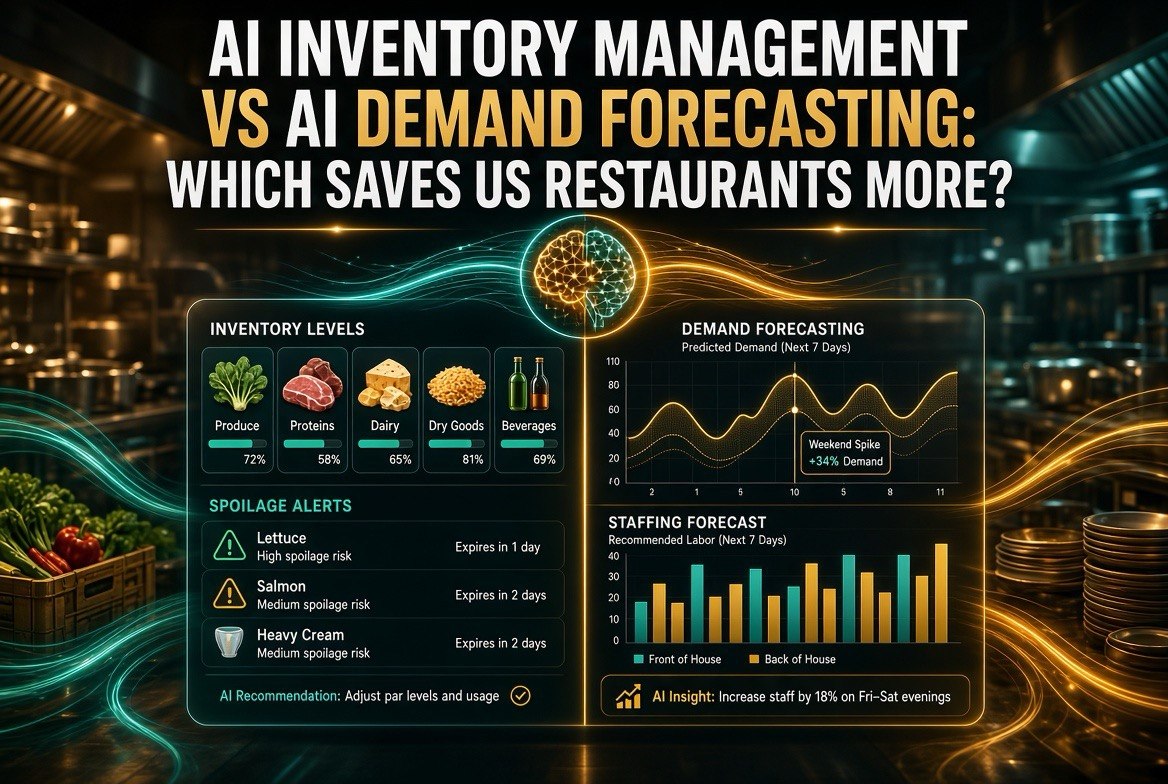
AI Inventory Management vs AI Demand Forecasting: Which Saves US Restaurants More?
If you run a restaurant in the United States and food cost is your relentlessly creeping enemy, you have probably seen two buzzwords flying around every industry newsletter: AI inventory management and AI demand forecasting. They sound similar. Vendors use them interchangeably. But they solve two different problems, cost differently, and deliver results on very different timelines.
This is the comparison I wish someone had handed me before I evaluated my own stack: a clear, side-by-side look at what each does, what it costs, how fast you see results, and which one a busy independent operator should buy first. No hype, no jargon, just the practical math for a real restaurant.
Quick Verdict
AI inventory management is the better first purchase for most US independent restaurants in 2026: it pins waste to specific items, delivers visible savings in the first month, and works with as little as a few weeks of data — while demand forecasting is the higher long-term ceiling once you have enough sales history to make its predictions trustworthy.
What Each Tool Actually Does
Before we compare, let’s be precise about the two jobs, because the confusion between them is exactly why restaurants buy the wrong tool and call it a failure.
AI inventory management watches what is physically in your building. It tracks stock levels across your walk-in, dry storage, and prep, flags items about to spoil, spots shrink and theft, and can auto-generate purchase orders or reorder points so you don’t overstock the things that go bad and understock the things you sell every day. Tools like Pantryfox position themselves as a “24/7 AI inventory agent” that watches your walk-in continuously. The pain it kills is the food you throw in the trash.
AI demand forecasting predicts what customers will want tomorrow, next week, or next month. It ingests historical sales, weather, local events, day-of-week patterns, and seasonal swings to tell you how much to prep, how many staff hours to schedule, and how much product to order. Tools like Livelytics and MarginEdge build forecasts from your own sales history. The pain it kills is uncertainty — the guess that makes you either overbuy (waste) or under-prep (86’d items and lost sales).
Look closely and you’ll see they’re complementary: forecasting tells you how much to buy; inventory tells you whether you actually used what you bought. One plans the future, the other audits the past. That’s why the smartest operators treat them as a pair — but the order you buy them matters, and that’s what this comparison is really about.
Side-by-Side Comparison
| Factor | AI Inventory Management | AI Demand Forecasting |
|---|---|---|
| Core job | Tracks physical stock, waste, shrink, and reorder points | Predicts future demand for prep, ordering, and staffing |
| Time to visible savings | Fast — waste shows up in the first month | Slower — needs weeks/months of sales history |
| Data required to start | Low — counts what’s in the building now | High — needs a solid sales history to train on |
| Primary benefit | Less waste + fewer spoilage losses | Fewer 86’d items + tighter labor + better purchase plans |
| Example tools (2026) | Pantryfox, PreciTaste (camera-based), MarginEdge | Livelytics, MarginEdge, Restroworks |
| Best for | Operations where spoilage and over-ordering bleed the P&L every week | Multi-location or high-volume spots with rich sales data and unpredictable demand |
| Typical cost range | $99–$400/month depending on locations | $150–$500+/month, often higher for multi-unit |
That table is the whole debate in one screen. The deciding factors are almost never “which is smarter” — both are genuinely smart in 2026. They’re how much data you already have and how fast you need to see a return. A single-location restaurant with six weeks of chaotic sales history is not in a position to trust a forecast; it’s in a position to stop throwing produce away.
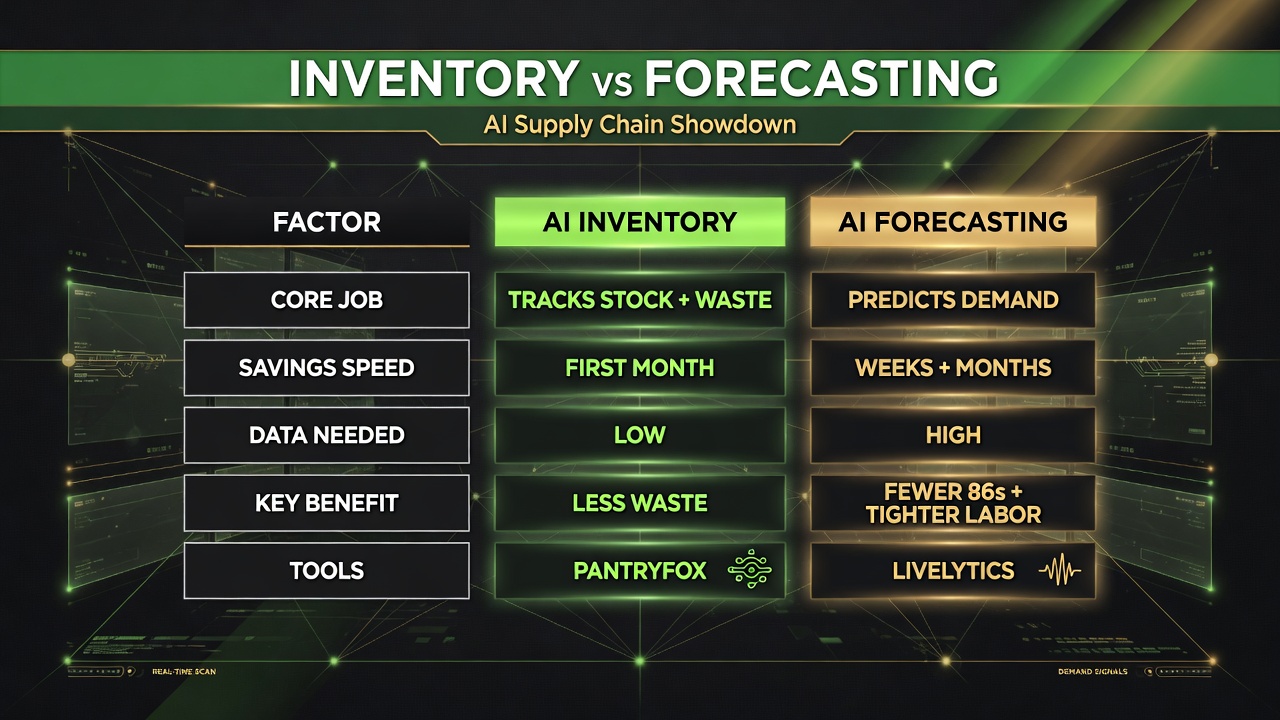
Inventory and forecasting answer different questions: inventory talks in weeks, forecasting talks in quarters. The tool you pick first should match the leak you can measure fastest. See the full 2-table breakdown in the Side-by-Side Comparison section above.
Why Start With Inventory First (The Case That Usually Wins)
Here’s the practical argument that tips most operators toward inventory management as the first buy, and it’s not about fashion — it’s about ROI timing.
The restaurant industry has been hammered for years about the size of the food-waste problem. Multiple 2026 industry studies have quantified it: reports from Restaurant365 and Deloitte both point to AI-driven food-cost tools pushing costs down dramatically, with figures like 61% of operators seeing lower food costs after adopting AI software. That number isn’t just about forecasting — it’s largely driven by inventory controls that stop waste from ever happening.
Inventory tools show results fast because they act on today’s shelf, not tomorrow’s guess. When an AI agent flags that you’ve been ordering three cases of a specialty cheese each week but throwing away forty percent of it, you can fix that order this week. The saving is immediate, concrete, and auditable — you can see it in the walk-in and in the invoice. That’s a compelling story for an owner who needs to justify the subscription to a skeptical partner or accountant.
There’s a second, subtler reason: inventory discipline is the foundation forecasting depends on. A forecast is only as good as the data feeding it. If your counts are sloppy and your waste is invisible, your “history” is fiction, and your forecast will be confidently wrong. Cleaning up inventory first makes the forecasting you add later dramatically more accurate. In that sense, starting with inventory isn’t just cheaper and faster — it’s the correct sequence for data quality too.
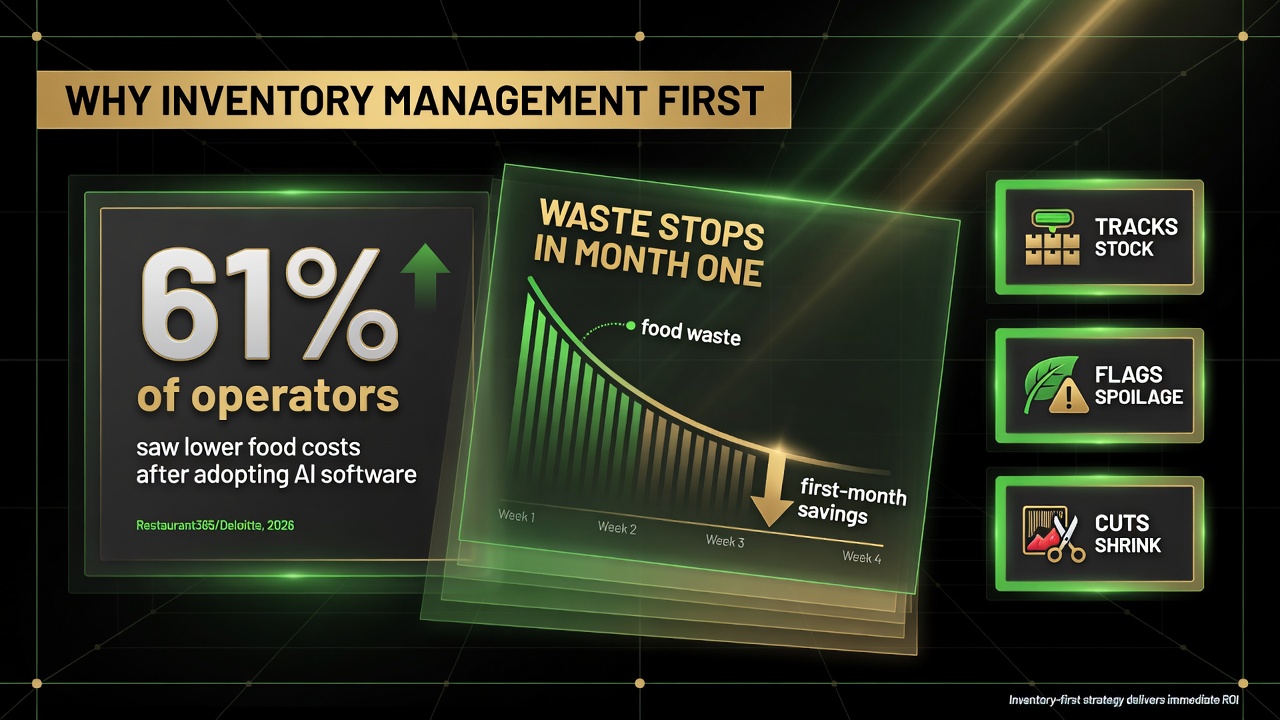
Waste is the leak a restaurant can see in month one. Restaurant365/Deloitte data shows 61% of operators saw lower food costs after adopting AI software — and inventory software is the fastest on-ramp to that number.
When Forecasting Is the Better First Buy (And Why It’s the Bigger Prize)
Now the honest flip side: if you’re a multi-location operator, or a high-volume single unit with two years of clean sales data, forecasting is often the better first investment — and it’s the tool with the higher ceiling.
Demand forecasting attacks a leak that inventory simply can’t see: lost sales from being under-prepared. Every time you 86 a popular dish at 7pm because you undersold prep, you lose that sale to a competitor. Every hour you overstaff on a slow Tuesday, you burn labor. Forecasting addresses both by telling you precisely how much to prep and how many bodies to schedule based on predicted demand. Tools like MarginEdge report sales forecasts landing within single-digit percentages of actuals, which is precise enough to change staffing and purchasing decisions.
For a group running three, five, or ten locations, the leverage multiplies. A small accuracy improvement across many kitchens compounds into meaningful monthly savings on both food and labor — the two biggest controllable costs besides rent. This is why enterprise-minded operators see forecasting as the “real” AI win: it’s the strategic brain that turns raw sales history into a plan.
The catch is the same one from the comparison table: forecasting needs history. If you have it, it rewards you richly. If you don’t, it will politely generate predictions anyway — and you’ll have no way to know if they’re any good.
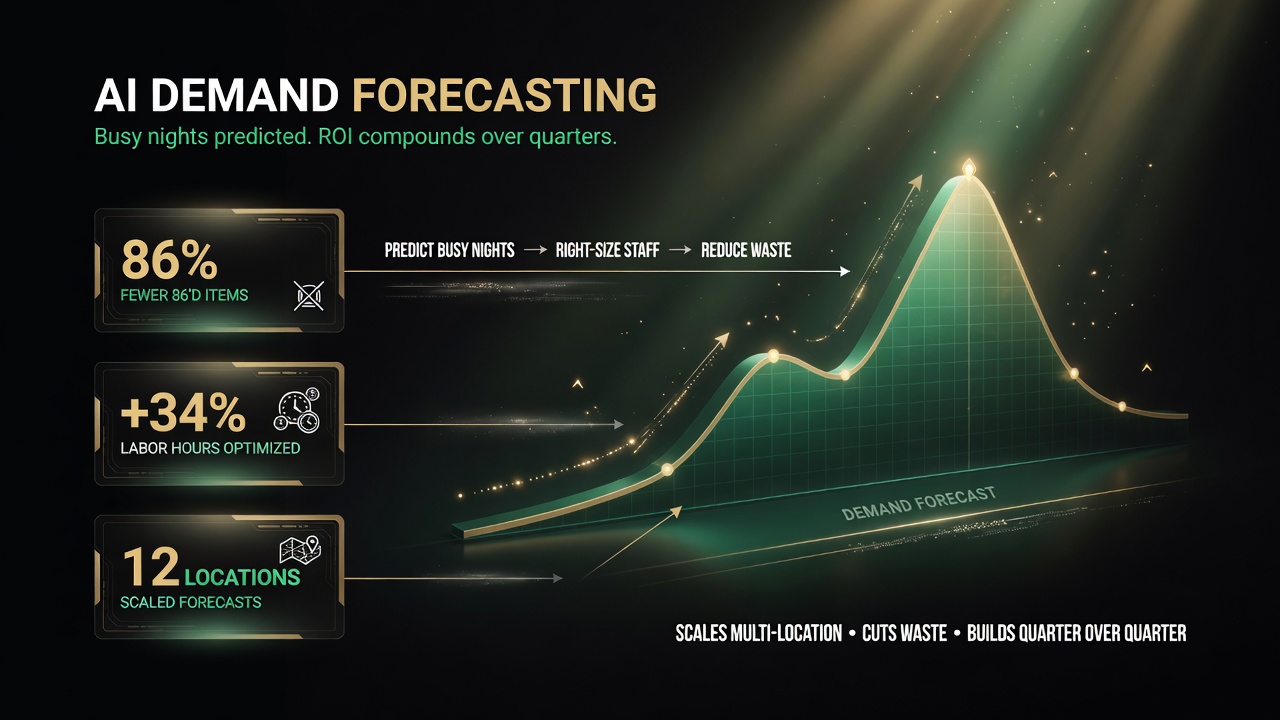
Forecasting is the higher-ceiling buy: it predicts busy nights, right-sizes labor, and scales across multi-location ops — but its ROI builds over quarters, not weeks, so it rewards operators with clean sales history.
Which One Should You Choose First?
Here’s the decision framework I’d hand a US independent operator, with no hedging:
- Single location, less than a year of reliable sales data, visible spoilage in your walk-in: buy AI inventory management first. It stops the bleeding now and builds the data hygiene forecasting needs later.
- Multi-location, or high-volume with two-plus years of clean sales history: buy AI demand forecasting first. It attacks labor and reactive-purchasing costs at scale, where the biggest multiplier lives.
- You can afford both after a trial of one: start with inventory for 60–90 days to clean the data and see waste savings, then layer on forecasting. This is the sequence most operators who succeed actually follow.
The mistake to avoid is paralysis — waiting to “figure out which one is right” while waste keeps piling up. Pick the one whose problem hurts most today, start a free trial, measure the first 30 days honestly, and let the data decide your next move.
AI Inventory Management vs AI Demand Forecasting: A Realistic Cost-Benefit View
| Scenario | Inventory Wins Because | Forecasting Wins Because |
|---|---|---|
| Spoilage is your top leak | Directly catches and flags waste item-by-item | Only reduces overbuying indirectly via better demand plans |
| Constantly under-prepping / 86’d items | No visibility into why you undersold a busy night | Predicts the busy night before it happens |
| Limited sales history | Works off what’s on the shelf today, no history needed | Weak until it has months of data to train on |
| Multi-location operation | Useful but repeats the same audit across sites | Scales your best forecasting across every kitchen |
| Need to justify cost fast | Visible savings in the first month | ROI builds over quarters, not weeks |
Read that table the way a buyer would: inventory wins the short game, forecasting wins the long game, and the tiebreaker is almost always how much clean sales history you already have. That single question — “do I trust my sales data enough to let AI bet prep and labor on it?” — is the most honest way to make the call.
Frequently Asked Questions
What is the difference between AI inventory management and AI demand forecasting?
AI inventory management tracks the physical stock in your building — what you have, what’s spoiling, what you’re wasting and over-ordering. AI demand forecasting predicts future customer demand — how much to prep, schedule, and buy — based on your sales history. Inventory audits the past; forecasting plans the future.
Which should a small restaurant buy first: inventory or forecasting?
Most single-location operators with less than a year of reliable sales data should start with AI inventory management, because it stops waste immediately and works with no history. Forecasters need solid sales history to be accurate, so they’re a better first buy for multi-location or high-volume operations that already have that data.
How much do these AI tools cost a restaurant?
AI inventory management typically runs $99–$400/month depending on location count, while AI demand forecasting is often $150–$500+/month and higher for multi-unit operations. Both are a small fraction of the food and labor costs they protect, which is why the ROI case is usually strong.
How fast will I see savings from AI inventory tools?
Usually within the first month. Inventory tools flag specific waste and over-ordering you can fix immediately, and the savings show up directly in your food cost and invoices. Forecasting, by contrast, typically needs a few months of history and tuning before its predictions become dependable.
Can I use both AI inventory management and demand forecasting together?
Yes, and that’s the strongest setup. Inventory keeps your data clean and stops current waste; forecasting then uses that clean data to plan future purchasing, prep, and staffing. The recommended sequence is to adopt inventory first for 60–90 days, then layer in forecasting.
Do these tools work with my existing POS?
Most modern AI inventory and forecasting tools integrate with major restaurant POS systems and pull your sales history automatically. Before buying, confirm the tool supports your specific POS and that it can access the data it needs — this avoids a painful integration surprise later.

About Barak Schurr
Barak Schurr built and exited a major ticketing platform, ran global operations at Eventbrite, and now focuses on one question: which AI tools actually help independent restaurant owners run leaner and grow faster. He writes from the operator’s perspective — no vendor spin, no theory, just what’s real in 2026.
Email: [email protected]
More Resources for Restaurant Operators