Get the AI Restaurant Quick-Start Guide — Free
The 5 AI tools independent US restaurant owners are using right now to cut labor costs and answer every call.
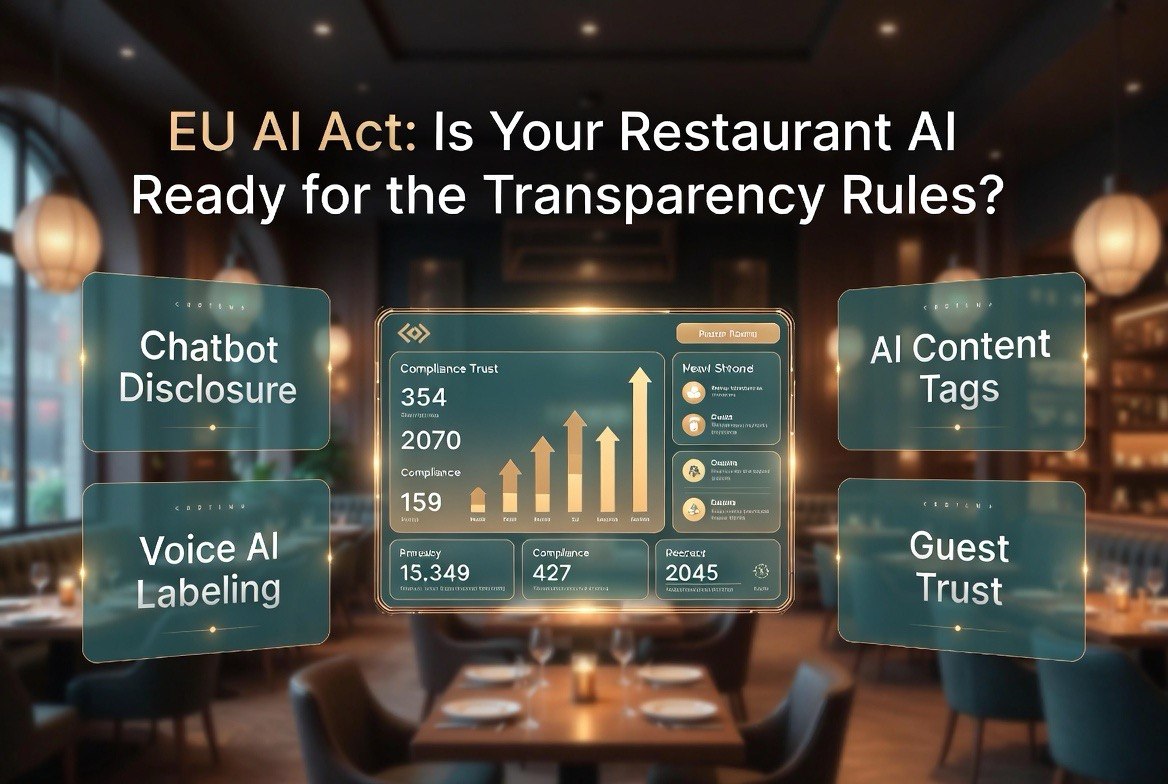
EU AI Act: Is Your Restaurant’s AI Ready for the Transparency Rules?
⚡ Expert Summary: The EU AI Act’s transparency obligations take effect for a batch of AI systems this week, and they apply far beyond Europe. If your restaurant uses AI anywhere — an AI voice-ordering assistant, a chatbot on your website, or an AI that generates or alters content guests see — and you serve anyone from the EU (tourists, business travelers, remote orders), the rules start to matter now. The core requirements are practical: tell people when they are interacting with AI, label AI-generated content, and keep records proving your system is safe and transparent. This is not a reason to rip out your AI tools; it is a reason to make sure the ones you run are labeled, documented, and compliant so you avoid fines and stay trusted with guests.
What Exactly Changed This Week
The European Union’s Artificial Intelligence Act is the world’s first comprehensive legal framework for AI. It does not switch on all at once — it rolls out in phases, and a key batch of obligations becomes effective this week. The obligations landing now are the transparency obligations that apply to a broad set of AI systems, including chatbots and AI systems that generate or manipulate content such as images, audio, or video.
For a restaurant operator who is not in Europe, the instinct is to assume “this does not apply to me.” That instinct is wrong for a meaningful number of operations. The AI Act applies to providers and deployers that offer services in the EU market, and it also has extraterritorial reach: if an AI system puts content or services in front of people in the EU — even transiently, like a tourist ordering through your AI assistant — the obligations can attach to that deployment.
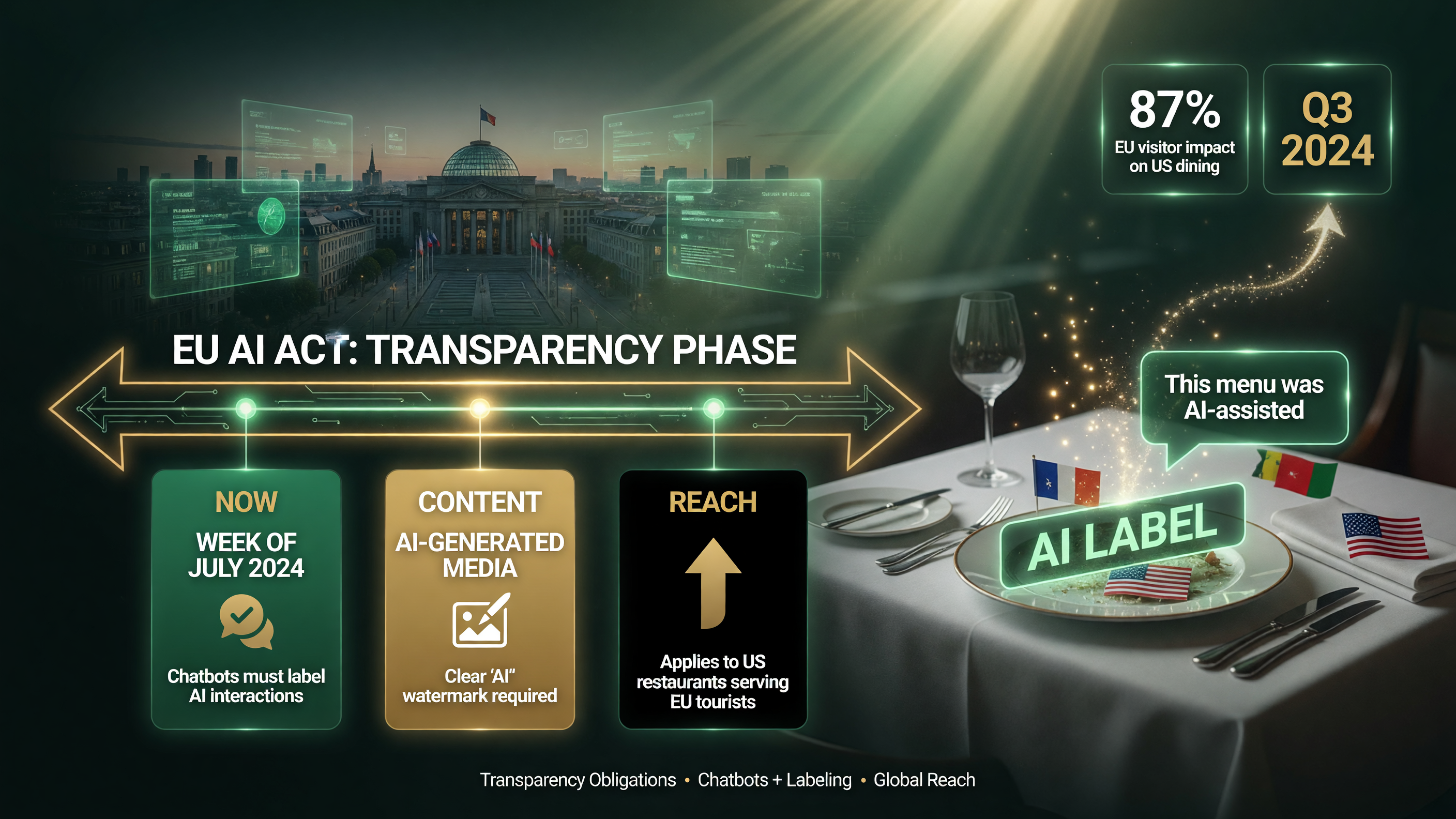
The AI Act rolls out in phases, and this week’s batch is the transparency layer that touches chatbots and AI-generated content — the AI tools restaurants are actually adopting.
Which Restaurant AI Tools Are Affected
Not every AI system in a restaurant falls under these rules, and operators should not panic about a voice assistant that only takes orders internally. But several common restaurant uses do sit inside the transparency scope:
- AI chatbots on your website: If a guest can chat with an AI bot to ask about hours, reservation policies, or menu allergens, the user must be told they are talking to an AI, not a human.
- AI voice-ordering systems: If your AI takes orders by phone, guests need to know an AI is handling the call, not a person.
- AI-generated marketing content: If you use AI to create images of dishes or produce promotional video or audio, and that synthetic content could be mistaken for a real person, event, or product, it typically needs to be labeled as AI-generated.
- AI that generates realistic people: Systems that produce deepfake-style content or realistic synthetic media face the strictest labeling duties.
| Restaurant AI Use | Do Transparency Rules Apply? | What You Must Do |
|---|---|---|
| Website chatbot | Yes | Disclose it is an AI bot |
| AI voice ordering | Yes | Tell callers an AI takes the order |
| AI dish photos | Yes, if synthetic | Label as AI-generated |
| Back-office scheduling AI | Usually no | No guest-facing duty |
| Net effect | Guest-facing AI = transparency applies | Label, disclose, document |
Why a US Restaurant Should Care Right Now
If your restaurant is in the United States and you do not knowingly sell to Europe, you might still feel this does not apply. But the AI Act has extraterritorial reach that catches real scenarios: the tourist from Paris who books a table and then uses your chat widget, the EU-based reviewer who interacts with your AI assistant, or the international business traveler ordering by phone through your AI voice system. Any of those interactions can pull a deployment into the rules.
There is also a reputational and best-practice angle that is not about the letter of the law. Treating AI as transparent with guests is simply good business. A guest who learns after the fact that they spent ten minutes talking to a bot, or saw AI-generated dishes that did not match what arrived, feels misled. Disclosing AI up front builds trust, and it aligns you with the direction the whole industry is heading — paid regulators in Europe are not the only ones moving this way.
The Practical Compliance Checklist
You do not need a legal team to get the basics right. Run a short audit of every AI your restaurant touches and put each one through this checklist:
- Disclose chatbots and voice AI. Make it obvious — in the chat window, in the phone greeting, or at the point of interaction — that the guest is speaking to an AI, not a human.
- Label AI-generated content. If you publish AI-made images, audio, or video that could be mistaken for real, mark it clearly as AI-generated in the caption or on the asset.
- Document your AI systems. Keep a simple internal note of which AI tools you use, what data they touch, and how they were evaluated. The Act’s risk-management and record-keeping duties reward organizations that can show they thought about safety and transparency.
- Confirm your vendor’s compliance posture. Ask your AI vendors whether they meet the EU AI Act’s requirements. A reputable provider should have a compliance statement; if they cannot answer, that is a red flag about their maturity.
- Watch for phase-two obligations. This week is the transparency batch, but higher-risk categories roll out over the following years. Stay aware so you are not surprised later.
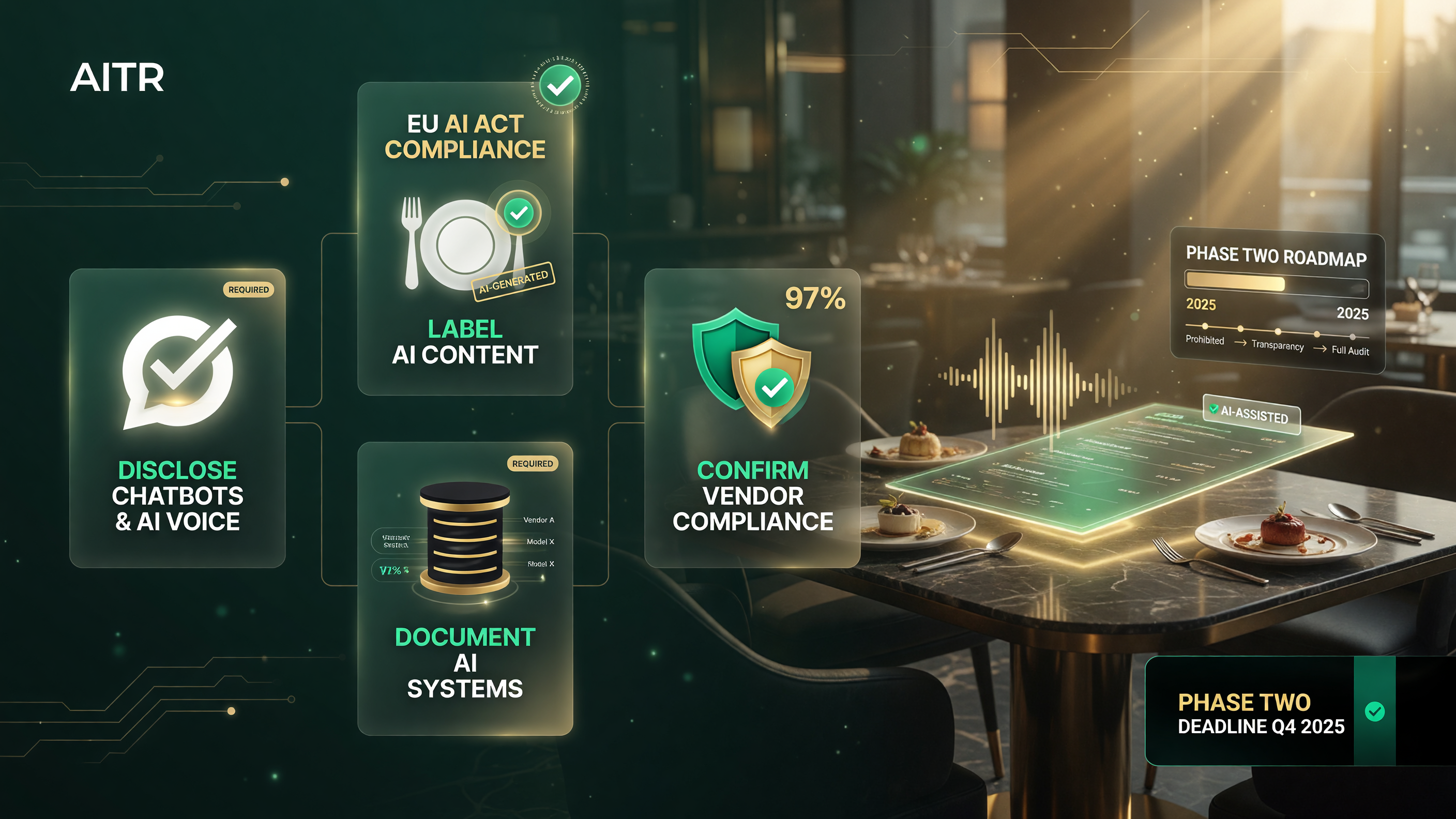
Five steps separate a compliant restaurant from one that is exposed: disclose, label, document, verify your vendor, and watch the roadmap.
Named Sources on the AI Act Scope
The European Commission has published detailed guidance on the AI Act’s phased implementation, and the Act itself specifies the transparency duties for chatbots and AI-generated content. Industry analysis from the restaurant technology press (including coverage of how AI features are reaching restaurant operators this year) consistently notes that guest-facing AI is where transparency obligations concentrate. For a US operator, the safe assumption is simple: if AI is visible to a guest, treat it as in scope and label it.
This matters because restaurants are adopting exactly the kinds of AI the transparency rules target. AI voice ordering, website chatbots, and AI content creation have all become mainstream in the US hospitality sector in the last two years, according to industry adoption tracking. That convergence means the AI Act’s latest batch is not an abstract European matter; it lands on the exact tools an independent owner is most likely to have deployed.
The Bottom Line for Restaurant Owners
The EU AI Act’s transparency obligations are best read by a restaurant operator as a straightforward trust mandate: be honest with guests about when AI is involved. Label your chatbots, disclose your AI voice ordering, mark AI-generated content, and keep simple records. For a US restaurant that serves any international guests, compliance avoids fines while reinforcing the trust that keeps people coming back.
The tools restaurants now rely on — voice ordering, chatbots, AI-driven marketing — are precisely the ones the regulator is watching. Getting the basics right this week is cheap; ignoring it can be expensive in fines and in lost guest confidence. For more AI strategy built for independent operators, see our restaurant AI hub.

Compliance is the cheap insurance: an afternoon of labeling costs almost nothing next to a fine that can reach tens of millions of euros.
What the Fines Actually Look Like
Operators who dismiss regulation often assume the worst case is a warning letter. Under the EU AI Act, the penalty structure is not trivial. For violations of the prohibited-practices provisions, fines can reach up to 35 million euros or seven percent of global annual turnover, whichever is higher. For most other obligations, including transparency duties, the ceiling is typically higher than comparable data-protection penalties — in the range of 15 million euros or three percent of worldwide annual turnover. The exact figures depend on the nature of the violation, whether the operator acted in good faith, and the phase of the rollout when the breach occurred.
Those numbers are designed to get an organization’s attention, and they are why even a mid-sized independent restaurant that serves international guests should not treat this as a purely European bureaucracy problem. The asymmetry is stark: getting the basics right — a label on a chatbot, a disclosure on a voice line, a caption on an AI-generated photo — costs almost nothing, while getting it wrong can mean fines that dwarf the annual profit of a single location. This is the rare case where compliance is genuinely cheaper than negligence.
The practical point for an owner is not to hire outside counsel tomorrow. It is to recognize that the cost of inaction is real and that the fix is a checklist item, not a project. Most restaurants can complete a basic AI transparency audit in an afternoon: inventory the guest-facing AI, add the required disclosures, and save a one-page record. That investment is trivial next to the worst-case exposure, and it compounds into a trust advantage with guests who appreciate honesty about automation.
How This Connects to the AI Your Restaurant Already Runs
The restaurant industry has been adopting exactly the categories of AI that this week’s transparency rules target, and that is the through-line owners should notice. AI voice-ordering systems, which we have covered separately, are becoming a practical option for independent operators. Website chatbots answer reservation and allergen questions around the clock. AI tools generate menu photography and promotional material. All of these sit squarely inside the obligations that just became effective.
That convergence means a restaurant does not have to go looking for a compliance problem; the problem is in the tools it already chose for good operational reasons. The voice assistant that eases the phone-order labor shortage is the same system that must tell callers it is an AI. The chatbot that saves staff hours is the same widget that must disclose it is not human. The AI photography that makes a menu look polished is the same content that should carry an AI-generated label when it could be mistaken for a real dish.
The constructive way to read this is that transparency is not an obstacle to using good AI; it is a feature of using it responsibly. The restaurants that will do best are the ones that treat disclosure as part of their guest experience — a small, honest touch that reinforces trust the way a posted ingredient list does. And because the same rules are spreading beyond Europe, operators who build transparency into their AI now are ahead of the curve rather than behind it.
Frequently Asked Questions
Does the EU AI Act apply to my US restaurant?
It can. The AI Act has extraterritorial reach into any AI deployment that puts content or services in front of people in the EU, including international guests using your chatbot, voice assistant, or website.
What transparency obligations take effect this week?
This batch covers chatbots and AI systems that generate or manipulate content. Users must be told when they interact with AI, and AI-generated content must be labeled as such.
Does an AI voice-ordering system need to identify itself?
Yes. If your AI takes orders by phone, guests should be told an AI is handling the call rather than being left to believe they are speaking to a person.
Do I need to label AI-generated marketing images?
If AI creates images, audio, or video that could be mistaken for a real person, event, or product, the content generally needs to be labeled as AI-generated.
What should I do first to get compliant?
Run a short audit of every AI your restaurant touches, disclose chatbots and voice AI, label AI-generated content, and keep a simple record of which AI systems you use and how they were evaluated.
Is back-office AI like scheduling covered?
Usually not under the guest-facing transparency duties, because it does not interact with users. The obligations concentrate on AI that is visible to or interacts with guests.

About Barak Schurr
Barak Schurr built and exited a major ticketing platform, ran global operations at Eventbrite, and now focuses on one question: which AI tools actually help independent restaurant owners run leaner and grow faster. He writes from the operator’s perspective — no vendor spin, no theory, just what’s real in 2026.
Email: [email protected]
More AI Resources for Your Operation