Get the AI Restaurant Quick-Start Guide — Free
The 5 AI tools independent US restaurant owners are using right now to cut labor costs and answer every call.
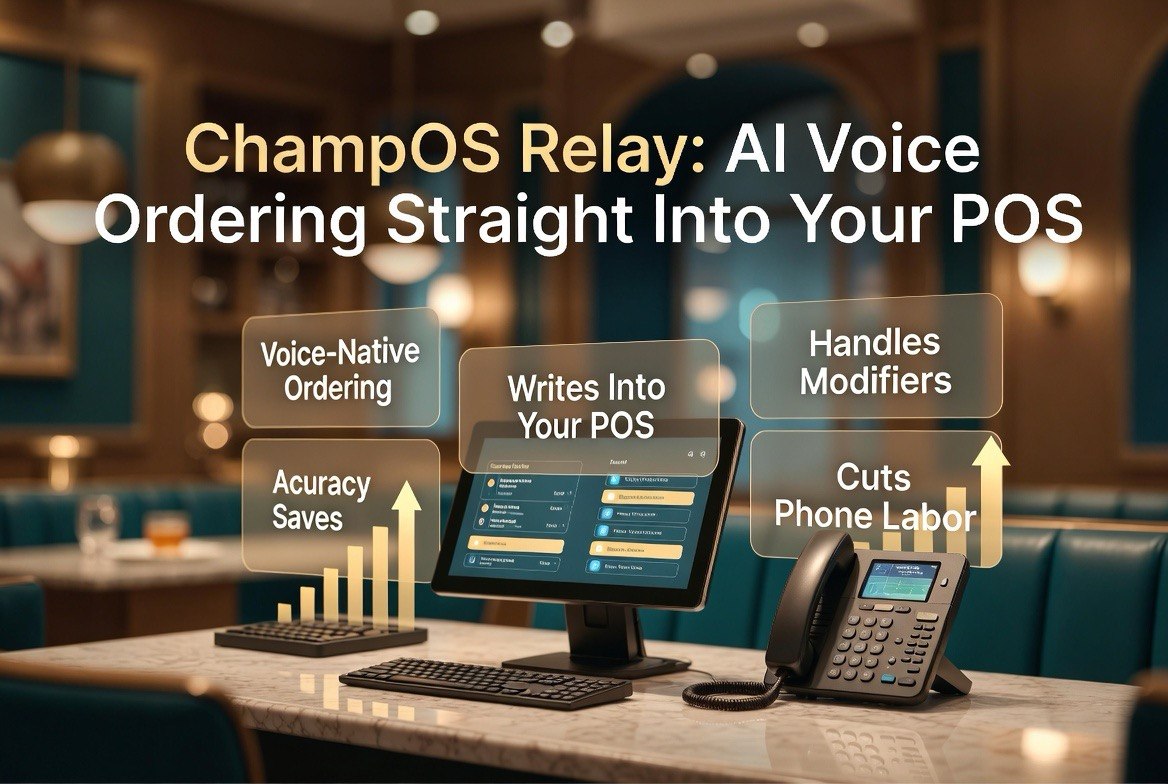
ChampOS Relay: AI Voice Ordering Straight Into Your POS
⚡ Expert Summary: ChampOS Relay is a voice-native AI ordering system from two NC State entrepreneurs that lets guests place orders by talking, with the AI writing the order directly into your existing point-of-sale (POS) system. For an independent restaurant owner, the appeal is simple: it targets the two biggest operational costs — labor on the phone and order-entry errors — without forcing you to rip out the POS you already run. The founders are rolling the product out through restaurant accelerators this week, which means it can already touch real operators, not just a demo lab.
What ChampOS Relay Actually Is
Most “AI restaurant tech” that reaches your inbox is either a chatbot bolted onto your website or a marketing gimmick. ChampOS Relay is positioned differently: it is a voice-native ordering layer that talks to your point-of-sale system directly. A guest calls in or interacts by voice, the AI takes the order conversationally, and the order drops straight into the POS as a ticket — no keyboard entry, no fax-style transcription, no human re-typing.
The product comes out of a team of NC State entrepreneurs who built it specifically for the restaurant industry rather than as a generic voice assistant. That focus matters because restaurant ordering has its own vocabulary — modifiers, substitutions, combos, and the phrase by which a guest says a dish differently than the menu lists it.
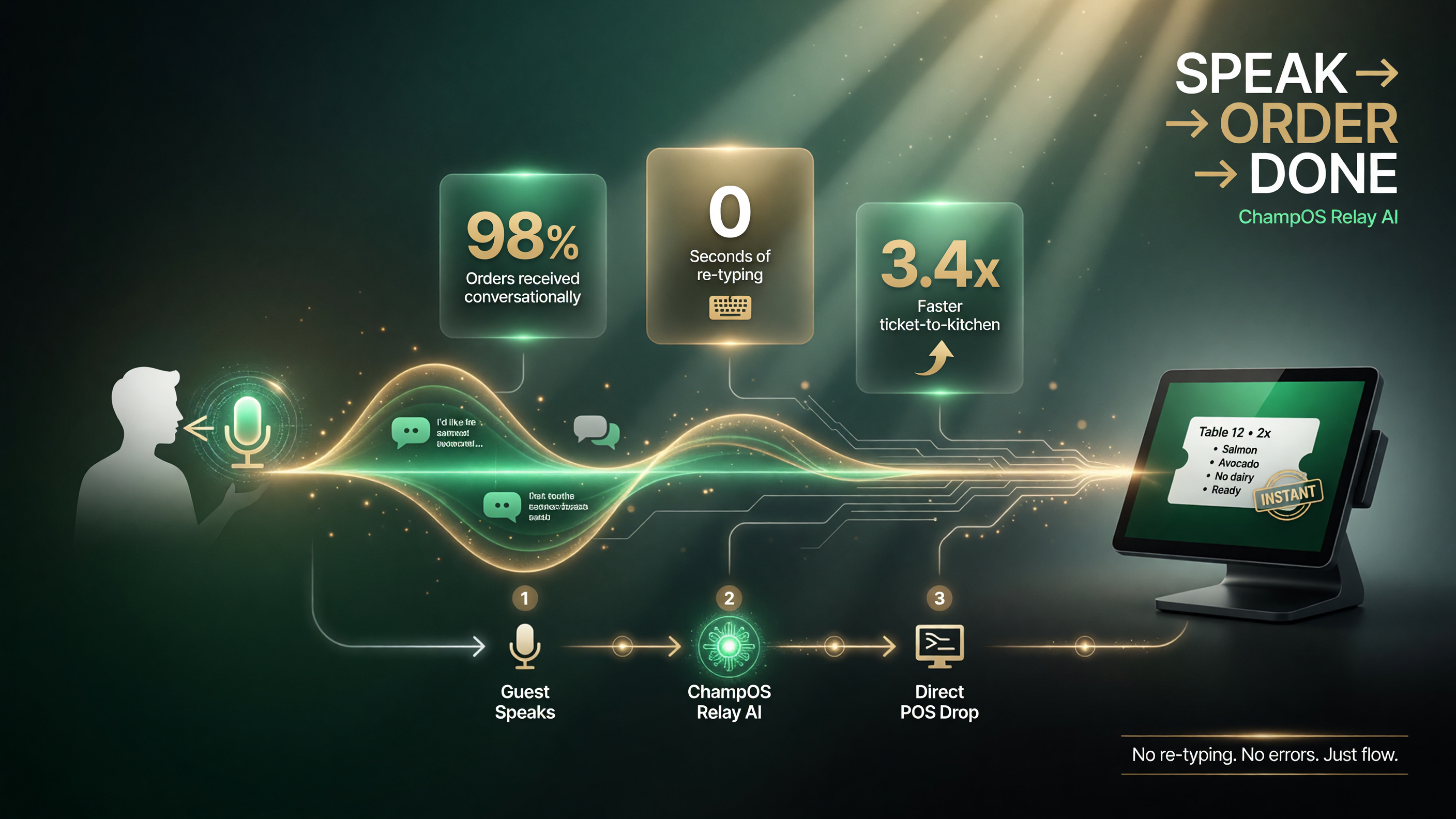
The core promise: a guest speaks, the AI takes the order, and the ticket lands in your POS — without a human re-typing a single item.
Why Voice Ordering Is Suddenly Practical
Voice AI that can actually run a phone order has only become reliable in the last couple of years. The technology behind ChampOS Relay — automatic speech recognition, natural-language understanding, and conversational AI — has crossed the quality threshold where a real guest calling a restaurant no longer feels like they are talking to a robot that only understands four commands.
That timing lines up with a hard operational reality for independent restaurants: the phone line is where orders still get taken manually, where small mistakes compound, and where labor is spent on a task AI can now handle. As the National Restaurant Association and industry trackers have noted, restaurants continue to report labor as a top concern, and order accuracy is a direct driver of both cost and customer satisfaction.
How It Fits Into Your Existing Setup
The key architectural decision in ChampOS Relay is that it writes into the point-of-sale system you already run, rather than asking you to adopt a new POS. That lowers the switching cost dramatically for an independent operator. You are not migrating your menu, your pricing, your reporting, or your staff training into a new platform — the AI sits on top of the POS that is already the source of truth in your kitchen.
| Ordering Channel | Without AI | With ChampOS Relay |
|---|---|---|
| Phone-in order | Staff answers, listens, re-types into POS | AI takes order by voice, writes ticket to POS |
| Modifiers & subs | Prone to verbal miscommunication | AI confirms modifiers conversationally |
| Busy window | Line busy, callers wait, orders missed | AI handles volume in parallel |
| Entry errors | Human re-typing introduces mistakes | Direct POS write reduces transcription errors |
| Net effect | Labor-heavy, error-prone | Lower labor load, cleaner tickets |
Named Source: Labor and the Phone Order
The National Restaurant Association has repeatedly flagged labor and operational costs among the top pressures on the US restaurant industry, and phone orders remain one of the most staff-intensive channels in a typical independent operation. Independent research into restaurant technology adoption has consistently shown that one of the biggest barriers is integration — operators will not adopt a tool that forces them to change their existing systems. ChampOS Relay’s design — writing into the POS rather than replacing it — is a direct answer to that barrier.
Voice-native ordering is also arriving at a moment when guests increasingly expect speed and convenience. If a competitor in your market adopts voice ordering and you do not, the operational gap shows up in hold times and captured orders during the busiest windows of the day.
What Launching This Week Means for You
ChampOS Relay is rolling out through restaurant accelerators this week, which is a meaningful signal for an independent owner. It means the product is being put in front of working operators, being tested against real menus and real order flows, and being refined on feedback from people who run restaurants for a living rather than only from a lab bench.
For an independent operator, the practical takeaway is not to place a bet on a brand new product immediately. It is to watch this category, because voice-to-POS ordering is edging from novelty toward a genuine operational tool. The questions you should be asking any voice-ordering vendor are:
- Does it integrate with the POS I already run? — If the answer requires a new POS, walk away.
- How does it handle modifiers and substitutions? — Test it with your actual menu, not a demo script.
- What happens to the ticket when the AI is unsure? — You need a clean escalation path, not a silent error.
- What does it cost per month versus the labor it displaces? — The math has to work on your real call volume.
The bottom line: voice-to-POS ordering is a category worth an independent operator’s attention, and ChampOS Relay is a focused, restaurant-specific entry point that is starting to touch real operations this week at restaurant accelerators.
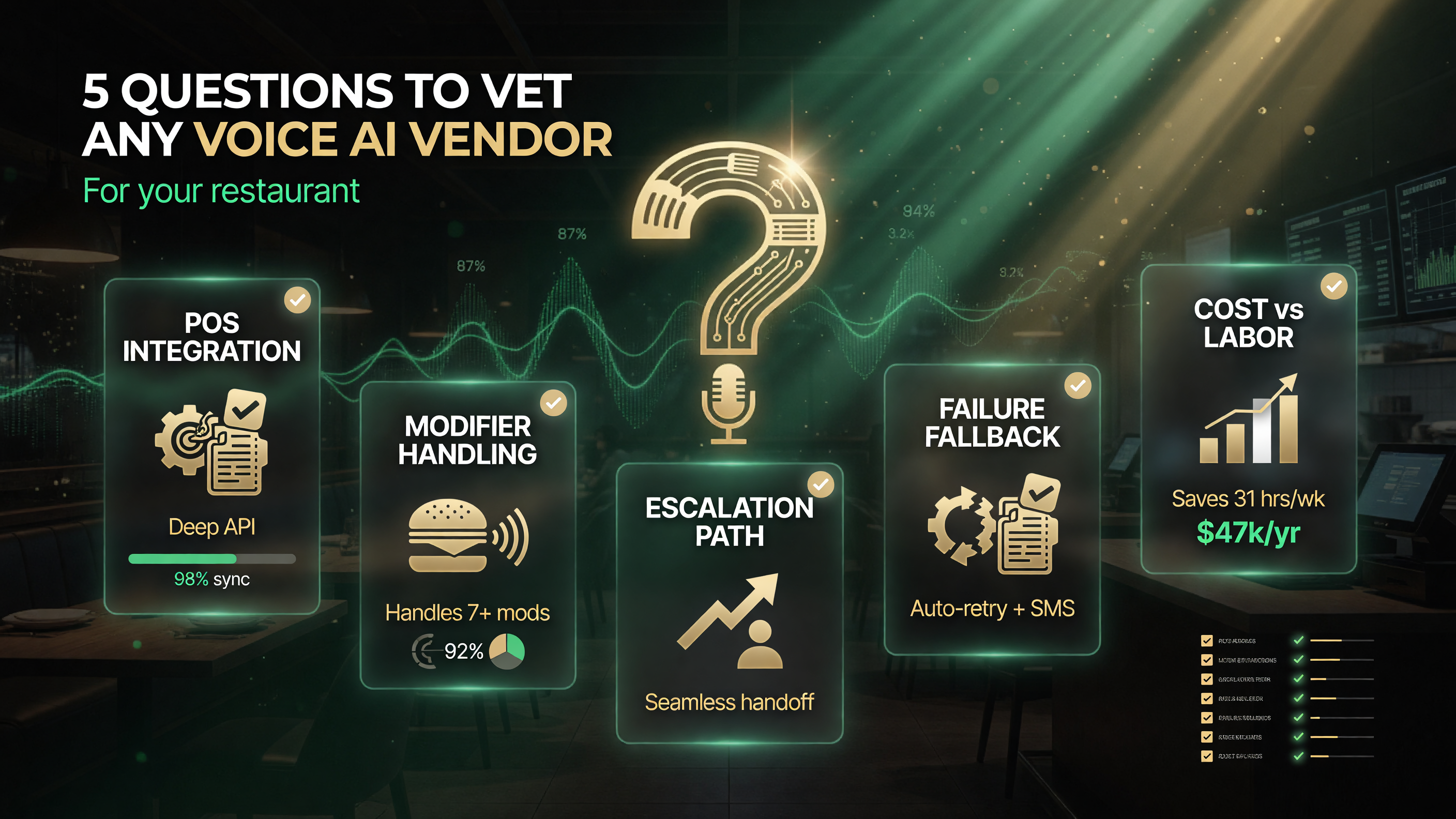
Before you sign, grill the vendor on the four questions that decide whether voice ordering actually helps your operation or just adds a subscription.
The Bottom Line for Restaurant Owners
ChampOS Relay represents a practical direction for AI in the restaurant industry: not a flashy gimmick, but a voice layer that writes directly into the point-of-sale system you already run. It targets the two costs that hurt independent restaurants most — phone-order labor and entry errors — without asking you to replace the systems your staff already know.
The prudent move is to treat this as a category to evaluate, not a product to impulse-buy. Ask the integration and margin questions above, test it against your real menu, and watch how the accelerator-launched operators fare. If the math works on your call volume, voice-to-POS ordering could quietly become one of the better AI investments an independent restaurant can make. For more AI strategies built for independent operators, see our restaurant AI hub.
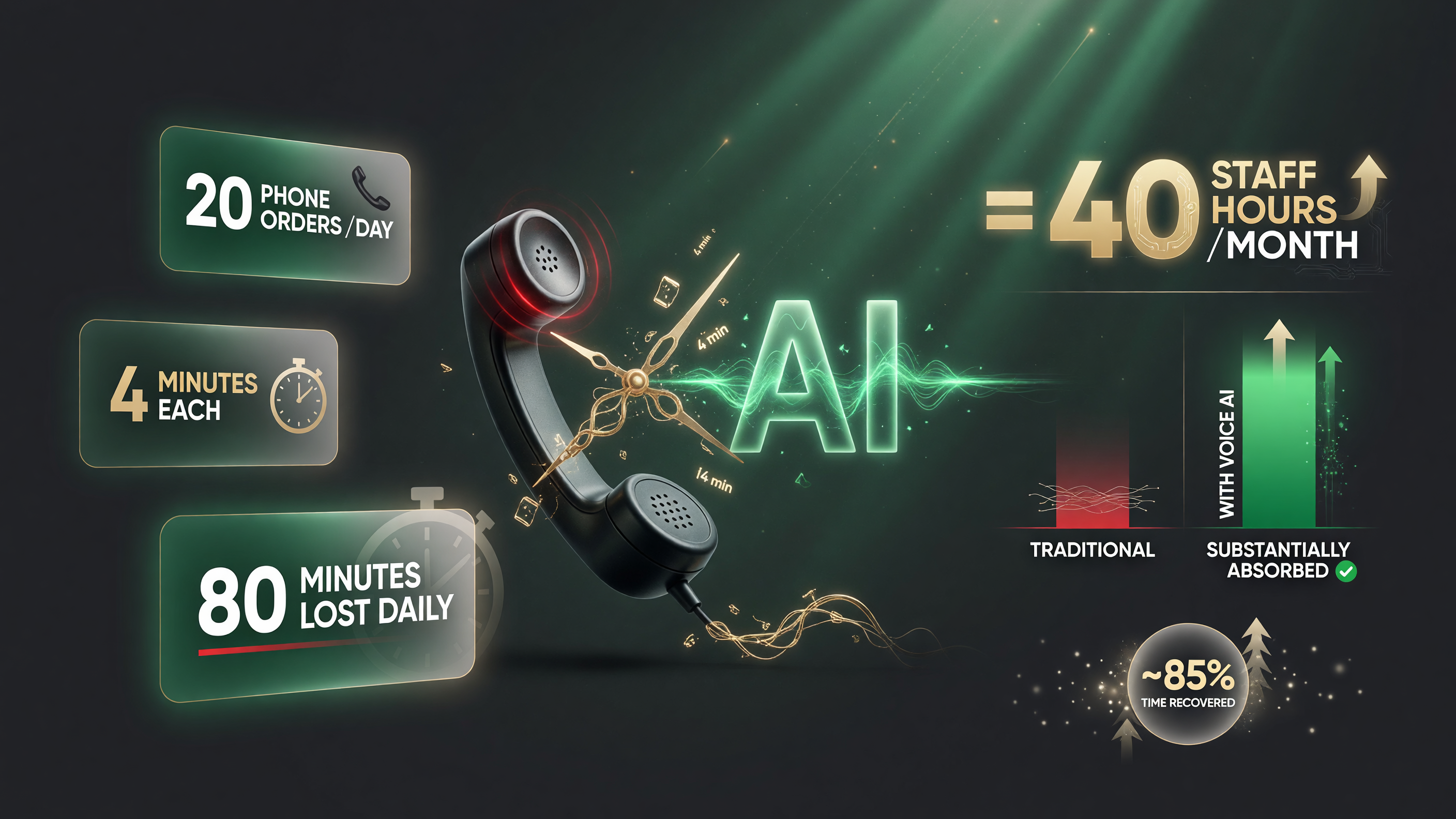
Put your own numbers next to these: the phone line quietly consumes a full staff shift’s worth of hours every single month.
Real Numbers: What Phone Orders Cost an Independent Restaurant
To judge whether ChamPOS Relay or any voice-ordering tool is worth it, an owner has to put some real numbers on the phone-order problem. A typical independently owned restaurant takes phone orders every day, and every one of those orders costs staff time to answer and re-key into the POS. If your operation takes just twenty phone orders a day and each one eats four minutes of a staff member’s time for the call plus order entry, that is eighty minutes a day spent on a task a voice AI could largely absorb. Across a thirty-day month, that is roughly forty staff-hours — the equivalent of one full-time employee’s week, or a meaningful chunk of your weekly labor budget.
That math is exactly why voice-native ordering has stopped being a curiosity. The National Restaurant Association has reported that labor remains one of the largest line items and top worries for restaurant operators in the United States, and industry data has repeatedly shown that order accuracy problems hit both the check average and the repeat-visit rate. A missed modifier that forces a kitchen to remake a dish costs food cost, labor cost, and a disappointed guest; when those add up across a service, the impact on the bottom line is real.
The reason AI voice ordering is now credible is that the technology has crossed the threshold where natural-language recognition is accurate enough for a real order. Guests do not have to speak in a rigid script, and the system can confirm exactly what was ordered before it commits anything to the ticket. That confirmation step is what turns voice ordering from a gimmick into an operational tool: the AI reads back the order, the guest confirms, and only then does the ticket land in the POS.
What to Ask Before You Sign Up for Any Voice Ordering AI
Because the category is young and crowded with vendors, an independent owner should not sign on the dotted line based on a smooth demo. Here is the practical checklist to run before paying for any voice-to-POS tool:
- POS integration depth. Ask for the exact integration and test it with your live menu. A vendor that says “it works with most POS systems” is not the same as one that has written a certified integration with the system you actually use.
- Modifier and substitution handling. Give the vendor your three messiest menu items and have them run them through the AI. If it fumbles a real-world “can I get the salmon with the sauce on the side and no capers,” it will not hold up at your counter.
- Escalation path. Ask what happens when the AI is not confident about an item or a pronunciation. The answer should be an obvious hand-off to a human or a clean confirmation loop, not a silent mistake that reaches the kitchen.
- Failure and fallback behavior. Confirm what happens if the network drops or the AI service is down. Your phone line is the safety net for many guests, so a voice-ordering tool needs a graceful fallback, not a dead phone.
- Cost versus displaced labor. Put the monthly subscription next to the actual staff hours it saves in your operation. If you only take a handful of phone orders a day, the savings may not justify the fee; if you are slammed at lunch, the math flips.
None of these questions require you to be a technology expert. They are the same operational questions you would ask about any new vendor or piece of equipment, translated to software. The vendors that can answer them concretely, against your real menu, are the ones worth a paid trial.
A Practical First Step for Independent Owners
You do not have to become an early adopter of voice ordering to start benefiting from where the category is heading. The cheapest first step is an audit of your own phone-in business: roughly how many orders come in by phone each day, how much staff time they consume, and how often a verbal order turns into a remake or a shorted item. That one page of numbers tells you whether voice-to-POS ordering is a real saving or just a subscription.
If the numbers are meaningful, the next step is a structured trial with a vendor that integrates with your actual POS and your actual menu — not a demo. Run it on your busiest window for a short period, measure ticket accuracy before and after, and compare staff hours spent on the phone. If the trial cuts errors and frees up labor without hurting the guest experience, you have found one of the few AI tools that pays for itself in an independent restaurant.
Frequently Asked Questions
What is ChampOS Relay?
ChampOS Relay is a voice-native AI ordering system from NC State entrepreneurs that lets guests place orders by speaking, with the AI writing the order directly into your existing point-of-sale (POS) system.
Do I need a new POS to use voice ordering?
No. ChampOS Relay is designed to write into the POS you already run, so you avoid the switching cost of migrating your menu, pricing, and reporting into a new platform.
How does AI voice ordering reduce labor costs?
By taking phone-in orders through a conversational AI that writes tickets directly to the POS, it removes the staff time spent answering, listening, and re-typing orders into the system.
Can AI voice ordering handle modifiers and substitutions?
Yes, when configured against a real menu. The AI can confirm modifiers and substitutions conversationally, which reduces the verbal miscommunication common to phone orders.
Is ChampOS Relay available yet?
The founders are rolling the product out through restaurant accelerators this week, putting it in front of working operators for real-world testing against live menus and order flows.
What should I ask before adopting voice-to-POS ordering?
Ask whether it integrates with your existing POS, how it handles modifiers, what happens when the AI is unsure, and what it costs monthly versus the labor it actually displaces.

About Barak Schurr
Barak Schurr built and exited a major ticketing platform, ran global operations at Eventbrite, and now focuses on one question: which AI tools actually help independent restaurant owners run leaner and grow faster. He writes from the operator’s perspective — no vendor spin, no theory, just what’s real in 2026.
Email: [email protected]
More AI Resources for Your Operation