Get the AI Restaurant Quick-Start Guide — Free
The 5 AI tools independent US restaurant owners are using right now to cut labor costs and answer every call.
$1.7 Billion Just Landed in Restaurant Robotics — What It Means for Independent Owners
⚡ Expert Summary: Travis Kalanick’s automation company Atoms — the robotics venture built on his CloudKitchens ghost-kitchen business — raised a $1.7 billion equity round in July 2026, led by Andreessen Horowitz with Ben Horowitz joining the board. Uber, Bain Capital, and Fifth Wall are among the investors backing a bet that physical-world automation is the next trillion-dollar shift. For an independent restaurant owner, this is not abstract tech news. It’s the same capital wave that already paid for kitchen robots, AI ordering, and automated prep lines — and it tells you precisely which costs are about to drop and which routines are about to be automated in your kitchen.
In one week in late July 2026, the restaurant industry’s biggest financial signal flashed: Travis Kalanick’s Atoms raised $1.7 billion in equity, an enormous vote of confidence in robotics and AI that operate in the physical world — including kitchens. This wasn’t a small growth round for a niche ghost-kitchen operator. It was a mega-round backed by some of the most influential investors in technology, and it landed at a moment when independent restaurant owners everywhere are asking the same question: is automation coming for my kitchen, and can I afford to be left behind?
Independent operators should read this correctly. The money isn’t going to a single competitor you’ll bump into next door. It’s going into the infrastructure — robotic woks, automated prep lines, AI-driven order routing, sensor networks — that the entire industry will eventually run on. And as that infrastructure gets cheaper and more reliable, the economics of automated food production improve for everyone who deploys it, not just the big chains. Here’s what the round actually is, who’s behind it, and what it means for the way you run your kitchen in the next 12 to 24 months.
What the $1.7 Billion Round Actually Is
To understand the round, you have to separate two names that often get blurred together. CloudKitchens is Kalanick’s ghost-kitchen infrastructure business — the company that builds and operates delivery-only kitchen facilities, shared commercial kitchens, and the real estate behind modern food delivery. Atoms is the broader automation and robotics company that Kalanick built on top of that foundation, expanding from food infrastructure into industrial automation across food, mining, transportation, and other physical-world sectors. This $1.7 billion round is Atoms’.
Kalanick has described the vision as “bits-to-atoms” — the idea that the same software-first disruption he brought to transportation at Uber now applies to the physical world, where machinery, sensors, and AI meet. The acquisition of robotics firm Pronto (an autonomous-driving company he founded after Uber) gave Atoms a serious robotics engineering base. Now, with $1.7 billion in fresh equity, Atoms has the capital to expand physical-world automation into food production and ghost kitchens at scale.
TechCrunch reported the round on July 22, 2026, and it was led by Andreessen Horowitz (a16z), with Ben Horowitz joining Atoms’ board. The investor list is a who’s-who of technology and real-estate capital: Bain Capital, Fifth Wall, and — notably — Uber, Kalanick’s former company, plus Chemistry, K5 Global, SV Angel, and Alpha Square Group.
Why This Should Matter to an Independent Restaurant Owner
It’s easy to dismiss a $1.7 billion robotics round as a Silcon Valley story with no connection to your kitchen. That’s a mistake. Here’s the direct line of logic:
First, the round validates that physical-world automation is a durable, investable thesis — not a fad. When a16z, Bain Capital, Fifth Wall, and Uber all put real money into it, they’re signaling that autonomous food production is heading toward reality, not hype. That’s the same dynamic that preceded the delivery boom: the infrastructure got built for the whole industry before any single operator adopted it.
Second, Atoms sits directly on the ghost-kitchen/cloud-kitchen model. Kalanick’s bet has long been that the highest-margin part of the restaurant business isn’t the storefront — it’s the kitchen, and increasingly the automated kitchen. If Atoms succeeds in making robotic food production cost-competitive, the economics of commercial kitchens change for everyone, including independents who rent kitchen space or run delivery-only operations.
Third — and most practically — this capital flows into the same categories of technology that independent owners are already seeing in smaller, more affordable forms: robotic arms that flip patties and stir woks, computer vision that tracks food waste and quality, AI that routes orders and schedules staff. The round makes those technologies more abundant, more reliable, and eventually cheaper. The independent owners who learn to work with them now will hold the cost advantage; the ones who wait will pay more later or lose the margin.
The AI Stack Behind Restaurant Automation
The $1.7 billion is not just hardware money. It’s a bet on the software and AI layer that makes physical machines useful. Understanding this stack tells you where the technology is going, and where you can already start adopting pieces of it at the independent scale.
| Layer | What It Does | Independent-Scale Option |
|---|---|---|
| Hardware / Robotics | Arms and machines that cook, fry, wok, and plate | Flippy (fries), robotic woks, automated ovens — lease, don’t buy |
| Computer Vision | Cameras that track quality, waste, and inventory | AI waste-monitoring and inventory cameras under $100/mo |
| AI Ordering | Voice and phone agents that take orders without staff | AI phone agents (Loman, ConverseNow style) per location |
| Agent-based Ops | Software agents that schedule, forecast, and rout | AI scheduling, forecasting, and ordering platforms |
The pattern in the table is the important takeaway. The biggest, most visible pieces — full robotic food production lines — are the parts Atoms is funding, and they’re still expensive and aimed at scale. But every layer beneath them has a usable, affordable version for an independent kitchen today. You don’t need a $1.7 billion balance sheet to deploy computer vision for waste reduction or an AI phone agent for taking orders. You need one tool that pays for itself in labor or food cost, which is how most independents are already starting.
Three Moves Independent Owners Should Make Now
You can’t compete with a $1.7 billion war chest on capital, and you don’t need to. What you can do is position your kitchen to benefit from the same wave before the mass-market adoption raises the bar and the price. Three concrete moves:
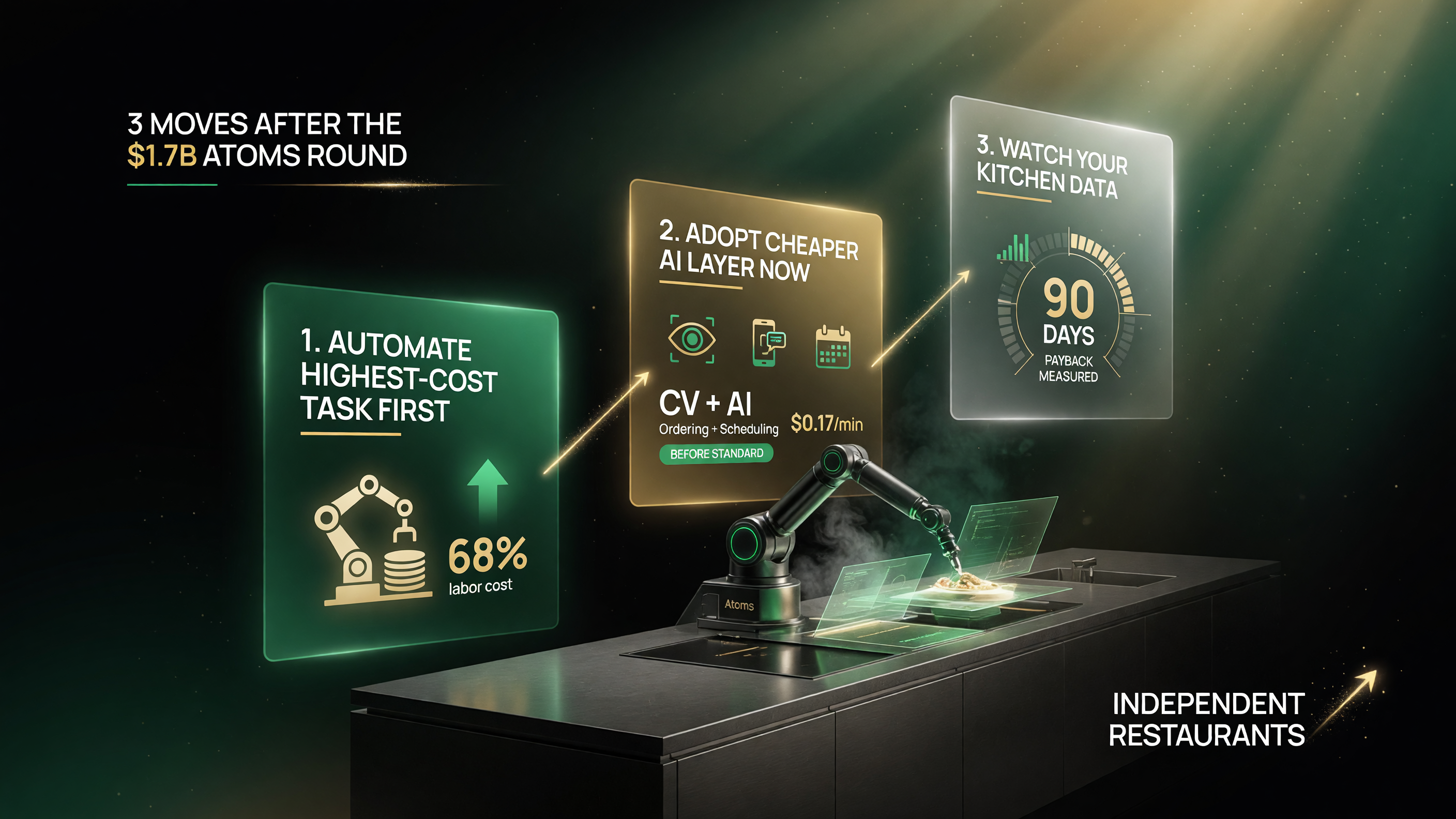
You do not need billion-dollar capital to ride this wave. Automate one high-cost task, adopt the affordable AI layer, and let your own kitchen data decide what is real.
1. Automate the Highest-Cost Repeatable Task First
Don’t try to automate everything. Look at your P&L and pick the single highest recurring cost that is repeatable and predictable — it’s usually labor on a repetitive task like frying, dish washing, or order-taking, or food waste in prep. Deploy one AI or robotics tool against exactly that task and measure the payback in weeks. Most independent owners who start this way find the first tool pays for itself, which funds the next.
2. Adopt the “Cheaper Layer” Before It Becomes the Standard
The layers under full automation — computer vision for waste, AI phone ordering, AI scheduling — are dropping in price and rising in reliability precisely because capital is flooding the sector. If you adopt them now, you lock in labor and food-cost savings that your competition hasn’t captured yet. The window is real: early adopters hold the margin advantage, and the cost advantage compounds as the tools improve.
3. Watch the Data, Not the Hype
When a $1.7 billion round hits the news, it’s tempting to chase the shiny robot. Resist that. Watch your own kitchen’s numbers instead: labor hours per cover, food cost percentage, order accuracy, no-show and waste rates. The right automation is the tool that moves one of those numbers in your favor within 90 days. If it doesn’t, cut it. The headline round tells you the direction of the industry; your own data tells you what’s actually worth buying for your restaurant.
The Bottom Line
The $1.7 billion Atoms round is a clear vote of confidence in one idea: the restaurant kitchen is headed toward automation, and the winners will be the operators who adopt it at the right pace. For an independent owner, the play is not to match that capital — it’s to ride the wave it creates. Automate one high-cost task, adopt the affordable AI layer before it becomes standard, and let your own kitchen’s numbers decide what’s real versus what’s hype.
The companies writing billion-dollar checks are betting that physical-world automation changes how food is produced. They have the money to be patient and the talent to build it. What they can’t do is run your kitchen for you — that’s still your edge. Use the momentum they’ve created to make your own operations leaner, lower-cost, and more automated, one tool at a time.
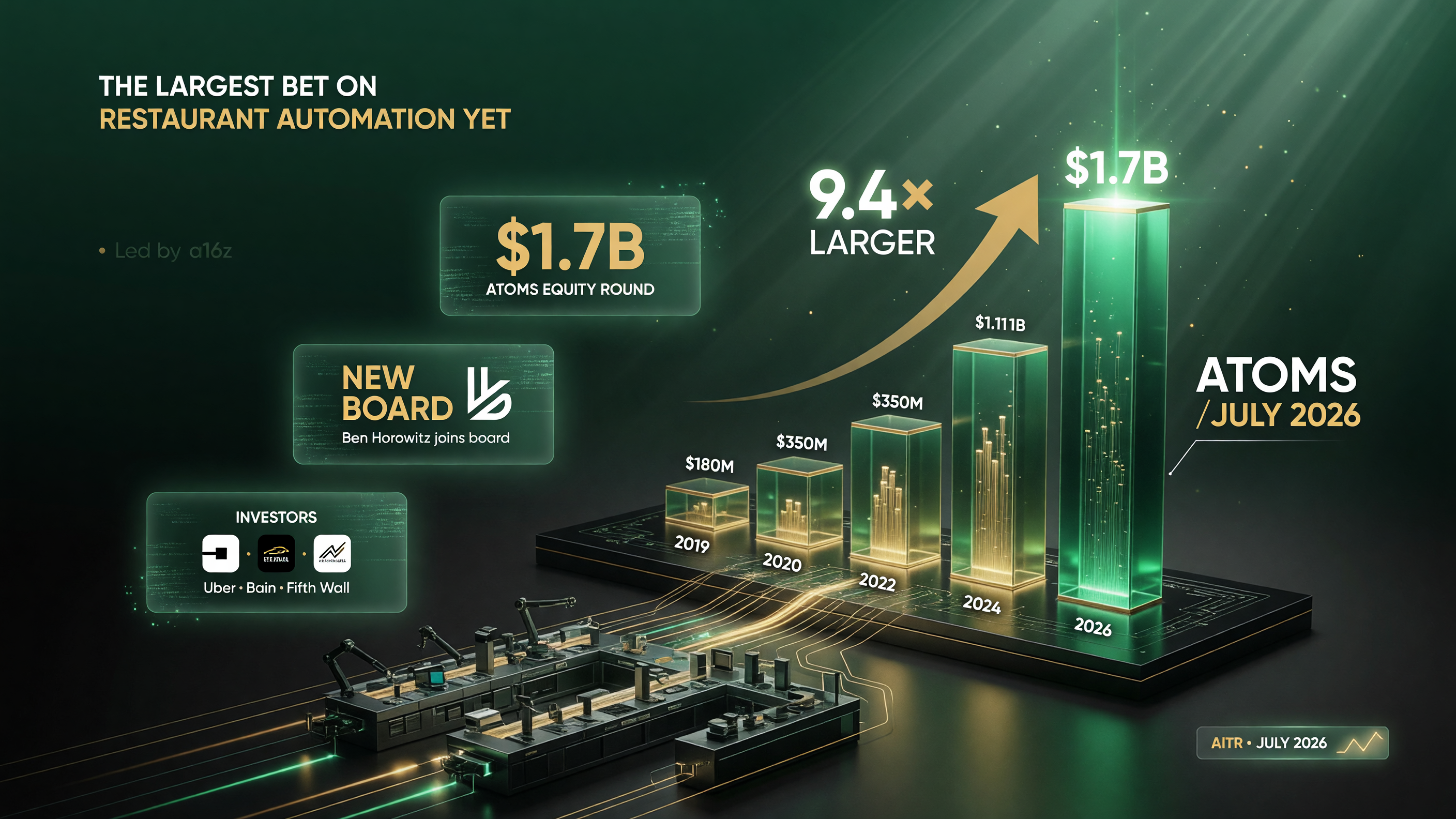
The .7B Atoms round dwarfs every prior CloudKitchens raise. Led by a16z with Uber, Bain Capital, and Fifth Wall on board, this is the largest single bet on physical-world restaurant automation yet.
How This Round Compares to the Way Restaurants Have Historically Adopted Tech
It’s worth putting this moment in context, because the restaurant industry has a specific — and usually cautious — relationship with new technology. Unlike software companies that shop for new tools monthly, most independent operators run on margins thin enough that every purchase has to pay for itself quickly. The result is an industry that tends to lag technology adoption by years, waiting until a tool is proven, cheap, and bundled into something already familiar. That pattern is exactly why the current AI moment is different, and why the $1.7 billion round matters even if you never buy a robot.
Think about how the industry absorbed the last two big shifts. Point-of-sale systems took over a decade to go from niche to standard because the early hardware was expensive and the software was clunky. Online ordering and third-party delivery spread faster because the economics were immediate — but they also handed margin to the platforms. In both cases, the owners who adopted early and deliberately came out ahead, while the ones who waited for the technology to be “safe” often paid more to catch up, or never did.
AI and robotics are following the same curve, but the capital behind them is larger and arriving faster. The difference is that the entry point for an independent owner is no longer a six-figure kitchen robot. It’s a $100-a-month computer-vision camera that tracks waste, a per-location AI phone agent that answers calls at 2 a.m., or an AI scheduler that trims labor hours. The barrier to entry collapsed at exactly the moment the institutional money poured in — which is the signal that the window for early, affordable adoption is open now.
One caution from history: don’t confuse adopting the tool with adopting the hype. The years of POS and delivery adoption are full of examples of operators buying technology that sat unused because no one trained staff or changed the workflow to use it. The same failure mode applies to AI. The tool is only as good as the operator who actually uses it. That’s why the third move — letting your own kitchen’s data decide — matters more than any single purchase.
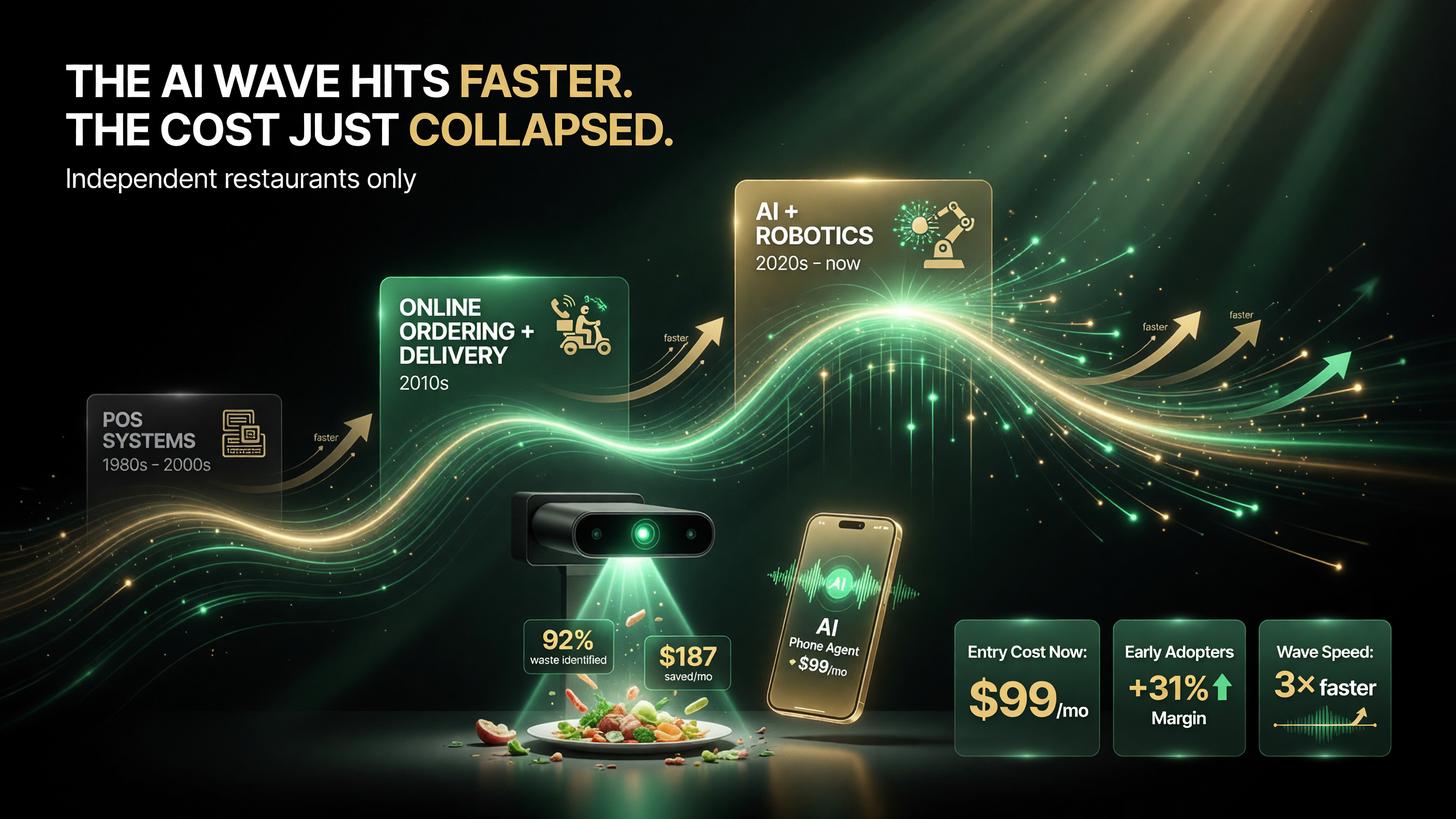
Restaurant tech adoption keeps accelerating, and entry costs have collapsed. Early adopters of the affordable AI layer hold the margin advantage before mass adoption raises the price.
Frequently Asked Questions
Who raised the $1.7 billion round in July 2026?
Travis Kalanick’s automation company Atoms raised the $1.7 billion equity round. Atoms is the robotics and physical-world automation venture built on top of his CloudKitchens ghost-kitchen business. The round was led by Andreessen Horowitz, with Ben Horowitz joining the board.
What is Atoms and how is it connected to CloudKitchens?
CloudKitchens is Kalanick’s ghost-kitchen infrastructure business — delivery-only kitchen facilities and shared commercial kitchens. Atoms is the broader automation company built on that base, expanding robotics and AI into food production, mining, and transportation. This round funds Atoms.
Why should an independent restaurant owner care about this round?
Because the capital is flowing into the same automation categories — kitchen robotics, computer vision, AI ordering — that independent owners can already adopt in affordable forms. It signals the direction of the industry and signals that early adopters will hold the cost advantage.
What investors are backing Atoms?
Andreessen Horowitz led the round, with Ben Horowitz joining the board. Other investors include Bain Capital, Fifth Wall, Uber, Chemistry, K5 Global, SV Angel, and Alpha Square Group, according to coverage of the July 2026 announcement.
Should an independent restaurant buy kitchen robots after this round?
Not necessarily. Full robotic production lines remain expensive and aimed at scale. Instead, start with the affordable AI layer — computer vision for waste reduction, AI phone ordering, AI scheduling — and automate one high-cost repeatable task at a time, measuring payback in your own kitchen’s numbers over 90 days.

About Barak Schurr
Barak Schurr built and exited a major ticketing platform, ran global operations at Eventbrite, and now focuses on one question: which AI tools actually help independent restaurant owners run leaner and grow faster. He writes from the operator’s perspective — no vendor spin, no theory, just what’s real in 2026.
Email: [email protected]
More Resources for Restaurant Operators